Introduction – Precision Guidance Begins Before the Weapon Is Launched
In a semi-active laser guidance system, precision begins long before a weapon enters its terminal guidance phase. A laser-guided munition does not search for a target on its own—it searches for reflected laser energy that has already been projected onto the target by another system. This separation of responsibilities is fundamental to the architecture of semi-active laser guidance and explains why target illumination is just as important as the guidance process itself. Because of this design, a laser seeker and a laser target designator perform two completely different tasks. The designator generates and projects a coded laser beam toward the target, while the seeker detects the reflected energy and continuously adjusts the weapon's flight path toward the illuminated point. Without an external source of coded laser energy, the seeker has nothing to detect, regardless of how advanced its optics or guidance algorithms may be.
Understanding this relationship is essential for anyone involved in developing EO/IR payloads, laser designation systems, or precision guidance technologies. Although discussions often focus on the capabilities of the laser seeker, the overall performance of a semi-active laser guidance system depends just as much on the accuracy, stability, and reliability of the laser target designator that initiates the entire guidance process.
Why a Laser Seeker Cannot Work Alone
A laser seeker is designed to detect reflected laser energy—not to generate it. Its optical receiver continuously monitors the scene for laser radiation with a specific wavelength and coded pulse pattern. Once a valid reflection is detected, the seeker determines the direction of the reflected spot and provides angular correction data to the guidance computer. Throughout this process, the seeker remains a passive optical sensor. It performs no target illumination and emits no laser energy of its own.
This distinction is often misunderstood because both the laser seeker and the laser target designator participate in the same guidance event. In reality, they perform complementary but fundamentally different optical functions. The designator actively illuminates the target with a coded laser beam, while the seeker passively tracks the reflected signal. Their responsibilities are separate, yet inseparable within the guidance chain.
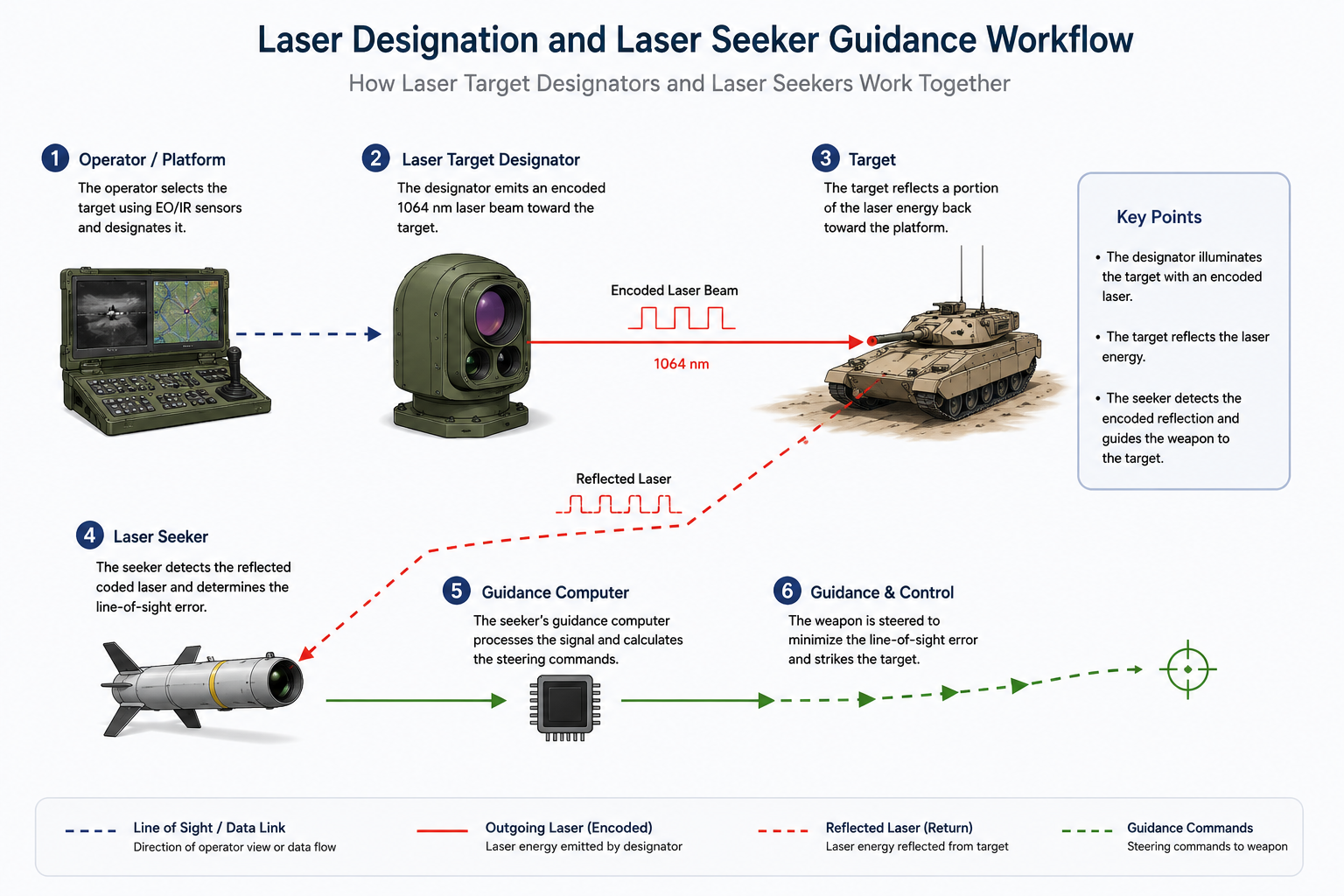
A typical semi-active laser guidance sequence follows a straightforward optical process. The target is first illuminated by a laser target designator mounted on an EO/IR payload, ground observation system, UAV, or operated by a forward observer. A small portion of the coded laser energy is reflected from the target surface and received by the laser seeker installed on the guided munition. The seeker filters the incoming signal, verifies the laser code, and continuously updates the weapon's trajectory toward the illuminated point.
If the reflected coded laser signal disappears—because the designator stops illuminating the target, line of sight is interrupted, or atmospheric conditions significantly weaken the return—the seeker immediately loses its guidance reference. Without a valid optical reference, semi-active laser homing can no longer continue.
This architecture is not a limitation but a deliberate engineering decision. Separating target illumination from target tracking allows the designator and the weapon to operate from different platforms, increasing deployment flexibility while keeping the seeker compact, lightweight, and optimized solely for terminal guidance.
Comparison of Key Components in a Laser Guidance System
| Component | Primary Function | Active or Passive |
|---|---|---|
| Laser Target Designator | Projects a coded laser beam onto the target | Active |
| Laser Seeker | Detects reflected coded laser energy and generates guidance corrections | Passive |
| Laser Rangefinder | Measures the distance to a target using laser time-of-flight | Active |
Although laser seekers, target designators, and laser rangefinders all employ laser technology, they serve entirely different roles within electro-optical systems.
How Laser Target Designators Enable Precision Guidance
A laser target designator contributes far more than simply projecting laser energy toward a target. It establishes the optical reference that enables the entire semi-active guidance process. Every measurement made by the laser seeker ultimately depends on the quality, stability, and coding of the laser beam emitted by the designator.
Among the wavelengths used in military laser designation, 1064 nm has become the established standard for semi-active laser guidance. This wavelength offers an effective balance between atmospheric transmission, mature solid-state laser technology, and detector compatibility, making it well suited for long-range target illumination under a wide range of operating conditions.
Equally important is the laser coding scheme. Rather than transmitting continuous laser energy, the designator emits precisely timed pulse sequences that follow standardized coding formats, such as those defined by STANAG 3733. These coded pulse trains allow a laser seeker to distinguish the intended target from other laser sources operating in the same area, significantly reducing the risk of false acquisition and enabling multiple designation events to occur simultaneously.
From the seeker's perspective, the guidance process is entirely dependent on the characteristics of the reflected signal. The reflected energy carries not only optical power but also timing information encoded by the designator. After passing through the seeker's optical filters and signal-processing electronics, the coded reflection is verified before guidance corrections are generated. In other words, the seeker is not simply following the brightest reflected spot—it is searching for the correct coded optical signature.
For system designers, this means that the performance of a semi-active laser guidance system cannot be evaluated by examining the seeker alone. Beam quality, pointing stability, pulse energy, laser coding accuracy, and target illumination geometry all originate at the laser target designator and directly influence the quality of the signal received by the seeker. Reliable terminal guidance therefore begins with reliable target designation.
Understanding the Laser Guidance Chain
A semi-active laser guidance system functions as a continuous optical chain. Every stage depends on the successful completion of the previous one, making the laser target designator the starting point of the entire guidance process. The chain is sequential, lossy by nature, and unforgiving of breaks:
- Operator – acquires the target using an EO camera or thermal imager inside the payload.
- EO Camera / Thermal Sensor – provides situational awareness and precise target localisation.
- Laser Target Designator – emits a coded 1064 nm beam at the selected aim point. This is where Laser Designation actually occurs.
- Laser Reflection – the target scatters a fraction of the incident energy. Surface properties, angle and atmospheric conditions dictate how much energy returns.
- Laser Seeker – on the weapon captures the weak reflected signal, filters it and measures the angle to the spot.
- Guidance Computer – converts angular error into steering commands, driving the weapon toward the centroid of the reflected laser energy.
- Target – terminal impact relies on the entire chain remaining intact from designator emission to seeker detection.
This linear dependency is why a Laser Rangefinder cannot substitute for a designator. A rangefinder emits a short, uncoded pulse burst purely for distance measurement, not a sustained, coded illumination train suitable for seeker tracking. They serve different functions within the guidance ecosystem. If target illumination stops at any point, the seeker can no longer receive a valid coded reflection, and the guidance process terminates immediately.
Engineering Factors That Influence Laser Guidance Accuracy
Achieving consistent terminal accuracy in Semi-Active Laser Guidance requires controlling variables that affect the laser beam on its round‑trip from designator to target and back to the seeker. These factors are entirely about the guidance link, not generic laser physics:
- Beam Divergence – a tightly collimated beam concentrates more energy on the target and reduces spillover, improving the seeker’s signal‑to‑noise ratio. Too wide a beam, and energy density drops, shrinking effective designation range. In our testing with stabilised micro‑gimbals, adjusting beam divergence from 0.8 mrad down to 0.3 mrad increased effective designation range by over 40% against a typical vehicle target — a gain that cannot be recovered by simply raising output energy. Excessively increasing pulse energy cannot fully compensate for poor beam quality or unstable pointing.
- Weather – fog, rain, dust and humidity attenuate 1064 nm radiation significantly. Guidance accuracy degrades when the atmospheric extinction coefficient rises because both the illumination and the reflected signal are weakened.
- Target Reflectivity – the fraction of incident laser energy reflected back toward the seeker varies enormously with surface material, paint, angle of incidence and surface roughness. A low‑reflectivity target demands higher designator output energy for the same seeker lock range.
- Atmospheric Transmission – beyond simple weather, scintillation and turbulence cause beam wander and intensity fluctuations at the seeker aperture, introducing momentary angular errors.
- Platform Stability – if the designator platform (UAV gimbal, tripod or vehicle mast) drifts during the engagement, the illuminated spot moves on the target, potentially dragging the weapon off‑aim. Even a well‑tuned control loop can introduce a milliradian of drift during a 20‑second engagement. We’ve found that a dedicated INS‑aided drift correction inside the gimbal controller cuts this error by half.
- Laser Coding – incorrect coding synchronisation between designator and seeker breaks the guidance loop immediately. Code selection also affects ambiguity rejection and multi‑round engagement capability.
- Pointing Accuracy – the alignment between the designator’s optical axis and the sighting reference (day camera or thermal channel) must be boresighted precisely. A milliradian‑level pointing error translates to a miss distance that grows with range, and this alignment must hold over temperature and vibration, not just on the calibration bench.
Each factor underscores why a Laser Target Designator is not a simple pointer. It is a calibrated, stabilised instrument whose performance directly shapes the probability of a successful guidance event.
Integrating Laser Target Designators into EO/IR Payloads
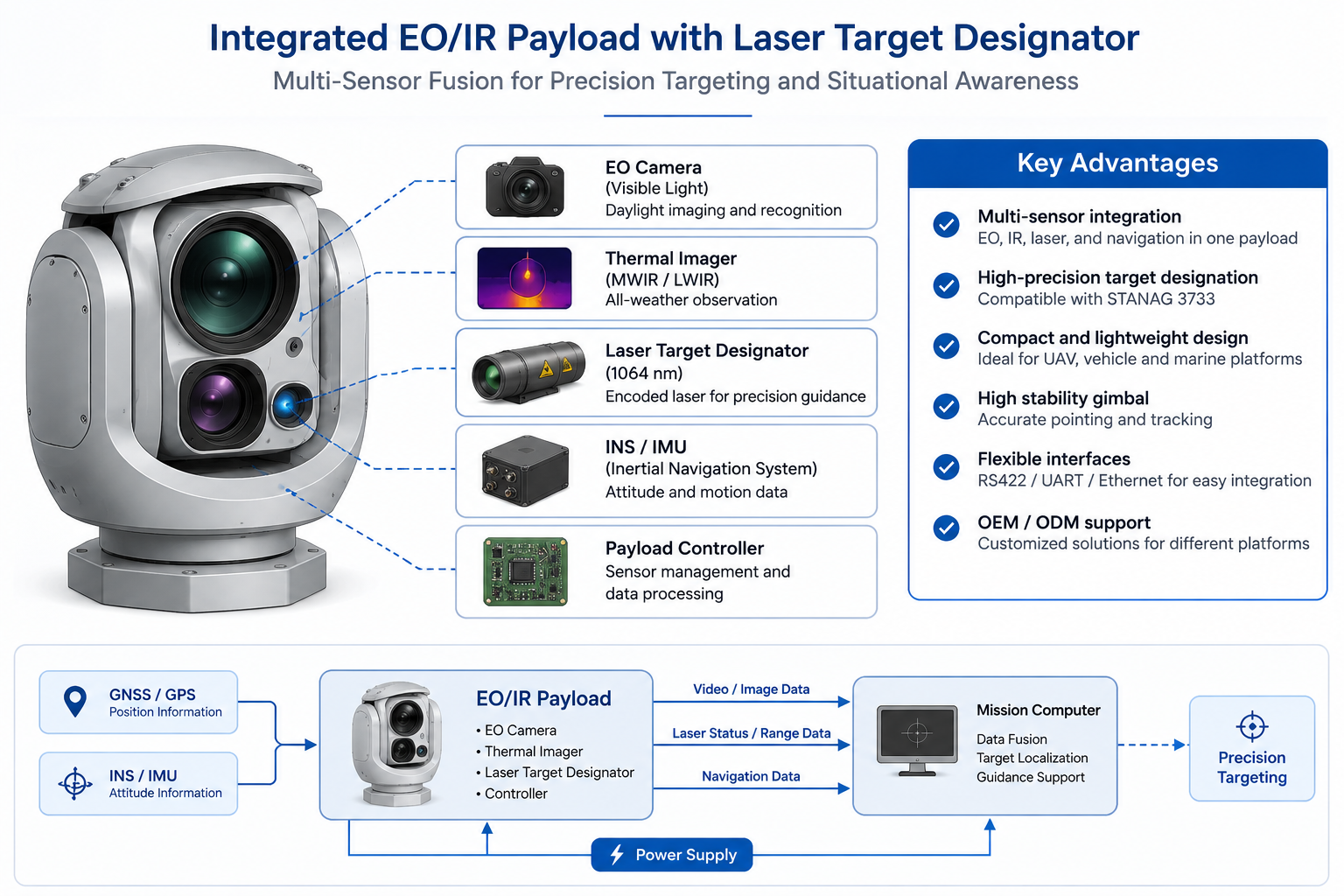
The engineering trend of the last decade has moved the Laser Target Designator out of a standalone handheld device and into a fully integrated EO/IR payload. This shift is driven by the need for rapid target handoff, accurate multi‑sensor bore‑sighting, and reduced operator workload. A contemporary stabilised payload fuses an EO day camera, a cooled or uncooled thermal imager, an inertial navigation system (INS), a video tracker and controller, and a Laser Target Designator module into a single line‑replaceable unit.
Modern compact laser target designator modules are increasingly integrated into stabilized EO/IR payloads used on UAVs, vehicle‑mounted systems, and fixed surveillance platforms. For OEM payload developers, one of the most challenging engineering tasks is maintaining boresight alignment between the thermal imager and the laser designator across wide operating temperatures while minimizing payload size and weight. One of the most underappreciated challenges is maintaining boresight alignment between the thermal imager and the designator across a wide temperature swing while keeping the designator module under 300 grams. It’s a problem that doesn’t show up on a spec sheet, but it will show up on the first cold-soak test. We addressed this with a common‑optics bench and athermalisation in the designator’s optical path, which preserves bore‑sight within 0.1 mrad from -20°C to +60°C. By embedding the designator inside the same inertially stabilised gimbal that holds the EO and thermal sensors, the boresight alignment remains stable over vibration and flight hours. The INS feeds real‑time platform attitude to the payload controller, allowing the designator to maintain illumination on the target even when the platform is moving. Power, communication, and safety‑of‑arm commands are all routed through a unified interface, making the integrated payload simpler to install and operate on an OEM platform.
This tight integration directly benefits the entire Laser Guidance chain: the operator acquires the target optically, confirms identity, lases with a coded 1064 nm beam, and tracks the impact — all through the same payload. The Laser Target Designator ceases to be a peripheral accessory and becomes a core payload function, as fundamental as the thermal imager itself.
Choosing a Laser Target Designator for OEM Integration
Selecting a laser target designator is a system-level engineering decision rather than simply choosing a laser source. Its performance must match the operational requirements of the complete guidance chain, from target acquisition to terminal engagement. For OEM developers integrating laser designation into UAV payloads, vehicle-mounted EO/IR systems, or surveillance platforms, several technical parameters deserve careful evaluation.
- Output Energy and Pulse Energy Stability:Laser output energy directly influences the maximum achievable designation range under specific target and atmospheric conditions. Equally important is pulse-to-pulse energy stability, which helps maintain a consistent reflected signal for the laser seeker throughout the engagement. Higher output energy may extend operational range but often increases system size, power consumption, and thermal management requirements.
- Laser Coding Compatibility:A designator must generate pulse codes that are fully compatible with the intended guidance system. Support for standardized coding schemes, including STANAG 3733, improves interoperability with a wide range of laser-guided munitions and simplifies integration into multinational or multi-platform systems. Multi-code capability can also support more flexible mission planning when multiple designated targets are involved.
- Communication and Control Interfaces:Integration is significantly simplified when the laser target designator supports commonly used communication interfaces such as RS-422, UART, CAN bus, or Ethernet, depending on the payload architecture. Well-defined command protocols and synchronization mechanisms also help ensure reliable interaction with mission computers, fire-control systems, and safety logic.
- Size, Weight, and Power (SWaP):For airborne platforms, particularly small and medium-sized UAVs, Size, Weight, and Power (SWaP) remain critical design constraints. A compact, lightweight laser target designator reduces payload burden, improves flight endurance, and leaves additional capacity for EO cameras, thermal imagers, or other mission sensors.
- Optical Performance and Environmental Reliability:Long-range designation performance depends not only on output energy but also on beam divergence, pointing stability, optical alignment, and environmental durability. These characteristics determine whether the laser beam remains accurately aligned with the imaging sensors under vibration, temperature variation, and continuous platform movement.
- OEM Integration Support:Beyond hardware specifications, practical integration resources can significantly shorten development cycles. Interface documentation, optical alignment procedures, coding configuration guidance, and environmental qualification data help reduce engineering effort during payload integration and system verification. For OEM developers seeking compact laser designation solutions, ERDI TECH LTD offers 1064 nm laser target designator modules designed for integration into stabilized EO/IR payloads, UAV systems, and vehicle-mounted observation platforms. Their modular architecture supports OEM customization while simplifying optical alignment and system integration within larger electro-optical platforms.
Frequently Asked Questions About Laser Target Designators and Laser Seekers
Can a laser seeker operate without a laser target designator?
No. A laser seeker is a passive optical sensor that detects coded laser energy reflected from a target. It does not illuminate the target itself. Without an external laser target designator providing continuous coded illumination, the seeker cannot establish a valid guidance reference.
Can a laser rangefinder replace a laser target designator?
No. Although both devices emit laser pulses, their purposes are fundamentally different. A laser rangefinder measures distance using short time-of-flight pulses, whereas a laser target designator provides a coded laser beam that remains on the target long enough for the seeker to track. They are complementary technologies rather than interchangeable components.
Why is 1064 nm commonly used for laser target designation?
The 1064 nm wavelength has become the industry standard for semi-active laser guidance because it offers an effective balance between atmospheric transmission, mature solid-state laser technology, and compatibility with commonly used seeker detectors. As an invisible near-infrared wavelength, it also enables covert target illumination during day and night operations.
What is STANAG 3733?
STANAG 3733 is the NATO standard that defines pulse-interval coding for laser target designation. Standardized coding allows compatible laser seekers to recognize designated targets while reducing interference from other laser sources operating in the same environment.
Can a laser target designator and a laser rangefinder be integrated into the same EO/IR payload?
Yes. Many modern EO/IR payloads integrate both functions into a single stabilized platform. In such systems, the laser rangefinder provides accurate distance measurement for target localization, while the laser target designator supplies the coded laser illumination required for semi-active laser guidance. Although they often share the same optical payload, each performs a distinct operational role.
What factors most affect long-range laser designation performance?
Long-range performance is influenced by several interacting factors, including beam divergence, pulse energy, atmospheric conditions, target reflectivity, platform stability, and optical alignment. Optimizing these parameters as a complete system generally has a greater impact on guidance performance than increasing laser power alone.
Conclusion
A semi-active laser guidance system performs reliably only when every stage of the guidance chain functions as intended. While the laser seeker is responsible for terminal target tracking, its performance depends entirely on receiving a stable, correctly coded laser reflection generated by the laser target designator.
For system designers and OEM integrators, selecting a laser target designator involves far more than evaluating output energy alone. Beam quality, laser coding, pointing stability, environmental reliability, communication interfaces, and integration with EO/IR payloads all influence the effectiveness of the complete guidance system.
As electro-optical payloads continue to become lighter, more integrated, and increasingly capable, laser target designators remain a fundamental enabling technology for precision guidance. Understanding how they interact with laser seekers—and how both fit into the broader guidance architecture—helps engineers design more reliable, interoperable, and mission-ready electro-optical systems.
The observations and integration challenges discussed above are drawn from ERDI TECH LTD's work in developing compact, athermalized 1064 nm laser target designator modules for stabilized EO/IR payloads. Our engineering approach focuses on maintaining precise boresight alignment under real-world conditions while minimizing SWaP burden for airborne platforms.
If you are an OEM integrator or system designer working on a laser designation requirement, our team is ready to provide detailed technical documentation, discuss customisation options, or review your payload architecture. To help us prepare the most relevant information, please briefly describe your platform and application when you reach out.
Contact our engineering team:
Email: yeva@erditechs.com
WhatsApp: +86 18123396539
Note: All product exports and technical disclosures are subject to applicable laws and regulations. Please verify your compliance status before reaching out.
Related Articles
Laser Target Designator vs Laser Seeker: Understanding Their Roles in Precision Guidance Systems
STANAG 3733 Explained: A Practical Guide for Laser Designator Integrators
How UAV Laser Designator Payloads Work for Target Acquisition and Precision Guidance
The Role of 1064nm Laser Rangefinder-Designator Systems in Modern Precision-Guided Munitions
Military Laser Rangefinder Market 2026: Technologies, Growth Drivers and Future Opportunities