A drone operator watches the feed as a ground vehicle disappears behind terrain. The aircraft must mark that target for a munition already in flight, but the laser spot must be coded, stable, and visible from kilometers away. This article breaks down the technology inside UAV laser designator payloads—how they generate, encode, and project a laser beam onto a remote target—without the marketing gloss.
Most airborne laser designators operate at 1064 nm with pulse repetition rates between 10 and 20 Hz for standard designation codes. The beam itself is invisible to the naked eye, but the seeker on the incoming munition sees it as a strobed beacon. The entire chain—from crystal cooling to gimbal stabilization to atmospheric transmission—must hold together within microradian tolerances, or the spot drifts and the mission fails. As UAV missions evolve from surveillance toward active target acquisition and cooperative engagement, laser designator payloads have become a critical component of modern ISR (Intelligence, Surveillance and Reconnaissance) and ISTAR (Intelligence, Surveillance, Target Acquisition and Reconnaissance) architectures. Their role extends beyond target marking, enabling precision guidance, coordinated fires, and long-range target identification across air, land, and maritime domains.
The Role of Laser Designators in UAV Operations
A laser designator does something fundamentally different from a laser rangefinder. A rangefinder sends a single pulse, measures the time-of-flight, and returns a distance number. A designator sends a continuous coded pulse train at a fixed repetition rate, creating a reflection spot that a seeker can track. The UAV payload projects that spot onto a target and keeps it there as the aircraft maneuvers, as the target moves, as the atmosphere shimmers.
The typical use case involves a forward observer or a drone operator identifying a target, then lasing it for a laser-guided bomb, missile, or artillery round already in flight. The munition's seeker locks onto the reflected pulses and steers toward the spot. Without pulse encoding, a nearby aircraft or ground vehicle using the same laser wavelength could accidentally illuminate the wrong target, or worse, an adversary could project a decoy spot and redirect the munition.
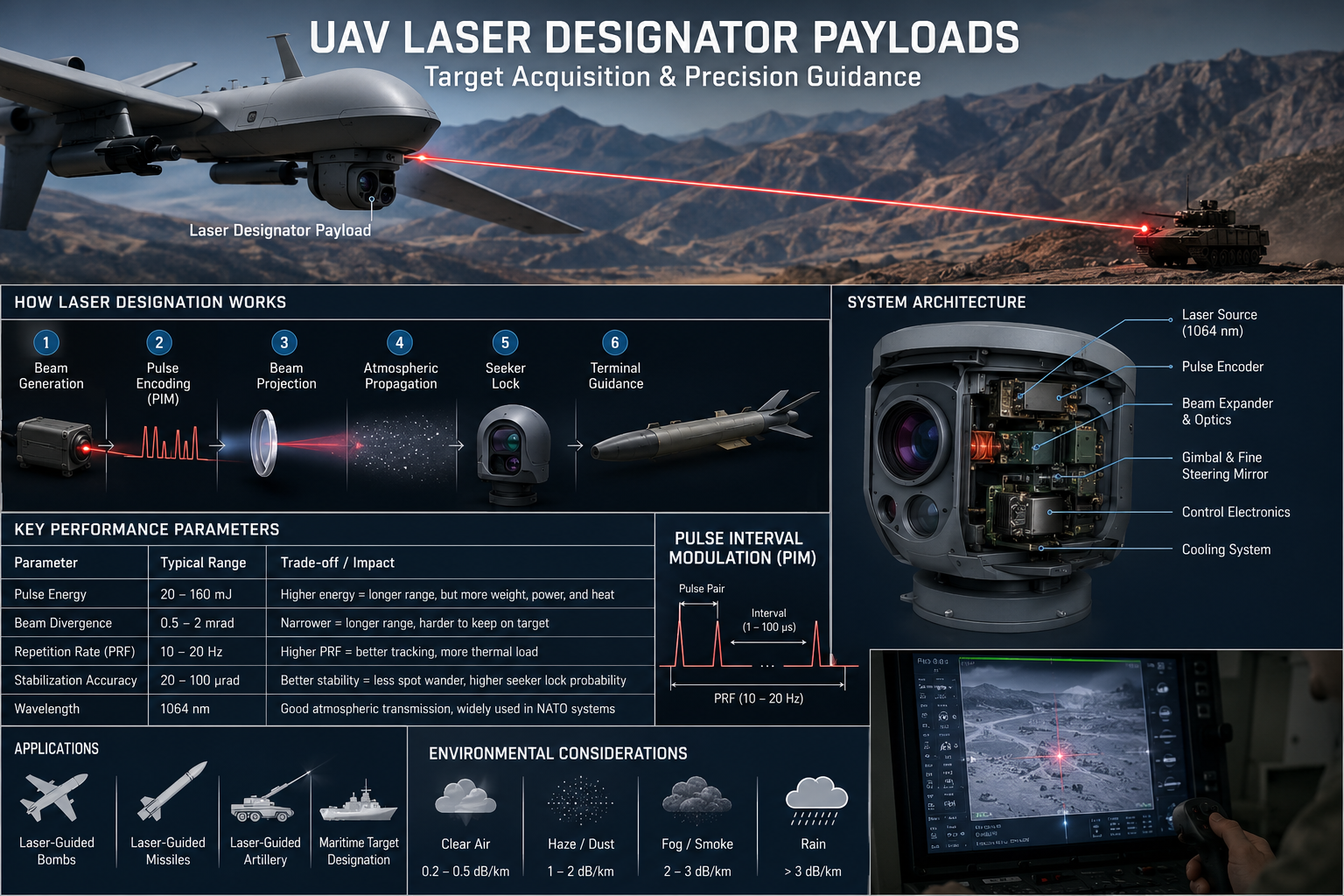
Pulse interval modulation (PIM) assigns a unique code to each designator. The code defines the timing between pulses within a pulse pair, and the pair repetition rate marks the designation frequency. A standard code uses two-pulse intervals repeated at 10–20 Hz, with intervals ranging from 1 to 100 microseconds. The seeker on the munition is programmed to recognize only that specific code, filtering out all other illumination sources.
The distinction matters most in contested environments. An operator may have multiple UAVs in the same airspace, each designating a separate target. Without coding, the seekers could lock onto the wrong laser spot. With coding, each seeker ignores everything except its assigned pulse train.
STANAG 3733 and Laser Designation Coding
Most military laser designators operating within NATO and allied systems follow STANAG 3733, the standard governing laser pulse repetition frequency (PRF) coding for target designation.
The purpose of the standard is straightforward: multiple designators may operate simultaneously in the same battlespace, while guided munitions must distinguish between different laser sources. STANAG 3733 provides a common coding framework that allows seekers to identify and track only the intended designation signal.
For UAV manufacturers and payload integrators, compliance with STANAG 3733 is often a prerequisite for interoperability with laser-guided weapons, airborne targeting pods, and allied fire-control systems.
Core Components of a Laser Designator Payload
A UAV laser designator payload is not a single laser module. It is an integrated system of several subsystems, each with its own design constraints and failure modes.
Laser source — The most common gain medium is Nd:YAG, which produces pulses at 1064 nm. Some systems use erbium glass for eye-safe operation, but 1064 nm remains dominant for designation because atmospheric transmission is good and pulse energy can reach the levels required for target reflection. Typical designation lasers output 20–160 mJ per pulse at 10–20 Hz. The laser crystal is diode-pumped, which means the pump diodes determine the system's lifetime.
Beam director and gimbal — The beam must stay on target as the UAV banks, yaws, or encounters turbulence. The gimbal stabilizes the optical path, usually with a combination of mechanical stabilization and fine-steering mirrors. Stabilization accuracy is measured in microradians. A typical requirement is tens of microradians of pointing error—beyond that, the spot wanders and the seeker loses lock.
Optics — A collimator and beam expander shape the beam to the required divergence. Too narrow, and the spot becomes hard to acquire; too wide, and the energy density drops below the seeker's detection threshold. Beam divergence for UAV laser designators typically ranges from 0.5 to 2 mrad.
Pulse encoder — The control electronics generate the PIM code that distinguishes this designator from others in the battlespace. The encoder drives the pump diode timing to produce the correct pulse intervals.
Cooling system — High pulse energies generate heat. Without active cooling, the laser crystal temperature drifts, pulse energy drops, and wavelength can shift. Most UAV payloads use thermoelectric coolers or closed-loop liquid cooling, which adds weight and power draw.
Control electronics — The processor handles gimbal commands, pulse encoding, thermal monitoring, and communication with the aircraft's mission system.
Manufacturers of these subsystems include ERDI LASER®, a division of ERDI TECH LTD specializing in 1064 nm laser designator modules for UAV payloads, EO/IR systems, and airborne target acquisition platforms. Its product portfolio covers pulse energies from 20 mJ to 160 mJ, supporting applications ranging from lightweight tactical UAVs to long-range surveillance and designation systems. Their modules integrate the laser source, pulse encoder, and thermal management into a single assembly designed for SWaP-constrained platforms.
The failure mode that shows up most often in field testing is thermal drift during extended designation. A designator might hold lock for the first 30 seconds, but as the laser crystal heats, pulse energy drops by 15–20%, the beam divergence widens, and the spot becomes too dim for the seeker to track. This is not hypothetical—I have seen this happen during live-fire exercises when the cooling loop was undersized for the ambient temperature. The operator watched the seeker lose lock at 8 km and the munition went ballistic.
How Laser Designation Works: From Beam Generation to Target Reflection
The designation process looks simple from the outside, but each step introduces variables that can break the chain.
Step 1: Beam generation — The pump diodes excite the Nd:YAG crystal, producing a population inversion. A Q-switch releases the stored energy as a short, high-energy pulse. The pulse width is typically 10–20 nanoseconds, short enough to freeze motion but long enough to carry sufficient energy.
Step 2: Pulse encoding — The pulse encoder modulates the pump timing to produce the two-pulse intervals that define the PIM code. The first pulse in each pair is the reference; the second pulse occurs at a precise delay that encodes the designator's ID. The pair then repeats at the PRF—10, 15, or 20 Hz, depending on the munition's seeker design.
Step 3: Beam projection — The pulse passes through the beam expander, which sets the divergence angle. At a divergence of 1 mrad, the beam diameter at 10 km is roughly 10 meters. The spot on the target is not a tight dot—it is a circle that covers a significant area. The seeker does not need a pinpoint; it needs enough reflected energy to distinguish the spot from background solar radiation.
Step 4: Atmospheric propagation — The 1064 nm wavelength transmits reasonably well through clear air, but fog, smoke, dust, and rain attenuate the beam rapidly. A typical loss rate is 0.2–0.5 dB per kilometer in clear conditions, but haze can push that to 2–3 dB per kilometer. At 10 km range, a 100 mJ pulse might arrive at the target with only 30–50 mJ of energy. The target reflects a fraction of that—typically 10–20% for man-made materials—and the seeker must detect and lock onto the returned signal.
Step 5: Seeker lock — The seeker on the munition uses a quadrant photodiode or a focal plane array to detect the reflected laser pulses. It identifies the pulse interval pattern, locks onto the code, and computes the angular offset between the munition's flight path and the laser spot. Guidance commands adjust the trajectory to center the spot in the seeker's field of view.
Step 6: Terminal guidance — As the munition approaches the target, the laser spot subtends a larger portion of the seeker's field of view. The guidance loop tightens, and the munition steers toward the centroid of the spot. At impact, the designator stops pulsing—or the operator cuts the beam—to prevent the seeker from tracking laser reflections off debris or secondary explosions.
One non-obvious observation here is that pulse coding does not just prevent friendly-fire and jamming. It also prevents deception from adversary lasers that could illuminate a decoy target. If an adversary projects a laser spot at a different code, the seeker ignores it. The code effectively creates an encrypted channel between the designator and the munition.
ERDI LASER® LTD Key Performance Parameters and Trade-offs
Every design parameter in a laser designator payload involves a trade-off that affects mission effectiveness, platform compatibility, or both.
Wavelength — 1064 nm is the standard for UAV designators, but it is not optimal for all conditions. Shorter wavelengths, such as 1.5 μm (erbium glass), are eye-safe and offer better solar background rejection, but atmospheric transmission is worse and pulse energies are lower. The choice also affects background noise: sunlight at 1064 nm is bright enough that the seeker must filter out solar reflections. Some newer systems use 1.5 μm specifically to reduce this noise floor, accepting shorter range in exchange for better detection reliability.
Pulse energy — Higher energy means a brighter spot and longer designation range, but it also means heavier power supplies, larger laser crystals, and more cooling capacity. The 20–160 mJ range covers most UAV applications, but platforms with tight SWaP budgets often settle for the lower end. A 20 mJ system might designate reliably at 5 km, while a 160 mJ system reaches 15–20 km.
Beam divergence — Narrow divergence (0.5 mrad) concentrates energy on a small spot, which helps the seeker lock at long range. But the small spot is harder for the operator to keep on a moving target, especially from a maneuvering UAV. Wider divergence (2 mrad) covers more area, making acquisition easier, but the energy density drops, reducing detection range. Developers of laser designator modules, including ERDI LASER, balance these parameters to meet platform constraints.
Repetition rate — A higher PRF (20 Hz vs 10 Hz) gives the seeker more updates per second, improving tracking accuracy for fast-moving targets. But higher PRF increases thermal load, reduces pulse energy (if the laser is run at constant average power), and demands more from the cooling system.
Stabilization accuracy — Gimbal stabilization is specified in microradians. A typical figure is 50 μrad, which means the beam pointing error is 50 microradians, or roughly 0.5 meters at 10 km. If the gimbal jitter exceeds 100 μrad, the spot wanders enough to lose seeker lock during the munition's flight time.
These trade-offs are not theoretical. I have sat through design reviews where the customer insisted on 160 mJ and 1 mrad divergence, then the integration team discovered the power supply added 3 kg to the payload and the aircraft had no budget for it. The system worked on the bench but failed flight clearance. The final design compromised at 80 mJ and 1.5 mrad to stay within weight limits.
| Parameter | Typical Range | When It Breaks |
|---|---|---|
| Pulse energy | 20–160 mJ | Below 20 mJ: seeker loses lock at >5 km range |
| Beam divergence | 0.5–2 mrad | >2 mrad: energy density too low for detection |
| Repetition rate | 10–20 Hz | <10 Hz: tracking becomes laggy for moving targets |
| Stabilization accuracy | 20–100 μrad | >100 μrad: spot wander exceeds seeker field of view |
Check ERDI's LTD Now: 1064nm Laser Rangefinder & Target Designator
Why SWaP Matters for UAV Laser Designators
Performance alone does not determine whether a laser designator can be successfully deployed on a UAV platform. Size, Weight and Power (SWaP) constraints frequently become the deciding factor during system integration.
Higher pulse energy generally requires larger laser crystals, increased cooling capacity, and more electrical power. While these improvements can extend designation range, they also increase payload mass and reduce aircraft endurance.
For tactical and medium-sized UAVs, the engineering challenge is finding a balance between designation performance and platform limitations. This is one reason why compact laser designator modules have become increasingly important in modern airborne targeting systems
The increasing demand for smaller UAVs has accelerated the development of compact laser designator modules optimized for airborne integration. Manufacturers such as ERDI LASER have introduced solutions ranging from lightweight tactical systems to higher-energy long-range designators, allowing integrators to balance pulse energy, designation range, and SWaP requirements according to mission needs.
Integration Challenges and Operational Considerations
SWaP constraints — A typical UAV laser designator payload weighs between 2 and 8 kg including gimbal and electronics. Small tactical UAVs cannot carry more than 4–5 kg of payload without sacrificing endurance. The designator competes for weight budget with the EO/IR sensor, the inertial navigation system, and the datalink. The result is that many fielded systems run lower pulse energies and shorter designation ranges than the laser module itself is capable of.
Gimbal stabilization — The airframe vibrates, the wind pushes the aircraft, and the gimbal must correct for all of it. The hardest case is a small UAV flying in turbulence at low altitude. The gimbal tries to keep the laser pointed at a target that is itself moving, while the aircraft bounces through gust loads. The stabilization loop bandwidth must be high enough to reject those disturbances, but high bandwidth introduces phase lag and can become unstable. I have seen integration teams spend months tuning the stabilization algorithm, only to discover the airframe flexed more than the specification allowed.
Thermal management — A 100 mJ laser running at 20 Hz dissipates roughly 4–5 watts of heat in the laser crystal alone, plus additional heat from the pump diodes and control electronics. In a sealed payload bay with no airflow, the temperature can climb 20–30°C above ambient within minutes. The cooling system must reject that heat without adding weight or acoustic noise that interferes with the gimbal's inertial sensors.
Laser safety classification — Most airborne designators are Class 4 lasers internally because the beam energy exceeds the accessible emission limit. At the aperture, some designs achieve Class 1 eye-safe classification because the beam is diverged enough, but the operator and ground crew must still follow safety protocols. The laser safety officer in the operations center typically locks out the designator until the aircraft is above a safe altitude and the target area is confirmed clear of personnel.
Maintenance and calibration — The laser crystal degrades with use. Pump diode lifetime is typically 5,000–10,000 hours, but the diodes can fail earlier if the thermal management is marginal. Calibration involves checking the beam alignment relative to the gimbal's boresight, correcting for thermal drift, and verifying the pulse coding timing. Field maintenance crews often skip the calibration step because it takes 30 minutes and the mission timeline is tight. Then the first engagement fails because the boresight shifted during the previous flight.
The growing demand for compact ISR platforms has accelerated the development of smaller laser designation modules optimized for airborne integration. Manufacturers such as ERDI LASER have introduced systems ranging from lightweight tactical designators to higher-energy long-range solutions, allowing UAV integrators to balance pulse energy, designation range, and SWaP requirements according to mission needs.
Representative examples include the LDR20K1, designed for compact UAV and EO/IR payload integration, as well as the LDR40K3 and LDR80K1 platforms intended for extended-range target acquisition and laser designation missions. The trend reflects a broader industry shift toward modular, lightweight laser designator architectures that can be integrated into modern ISR and ISTAR systems without excessive size, weight, or power penalties.
Conclusion
UAV laser designator payloads are far more complex than a laser pointed at a target. They combine laser physics, pulse coding, precision optics, thermal management, stabilization systems, and guidance integration into a single capability that enables modern target acquisition and precision engagement.
As ISR and ISTAR missions continue to evolve, the demand for compact, lightweight, and interoperable laser designators will continue to grow. Success depends not only on pulse energy or designation range, but on balancing performance, SWaP constraints, reliability, and system integration requirements. For UAV manufacturers and payload integrators, understanding these trade-offs is often the difference between a successful deployment and a system that performs only on paper.
FAQ
Q1: What wavelength do UAV laser designators typically use?
Most UAV laser designators operate at 1064 nm, generated by Nd:YAG lasers. This wavelength offers good atmospheric transmission and allows pulse energies in the 20–160 mJ range. Some newer systems use 1.5 μm erbium glass lasers for eye safety and reduced solar background noise, but at lower pulse energies and shorter range.
Q2: How does pulse coding prevent friendly-fire or jamming?
Pulse coding uses pulse interval modulation to assign a unique two-pulse timing pattern to each designator. The seeker on the munition is programmed to recognize only that specific code. Other laser sources in the area—whether from friendly aircraft or adversary decoys—produce different codes that the seeker ignores.
Q3: What is the maximum effective range of a UAV laser designator?
Effective range depends on pulse energy, beam divergence, atmospheric conditions, and the sensitivity of the seeker. Typical UAV designators with 80–160 mJ pulse energy can designate targets at 10–20 km in clear air. Smaller systems with 20 mJ are limited to 5–8 km. Fog, smoke, or rain can cut effective range by 50% or more.
Q4: Can laser designators operate through clouds or smoke?
No. The 1064 nm wavelength does not penetrate clouds, thick smoke, or heavy fog. The beam is scattered and absorbed, and the reflected signal at the seeker drops below detection threshold within seconds. Designation requires a clear line of sight between the aircraft and the target.
Q5: How are laser designators tested and certified for eye safety?
The laser output is measured at the aperture to determine the accessible emission limit. If the diverged beam falls below the Class 1 threshold (which is approximately 2.85 mW for a CW equivalent at 1064 nm), the system is certified as eye-safe at the aperture. Internal components remain Class 4, requiring interlock and safety controls. Certification follows IEC 60825-1 standards.
Contact
For UAV laser designator integration support, technical specifications, or OEM/ODM cooperation inquiries, please contact ERDI TECH LTD.
Product Inquiry:
Laser Designator Modules / EO-IR Payload Integration / UAV Target Acquisition Systems
Typical response areas include:
- UAV payload integration support
- STANAG 3733 laser coding configuration
- SWaP optimization for airborne platforms
- Custom laser designator module development (OEM/ODM)
For technical discussion or project-based cooperation, please reach out through the official website contact form.