A laser-guided weapon misses its intended target, not because the designator lacks power or accuracy, but because the seeker is listening for a different laser code. Situations like this illustrate why STANAG 3733 remains one of the most important standards in modern laser designation systems. While many engineers focus on pulse energy, beam divergence, or designation range, interoperability often determines whether an entire targeting chain succeeds.
If you've ever spent hours debugging a designation system only to discover the problem was a mismatched PRF code, you already understand what STANAG 3733 is trying to solve. At its core, STANAG 3733 is essentially a common language between the laser designator and the seeker. Without this standard, every manufacturer would implement their own coding scheme, and coalition operations would devolve into a mess of incompatible hardware.
Why System Integrators Actually Care About STANAG 3733 Coding
From a systems integration perspective, STANAG 3733 isn't just another NATO checkbox on a compliance sheet. It's the reason you can swap out a designator from one vendor and pair it with a seeker from another without rewriting half your firmware.
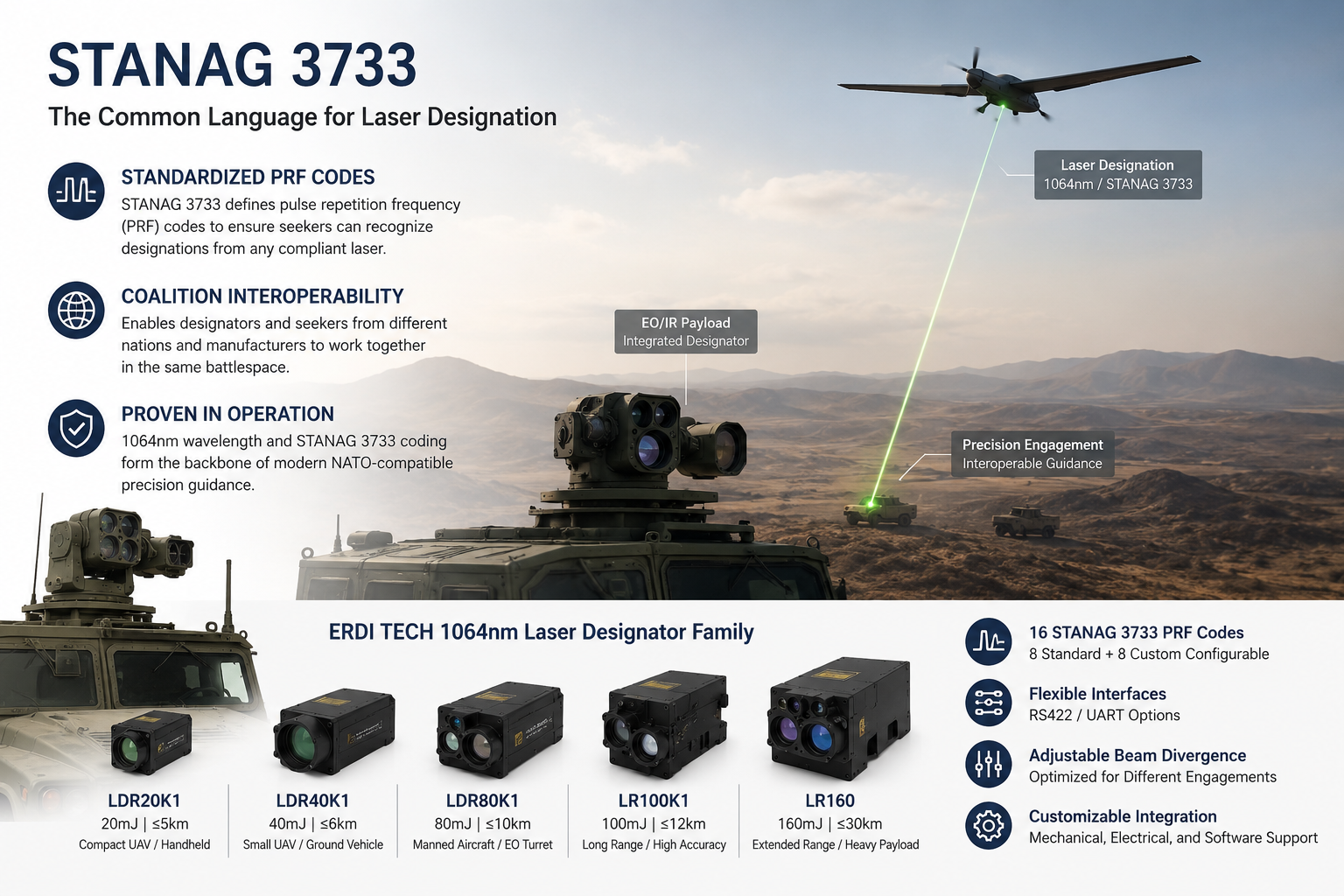
Here's the reality most integrators run into sooner or later: your customer buys a precision guided munition from Country A, mounts it on a platform from Country B, and expects the EO/IR turret from Vendor C to just work. Without standardized NATO laser coding, that "just work" part becomes a six-month firmware project. STANAG 3733 defines the pulse repetition frequency (PRF) code structure so that as long as both sides adhere to the standard, the seeker can recognize the designation — assuming everything else in the chain is set up correctly.
What Exactly Is a Laser PRF Code?
A laser PRF code isn't a single pulse — it's a specific temporal pattern of pulses that the seeker is trained to recognize. Instead of firing at a fixed repetition rate, the laser designator emits pulses in a coded sequence. The seeker on the precision guided munition looks for that exact pattern in the reflected laser energy and rejects everything else — including reflections from other designators, ambient infrared noise, or enemy countermeasures.
STANAG 3733 standardizes these code patterns so that a laser target designator built by one manufacturer can guide a seeker built by another. This is the foundation of coalition interoperability: when multiple nations operate together in a battlespace, every platform's designator speaks the same coding language.
A common integration scenario illustrates the value well. A customer specifies a seeker-equipped weapon from one supplier and an EO/IR payload from another, with no prior integration history between the two. Because both sides implement STANAG 3733, code compatibility can be validated in a bench test using a photo-detector and oscilloscope — without scheduling a full live-fire trial. That's the practical value of the standard: it de-risks laser designator integration before the platform ever takes to the field.
Why 1064nm Is the Standard Wavelength
Before diving into module selection, it's worth understanding why 1064nm dominates tactical laser target designator systems. The choice comes down to three practical factors: atmospheric transmission, detector sensitivity, and eye-safety tradeoffs.
First, 1064nm sits in a near-infrared window where atmospheric absorption is relatively low. 1064nm offers favorable atmospheric transmission under many operational conditions, allowing sufficient laser energy to reach the target over operational designation distances. Second, laser seeker detectors — the most mature and cost-effective sensor technology for seekers — have strong sensitivity at 1064nm. This means the seeker can pick up lower levels of reflected laser energy, extending effective designation range or allowing lower pulse energies on the designator side. Third, while 1064nm is not eye-safe at designation energy levels, it's well-characterized and the hazard distance is predictable and manageable with proper operational procedures. Alternate eye-safe wavelengths (such as 1535nm or 1550nm) exist for rangefinding, but the existing inventory of laser-guided weapon seekers of precision guided munition seekers is overwhelmingly built around 1064nm.
For these reasons, a 1064nm laser designator remains the default choice for any platform that needs to guide existing NATO-standard laser-guided weapons.
Where ERDI TECH 1064nm Modules Fit In
These days, a lot of lightweight drone platforms are moving away from separate rangefinder and designator payloads. Many EO/IR integrators are packing both functions into a single line-replaceable unit to save weight and optical alignment headaches. That's where multi-purpose 1064nm laser modules come in.
For system integrators looking for STANAG 3733-compatible hardware, ERDI TECH LTD offers a family of 1064nm laser designator modules covering pulse energies from 20mJ to 160mJ. Depending on the platform class — hand-launched mini-UAV on one end, larger tactical UAV platforms on the other — integrators can select the energy grade that matches their designation range requirement, and configure the communication interface (RS422 or UART) to match the payload's mission computer.
|
Model |
Pulse Energy |
Beam Divergence |
Dimensions & Weight |
Ranging Distance 20% Target reflectivity |
Designation Distance |
|---|---|---|---|---|---|
|
LDR20K1 View Details → |
20 mJ |
≤0.6 mrad |
≤ 92 × 67 × 53mm & <290 g |
300 m to 3 km |
2 km |
|
LDR25K1 View Details → |
25 mJ |
≤0.5 mrad |
≤ 68 × 52 × 90mm & <380 g |
120 m to 5 km |
2 km |
|
LDR40K1 View Details → |
40 mJ |
≤0.4 mrad |
≤ 115 × 65 × 60mm & <460 g |
100 m to 6 km(10 km visibility) |
3 km |
|
LDR40K3 View Details → |
40 mJ |
≤0.5 mrad |
≤ 95 × 97 × 48mm & <420 g |
300 m to 5 km(15 km visibility) |
3.5 km |
|
LDR60K1 View Details → |
60 mJ |
≤0.3 mrad |
≤ 116 × 52 × 96mm & <680 g |
300 m to 10 km(20 km visibility) |
6 km |
|
LDR80K1 View Details → |
80 mJ |
≤0.3 mrad |
≤ 116 × 52 × 96mm & <680 g |
300 m to 10 km(23 km visibility |
8 km |
|
LDR80K2 View Details → |
80 mJ |
≤0.15 mrad |
≤ 150 × 102 × 55mm & <850 g |
300 m to 15 km(20 km visibility) |
10 km |
|
LDR100K1 View Details → |
100 mJ |
≤0.15 mrad |
≤ 230 × 130 × 96mm & <1.5 kg |
300 m to 20 km(23 km visibility) |
15 km |
|
LDR120K1 View Details → |
50 /80 /120 mJ |
≤0.15 mrad |
≤ 75 × 90 × 220mm & <2 kg |
300 m to 20km/30 km(30km/45 km visibility) |
Long-range |
|
LR160 View Details → |
85 / 160 mJ |
≤0.2 mrad |
≤ 306 × 145 × 94mm & 3.3 kg |
300 m to 30km(45km visibility) |
Ultra-long-range |
Not Sure Which Laser Designator Fits Your Platform?
The right model depends on more than pulse energy or maximum range. Platform size, target distance, beam divergence, designation requirements, interface, and SWaP constraints all need to be considered together. If you are developing a UAV payload, stabilized EO/IR system, vehicle-mounted platform, or other laser designation system, send us your required designation distance, platform type, and integration requirements. ERDI TECH can recommend a suitable 1064nm laser designator for your application.
Email: yeva@erditechs.comWhatsApp: +86 18123396539
On the coding side, all ERDI 1064nm laser designator modules ship with 16 STANAG 3733 PRF codes pre-loaded. Eight are standard system codes — the commonly used NATO laser coding patterns that cover most coalition interoperability scenarios. The remaining eight are user-configurable custom codes, which system integrators can program for specialized missions, proprietary weapon interfaces, or operational security requirements. This dual approach gives integrators both out-of-the-box compatibility and the flexibility to adapt to specific customer needs without hardware changes.
Compliance Doesn't Equal Integration Done
One common misconception is that a STANAG 3733-compliant laser designator will automatically work with every compatible seeker. In reality, the standard defines the coding language, but successful integration still depends on synchronization, optical alignment, communication timing, and overall system implementation. Here's the part that catches a lot of junior engineers off guard: having a STANAG 3733-compliant designator module is necessary, but it's nowhere near sufficient. Integration teams regularly encounter systems where every component individually passes compliance testing, yet the system as a whole fails designation in flight. The problems almost always live in the gaps between boxes.
In practice, mission computer synchronization is often one of the first areas engineers investigate when designation issues appear. The designator doesn't fire codes in a vacuum — the mission computer has to tell it which code to use and when to start emitting. If your command protocol has even a single frame of latency between the fire control system solution and the code-switch command, you can end up designating with the wrong PRF during the critical handover window.
Gimbal Delay is another issue frequently encountered during system integration. EO/IR gimbals have their own control loops, and there's always a lag between the fire control system commanding "point at that pixel" and the laser bore sight actually being on target. If your designator fires its coded burst before the gimbal settles, the seeker sees a reflected signal that dances around the aim point — and may drop lock before guidance can converge.
Time Stamping accuracy matters more than most people think. In coordinated designation scenarios — especially where a separate observer platform is handing off target data — every designation event needs a precise timestamp. Drift between the designator's clock and the mission computer's clock will show up as intermittent code-lock failures that are notoriously difficult to reproduce during laboratory testing.
Fire Control integration is where system-level integration becomes critical. The fire control system has to know not just the code, but the code format, the burst duration, the pre-designation lead time, and the post-impact hold-off. Get any of those parameters wrong and you can have a situation where the designator is emitting a perfectly valid STANAG 3733 code, but the seeker logic never declares lock because the timing profile doesn't match what it expects.
Finally, end-to-end latency ties all of these factors together. Every millisecond of end-to-end latency in the targeting chain narrows your designation window. For moving targets or short-of-flight precision guided munitions, that margin can disappear entirely.
Common Integration Questions
Not if you keep both sets available. The standard eight system codes handle coalition and joint operations, while the custom codes can be reserved for national-only missions, proprietary weapon interfaces, or operational security. The key is that the fire control system manages code selection explicitly — you never want a platform accidentally transmitting a custom code during a coalition mission.
Closing Thoughts
As ISR and precision engagement systems continue to evolve, compliance with STANAG 3733 is becoming less about meeting a specification and more about ensuring interoperability across the entire targeting chain. For system integrators, selecting a laser designator is no longer only a question of pulse energy or range. Coding compatibility, communication interfaces, synchronization, thermal stability, and platform integration all influence mission success. Understanding these factors early in the design process helps reduce integration risk and shortens development cycles.
In practice, successful STANAG 3733 integration rarely depends on a single specification. Most integration issues emerge where optical, electrical, and software subsystems interact. Evaluating coding compatibility together with synchronization, interface architecture, and platform dynamics early in the design process usually saves far more time than troubleshooting interoperability issues during flight testing.
ERDI TECH LTD supports OEM and system integration projects with 1064nm laser designators ranging from 20mJ to 160mJ, providing customizable communication interfaces, beam divergence options, and mechanical configurations for UAV, EO/IR payload, and vehicle-mounted applications.
Whether you're developing a compact UAV payload, an airborne EO/IR turret, or a vehicle-mounted targeting system, selecting a laser designator should involve more than comparing pulse energy specifications. Evaluating interoperability, interface compatibility, and platform integration at the beginning of a project typically reduces development risk and shortens system validation time. If you're evaluating a STANAG 3733-compatible laser designator for your next integration project, ERDI TECH LTD can provide engineering support, product recommendations, and customized interface solutions based on your platform requirements.
Email: yeva@erditechs.com
WhatsApp: +86 18123396539