Introduction
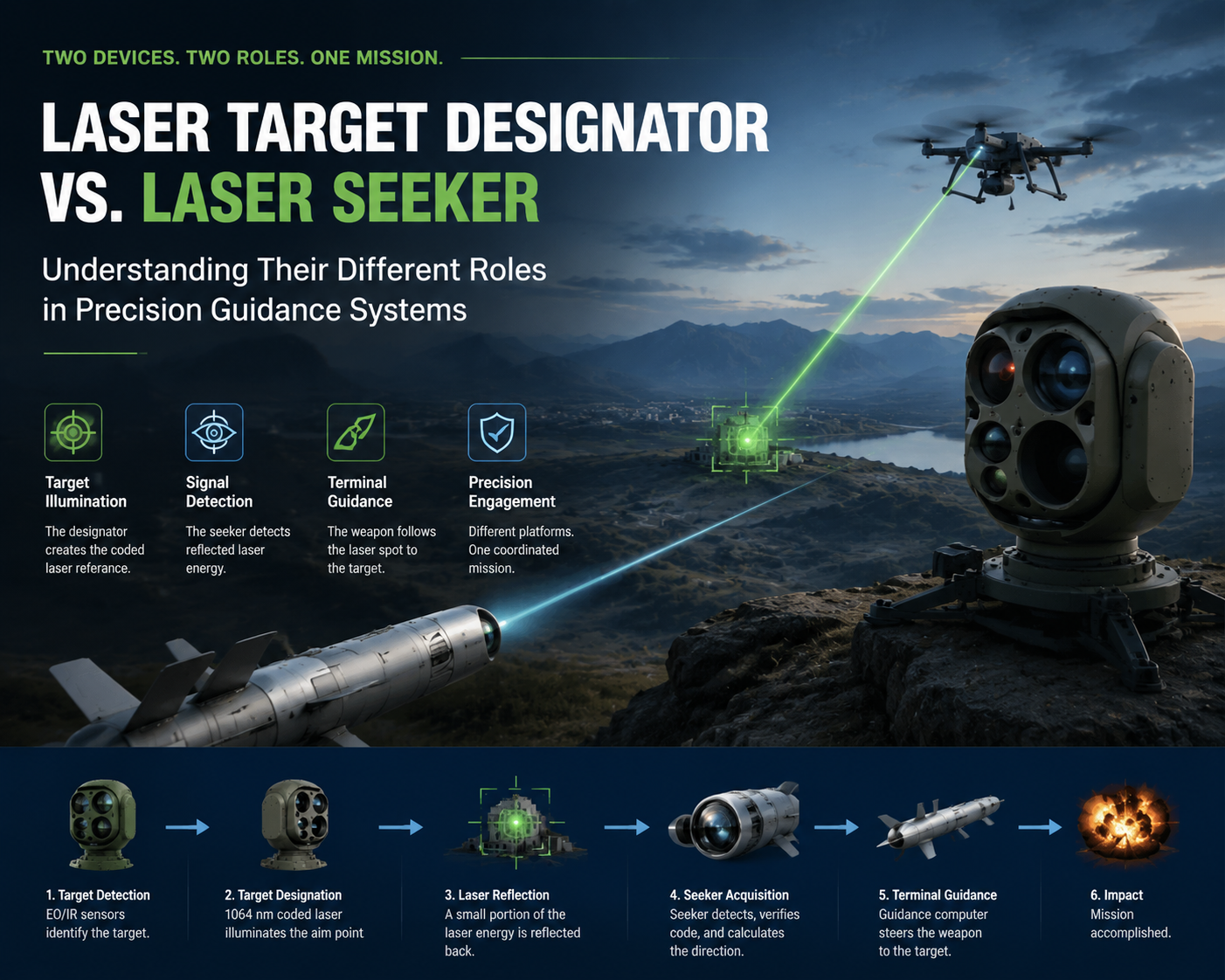
Engineers developing EO/IR payloads, precision-guidance systems, or laser-guided munitions often encounter two closely related terms: laser seeker and laser target designator. Because both are associated with semi-active laser guidance and frequently operate within the same engagement sequence, they are sometimes mistaken for different names of the same technology.
That misunderstanding can create much bigger problems than terminology alone. During system design or procurement, confusing these two components may lead to incorrect payload architecture, unrealistic performance expectations, or integration decisions that fail to support the intended mission profile.
The reality is much simpler—and far more important from an engineering perspective.
A laser target designator actively projects a coded laser beam onto the target, creating the optical reference required for precision guidance. A laser seeker, by contrast, is a passive optical sensor that detects the reflected laser energy and continuously guides the weapon toward the designated point. One creates the reference; the other follows it.
This separation is not merely a design preference. It is the fundamental principle behind semi-active laser guidance, enabling target designation and terminal guidance to be performed by different platforms operating within the same engagement.
Understanding how these technologies complement each other is essential for OEM system designers, EO/IR payload manufacturers, and integrators building modern reconnaissance and precision-targeting platforms. Rather than comparing two competing devices, this article explains how both components work together to form a complete laser guidance chain.
Internal Link Recommendation:Readers unfamiliar with the role of laser designation may first find it helpful to read Why Laser Target Designators Are Essential in Semi-Active Laser Guidance Systems, which explains why external target illumination is the foundation of semi-active laser guidance.
Why These Two Terms Are Often Confused
The confusion usually appears at the system level rather than the component level. When discussing precision-guided weapons, it is common to hear the entire engagement process described simply as "laser guidance." While technically correct, this simplified description hides the fact that multiple independent subsystems must work together before a weapon can accurately engage its target.
From an operator's perspective, the process appears seamless. A target is identified, illuminated with a laser, and the weapon strikes the designated point. Behind this apparently straightforward sequence, however, each subsystem performs a highly specialized task.
- The laser target designator generates and projects a coded laser beam.
- The target reflects only a small portion of that energy.
- The laser seeker detects the reflected signal, verifies the laser code, calculates the direction of the laser spot, and continuously updates the weapon's flight path.
Because these events occur almost simultaneously, the distinction between illumination and guidance is often overlooked. Another reason for confusion is that laser seekers, laser target designators, and laser rangefinders all employ laser technology and may even operate within the same electro-optical payload. Despite these similarities, they solve entirely different engineering problems. Understanding those differences is especially important during OEM integration. Selecting the correct subsystem affects everything from payload architecture and communication interfaces to optical alignment and overall mission capability.
Before comparing specifications or performance, it is therefore useful to examine the unique engineering objective behind each device.
They Solve Different Engineering Problems
Although laser target designators and laser seekers operate within the same guidance architecture, they are engineered to solve fundamentally different problems.
Rather than viewing one as an upgraded version of the other, it is more accurate to consider them complementary technologies that divide the guidance task into two independent functions: target illumination and terminal tracking.
The Laser Target Designator: Creating the Optical Reference
A laser target designator is an active laser transmitter. Its responsibility is to illuminate the selected target with a precisely coded laser beam while maintaining stable pointing accuracy throughout the engagement. From an engineering perspective, design priorities include:
- Stable pulse energy over extended operating periods
- Low beam divergence for long-range designation
- Accurate laser coding (such as STANAG 3733)
- High pointing stability under vibration and platform movement
- Reliable operation across changing environmental conditions
The objective is not simply to emit laser energy, but to generate a stable optical reference that can be recognized by compatible laser seekers.
The Laser Seeker: Following the Optical Reference
A laser seeker performs the opposite role. Instead of transmitting laser energy, it passively receives the coded laser signal reflected from the target.
Its engineering priorities focus on:
- High detector sensitivity
- Fast target acquisition
- Accurate angular measurement
- Reliable code discrimination
- Stable tracking during terminal flight
Once a valid laser reflection is detected, the seeker continuously measures the angular deviation between the weapon's line of sight and the reflected laser spot, allowing the guidance computer to calculate steering corrections. Although both devices are indispensable, their design priorities differ completely because they solve different engineering problems.
Separating illumination from guidance also offers significant operational advantages. The designator can remain on a UAV, reconnaissance vehicle, or forward observer position, while the weapon carrying the seeker follows the designated target from an entirely different platform. This distributed architecture is one of the defining strengths of semi-active laser guidance.
How They Work Together During Target Engagement
Laser target designators and laser seekers should not be viewed as isolated devices. They operate as consecutive stages within a continuous optical guidance chain, where each stage depends entirely on the successful completion of the previous one.
A typical engagement sequence follows this workflow:
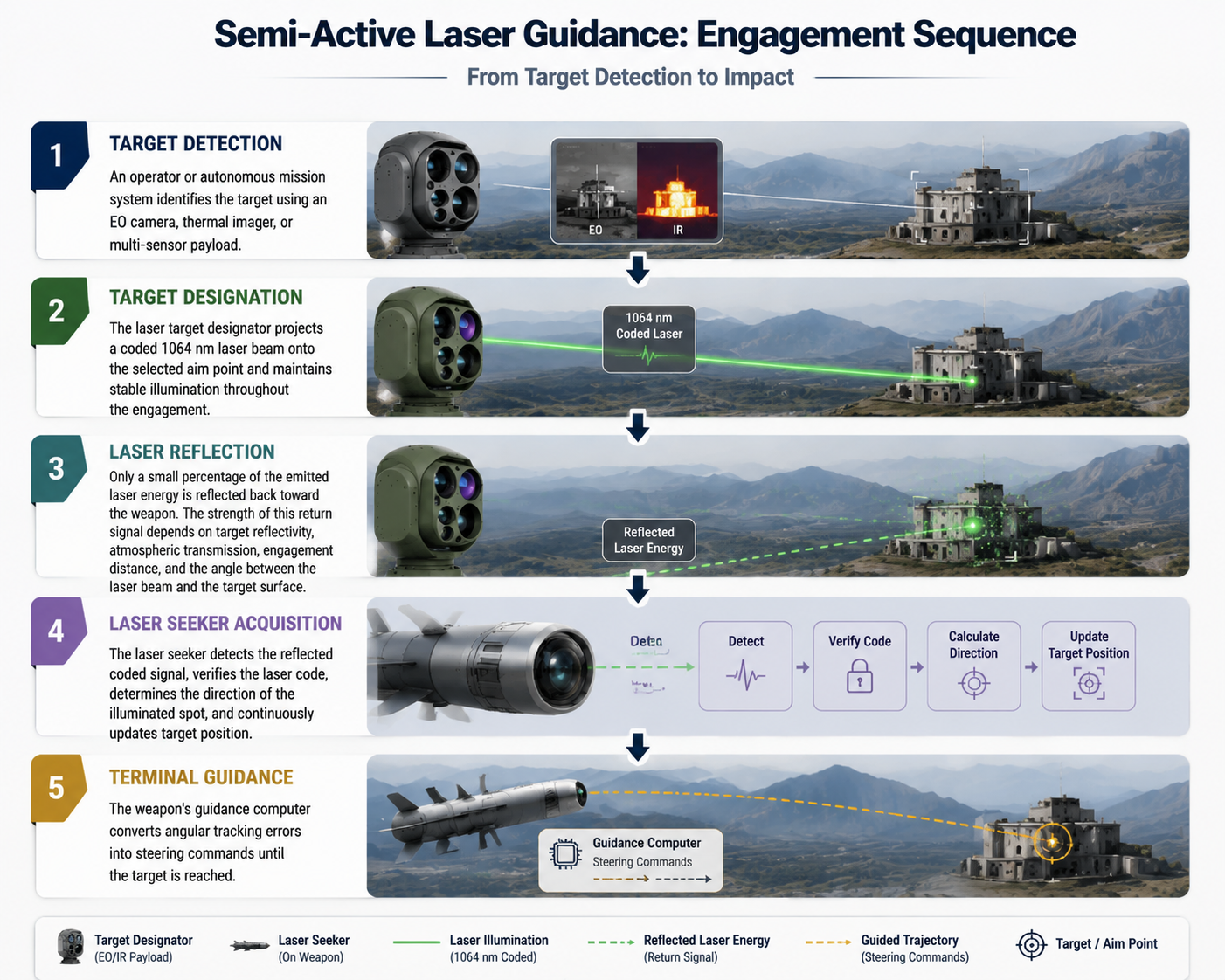
Because only a fraction of the emitted laser energy returns to the seeker, maintaining stable target illumination is often more challenging than generating the laser beam itself. Factors such as beam divergence, platform vibration, atmospheric attenuation, and optical alignment all influence whether the seeker can maintain continuous lock during the terminal phase.
For OEM developers integrating EO/IR payloads, this explains why laser target designators are evaluated not only by maximum output energy but also by beam quality, pointing stability, coding accuracy, and compatibility with the overall fire-control architecture.
Comparing Their Core Functions
Although laser target designators and laser seekers work together throughout the engagement process, their engineering objectives, installation locations, operating principles, and performance requirements are fundamentally different. The comparison below summarizes the key distinctions that OEM developers and system integrators should understand before selecting components for a precision-guidance platform.
| Feature | Laser Target Designator | Laser Seeker |
|---|---|---|
| Primary Function | Illuminate the target with a coded laser beam | Detect reflected coded laser energy for guidance |
| Operating Principle | Active laser transmitter | Passive optical receiver |
| Typical Installation | EO/IR payload, UAV, observation platform, vehicle | Guided missile, guided bomb, precision munition |
| Laser Emission | Yes | No |
| Receives Laser Reflection | No | Yes |
| Typical Wavelength | Emits 1064 nm | Detects reflected 1064 nm laser energy |
| Laser Coding | Generates coded pulse sequences (e.g., STANAG 3733) | Decodes and verifies received laser codes |
| Primary Engineering Focus | Beam quality, pointing accuracy, pulse energy, coding stability | Detector sensitivity, tracking accuracy, angular resolution |
| Can Operate Independently | Yes | No — requires external target illumination |
| Typical OEM Users | EO/IR payload manufacturers and system integrators | Guided weapon manufacturers |
Rather than competing technologies, laser target designators and laser seekers are two complementary components of the same guidance architecture. The designator establishes the optical reference, while the seeker converts that reference into precise steering information. Only when both systems operate together can a semi-active laser guidance system achieve reliable and repeatable target engagement.
Why They Are Designed as Separate Systems
If combining a laser target designator and a laser seeker into a single device were technically practical, why has the defense industry continued to develop them as separate systems for decades?
The answer lies in engineering optimization rather than technological limitation.
Although both devices participate in the same guidance chain, they operate under fundamentally different constraints. A laser target designator must generate a stable, high-energy laser beam, maintain accurate pointing over long distances, and continuously illuminate the selected aim point throughout the terminal phase. These requirements place significant demands on laser generation, thermal management, optical stability, and platform stabilization.
A laser seeker faces a completely different set of challenges. Mounted on a guided weapon traveling at high speed, it must detect an extremely weak reflected laser signal, reject background interference, decode the designated laser code, and calculate steering corrections in real time. Its performance depends far more on detector sensitivity, optical filtering, signal processing, and tracking algorithms than on laser generation.
Attempting to combine these functions into a single device would introduce unnecessary compromises. The optical transmitter, receiver, power supply, cooling system, and control electronics would compete for space, weight, and electrical power while serving different operational purposes. Separating the two subsystems allows each to be optimized independently for its own mission.
This modular architecture also increases operational flexibility. A laser target designator can remain on a reconnaissance UAV, a stabilized EO/IR payload, a ground observation post, or a vehicle-mounted surveillance system, while multiple compatible guided weapons equipped with laser seekers can engage designated targets from different launch platforms. The designation platform does not need to carry the weapon, and the weapon does not need to generate its own laser beam.
For OEM developers, this separation simplifies system integration as well. EO/IR payload manufacturers can focus on optical alignment, stabilization, and designation performance, while guided-weapon developers optimize seeker sensitivity and terminal guidance independently. Standardized laser coding—such as STANAG 3733—then provides the common language that enables these independently developed systems to operate together.
Engineering Insight:The separation between illumination and guidance is not a historical artifact—it is one of the key reasons semi-active laser guidance remains adaptable across UAVs, land vehicles, naval platforms, and airborne targeting systems.
Can One Replace the Other?
One of the most common questions during early-stage system development is whether a laser target designator, laser seeker, or laser rangefinder can substitute for one another.
In practice, the answer is always determined by system function, not by the fact that all three devices use lasers.
A laser target designator cannot replace a laser seeker because it does not detect reflected laser energy or calculate guidance corrections. Its purpose is to establish a stable optical reference by projecting a coded laser beam onto the target.
Likewise, a laser seeker cannot replace a laser target designator. Although it can accurately track reflected laser energy, it has no capability to illuminate a target or generate the coded laser pulses required to initiate guidance. Without external illumination, the seeker simply has no signal to process.
Laser rangefinders introduce another source of confusion. Because they also transmit laser pulses, they are sometimes assumed to perform target designation. In reality, their objectives are entirely different.
A laser rangefinder emits short pulses to measure distance using the time-of-flight principle. Once the range has been calculated, laser emission ends. A laser target designator, however, must continuously project a coded laser beam throughout the terminal engagement, allowing the seeker to maintain an uninterrupted guidance reference.
From an integration perspective, these devices should be viewed as complementary rather than interchangeable. Modern EO/IR payloads often combine imaging sensors, laser rangefinders, and laser target designators within a common optical assembly, with each subsystem contributing different information to the mission computer. Precision guidance is achieved through their coordinated operation—not by replacing one function with another.
Engineering Insight:During payload architecture reviews, experienced integrators usually begin by defining the mission workflow rather than selecting hardware. Once the operational sequence is clear, the required laser functions naturally become apparent.
Selecting the Right System for OEM Platforms
Selecting a laser target designator is rarely a matter of choosing the highest output energy or the longest advertised designation range. For OEM developers, successful integration depends on how well the laser subsystem supports the overall mission architecture.
The first step is to define the operational scenario. A lightweight UAV performing reconnaissance missions places different demands on a laser target designator than a stabilized naval observation system or a vehicle-mounted fire-control platform. Platform endurance, available electrical power, stabilization accuracy, and environmental conditions all influence the most appropriate design.
Once the mission profile is established, attention should shift to system integration rather than individual specifications.
Optical alignment is often more important than peak laser output. Even a high-performance designator cannot deliver reliable target illumination if its optical axis cannot maintain precise boresight alignment with the EO camera during vibration, temperature variation, or long-duration operation. Likewise, communication interfaces, synchronization with mission computers, and compatibility with existing fire-control software frequently determine integration complexity more than laser performance alone.
Interoperability should also be considered early in the development cycle. Support for standardized laser coding, including STANAG 3733 where applicable, simplifies compatibility with existing semi-active laser guidance systems and reduces future integration risks. Flexible electrical interfaces such as RS-422, UART, Ethernet, or CAN Bus further improve adaptability across different platform architectures.
Another factor that is often underestimated is long-term maintainability. As EO/IR payloads continue to evolve toward modular architectures, selecting a laser target designator that can accommodate future sensor upgrades or software enhancements helps protect the overall platform investment.
At ERDI TECH LTD, this system-oriented philosophy has shaped the development of our compact 1064 nm laser target designator modules. Rather than designing standalone laser products, we focus on modules intended for integration into stabilized EO/IR payloads used on UAVs, vehicle-mounted observation systems, and other OEM electro-optical platforms. This integration-first approach enables manufacturers to shorten development cycles while maintaining flexibility for future platform evolution.
Engineering Insight:The most successful OEM integration projects rarely begin with a discussion about laser power. They begin with a clear understanding of how information flows through the entire targeting system—from target detection and identification to designation, guidance, and mission execution.
Conclusion
The terms laser seeker and laser target designator are closely connected because they operate within the same semi-active laser guidance chain, yet they solve entirely different engineering problems. A laser target designator creates the coded optical reference that defines the target, while a laser seeker transforms the reflected laser energy into steering information during the terminal phase of flight. Neither subsystem can perform the role of the other, and their separation is precisely what enables semi-active laser guidance to remain accurate, modular, and adaptable across a wide range of operational platforms. For system integrators and OEM developers, understanding this distinction is more than a matter of terminology. It influences payload architecture, optical alignment, interoperability, and ultimately the overall effectiveness of an integrated precision-targeting system.
As electro-optical payloads continue to become lighter, smarter, and increasingly modular, laser target designators will remain a critical enabling technology for modern UAVs, vehicle-mounted surveillance systems, naval observation platforms, and other precision-targeting applications. By viewing laser designation as part of an integrated sensing and guidance architecture—rather than as an isolated laser device—developers can build platforms that are easier to integrate, easier to upgrade, and better prepared for future mission requirements.
Looking for a Compact 1064nm Laser Target Designator for Your EO/IR Platform?
ERDI TECH LTD develops compact 1064nm laser target designator modules designed for integration into UAV payloads, vehicle-mounted electro-optical systems, and OEM precision targeting platforms.Our engineering team supports system integrators with laser module selection, optical alignment considerations, communication interfaces, and customized solutions for different mission requirements.Contact ERDI TECH LTD to discuss your laser designation requirements:Email: yeva@erditechs.comWhatsApp: +86 18123396539Related Articles
Why Laser Target Designators Are Essential in Semi-Active Laser Guidance Systems
Understanding STANAG 3733 Laser Coding for Precision Guidance Systems
What Are 1064nm Lasers Used for in Precision-Guided Munitions
Frequently Asked Questions
Can a laser seeker detect a target without a laser target designator?
No. A laser seeker is a passive optical sensor that detects reflected laser energy. Without external target illumination provided by a compatible laser target designator, the seeker has no reference signal to track and cannot generate guidance commands.
Is a laser target designator the same as a laser rangefinder?
No. Although both devices emit laser pulses, their operational objectives are different. A laser rangefinder measures distance using the time-of-flight principle, while a laser target designator continuously projects coded laser energy to support terminal guidance.
Why is 1064 nm commonly used for laser target designation?
The 1064 nm wavelength offers an excellent balance of mature solid-state laser technology, favorable atmospheric transmission, and compatibility with semi-active laser guidance systems. It has therefore become the standard wavelength for many military laser target designators.
What is STANAG 3733?
STANAG 3733 is a NATO standard defining pulse coding for laser target designation. Standardized coding allows compatible laser seekers to recognize the intended designation signal while reducing interference from other laser sources operating nearby.
Can multiple weapons use the same laser target designator?
Depending on the operational scenario, yes. Multiple compatible guided weapons may engage targets designated by the same laser target designator, provided that laser coding, engagement timing, and tactical procedures are properly coordinated. Actual capability depends on the guidance system architecture rather than the designator alone.
What should OEM developers evaluate before selecting a laser target designator?
Rather than focusing solely on maximum designation range, OEM developers should evaluate beam quality, pointing stability, optical alignment, laser coding compatibility, communication interfaces, environmental performance, and how the module integrates with the complete EO/IR payload architecture.