Selecting the right 1535nm laser rangefinder module is one of the most important decisions when designing UAV payloads, EO/IR systems, and surveillance equipment. Lightweight construction, eye-safe operation, and reliable long-range performance have made erbium glass laser rangefinders the preferred solution for many modern applications.
But not all 1535nm rangefinders are created equal. In this guide, we'll break down what you actually need to know when selecting an erbium glass 1535nm laser rangefinder module for your project.
Why 1535nm Erbium Glass Rangefinders?
Eye Safety That Doesn't Cripple Performance
Better Performance in Bad Air
Small, Light, and Drone-Friendly
Key Applications
UAV and Drone Payloads
Surveillance and Border Security
Reconnaissance and Handheld Systems
Mapping and Geomatics
Pulse Energy and Ranging Performance
- Sensitive InGaAs APD detectors that pick up photon-level return signals
- Tight beam divergence (0.3-0.5mrad) that keeps energy concentrated
- Smart signal processing that filters out noise and false returns
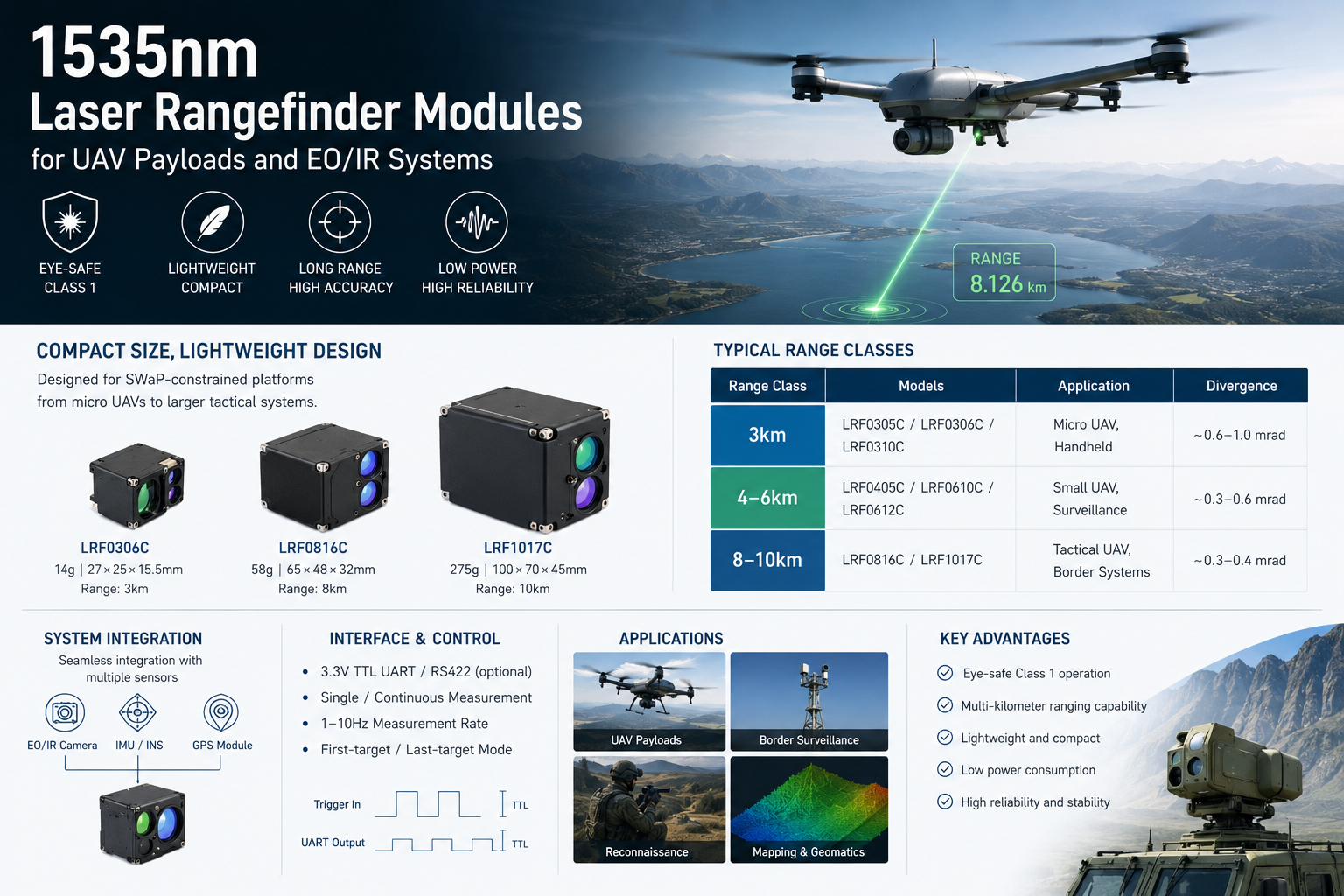
Range Classes at a Glance
| Range Class | Models | Typical Use | Beam Divergence |
|---|---|---|---|
| 3km Short-Range | LRF0305C, LRF0306C, LRF0105C, LRF0310C | Micro UAVs, handheld | 0.6-1.0 mrad |
| 4-6km Mid-Range | LRF0405C, LRF0609C, LRF0610C, LRF0612C | Small drones, perimeter surveillance | 0.3-0.6 mrad |
| 8-10km Long-Range | LRF0815C, LRF0816C, LRF0818C, LRF1017C | Larger UAVs, border monitoring | 0.3-0.4 mrad |
| 12-18km Extended | LRF1221C, LRF1222C, LRF1525C, LRF1830C | Long-range observation, strategic ISR | Tighter divergence |
Explore 1535nm DPSS laser rangefinder modules
Why Beam Divergence Matters
Interface and Integration Basics
- Voltage levels (3.3V vs 5V—incompatible voltage levels may damage the communication interface.)
- Baud rate (9600 is common, but some default to 115200)
- Data format (ASCII vs binary)
Size and Weight by Platform
| Platform Type | Weight Budget | Recommended Module |
|---|---|---|
| Micro drones (<5kg) | Every gram counts | LRF0306C (14g, 3km) |
| Small tactical drones (5-25kg) | Balance range & weight | LRF0612C / LRF0816C (58g, 6-8km) |
| Larger UAVs / fixed-wing | More flexibility | LRF1017C (275g, 10km) |
| Handheld / man-portable | Battery life matters | 3km or 6km class |
Sensor Fusion Tips
Eye Safety and Operation
- No safety goggles required
- Safe for populated areas
- Easier regulatory approval on your end product
What the Spec Sheet Doesn't Tell You
Thermal Drift
Power Supply Noise
Vibration and Mounting
How to Choose the Right Module
- Start with range, add margin. If you need 5km in good conditions, get a 6km module. If you need 5km in fog, step up to 8-10km.
- Check divergence. For imaging/targeting, 0.3mrad or tighter is worth paying for.
- Be realistic about weight. A 275g module won't fit in a 50g payload.
- Factor in power. 2.5W vs 3W doesn't sound like much, but over a 2-hour drone mission it adds up.
- Don't cheap out on integration. Slightly more expensive modules with good documentation and support usually save money in the long run.
Ready to Find Your Module?
1. What are the advantages of a 1535nm laser rangefinder?
A 1535nm laser rangefinder combines eye-safe operation, compact size, and long-range performance. Compared with many other laser wavelengths, it offers good atmospheric transmission while remaining suitable for applications where operator safety and regulatory compliance are important. These characteristics make it a common choice for UAV payloads, EO/IR systems, surveillance equipment, and portable observation devices.
2. Why is erbium glass used in 1535nm laser rangefinders?
Erbium glass is widely used because it efficiently generates laser pulses at 1535nm. Compared with many alternative laser technologies, erbium glass lasers provide stable output, compact construction, and low power consumption, making them suitable for lightweight laser rangefinder modules.
Explore 1535nm Erbium Glass Laser
3. Is a 1535nm laser rangefinder better than a 905nm laser rangefinder?
The answer depends on the application.
A 1535nm laser rangefinder is generally preferred when eye safety, long-range performance, and operation in complex environments are priorities. A 905nm laser rangefinder is often selected for shorter-range applications where lower cost and compact integration are the primary considerations.
The best choice depends on your required range, platform size, environmental conditions, and system budget.
4. How far can a 1535nm laser rangefinder measure?
The measurement range depends on the module model, target reflectivity, atmospheric visibility, and operating conditions.
Compact modules typically provide approximately 3km ranging capability, while larger systems can achieve 6km, 8km, 10km, or even longer distances against NATO-standard targets under specified test conditions.
5. Are 1535nm laser rangefinders suitable for UAV payloads?
Yes. Their lightweight design, low power consumption, and eye-safe operation make them well suited for UAV payload integration.
Many UAV manufacturers use compact 1535nm laser rangefinder modules together with EO/IR cameras, gimbal systems, GPS, and INS to support target localization and geolocation.
6. What communication interfaces do 1535nm laser rangefinder modules support?
Most compact laser rangefinder modules support UART communication, while many industrial and defense platforms also require RS422 for improved noise immunity over longer cable distances.
The available interface depends on the specific module configuration.
7. How important is beam divergence in a laser rangefinder?
Beam divergence directly influences ranging precision and target association.
A smaller beam divergence helps concentrate laser energy on the intended target and improves alignment with EO/IR imaging systems, particularly in long-range observation applications.
8. How do I choose the right 1535nm laser rangefinder module?
When selecting a laser rangefinder module, consider the following factors:
- Required measurement range
- Platform size, weight, and power (SWaP) constraints
- Beam divergence
- Communication interface
- Operating temperature range
- Integration with EO/IR or UAV systems
- Environmental conditions such as fog, dust, and humidity
Choosing a module with appropriate performance margins helps ensure reliable operation in real-world conditions.