A laser rangefinder specification often looks deceptively simple. A datasheet may state a maximum range, accuracy, wavelength, divergence angle, and power consumption, and it is tempting to compare modules by those numbers alone. For an OEM engineer integrating a rangefinder into a UAV, stabilized EO/IR payload, vehicle-mounted observation system, or other optronic platform, the real selection process is more complicated. A stated range only has meaning when you know what the system is measuring, how reflective the target is, how far away it is, and under what conditions the measurement must work.
This becomes particularly important with long-range 1535nm laser rangefinder modules. ERDI TECH's 1535nm rangefinder family covers approximately 3 km to 18 km classes, but the different models are not simply higher- and lower-powered versions of the same product. They are designed around different target, range, optical, and integration requirements.
This article explains how to interpret those requirements and how to approach laser rangefinder selection from an OEM integration perspective.
What Determines the Practical Range of a Laser Rangefinder?
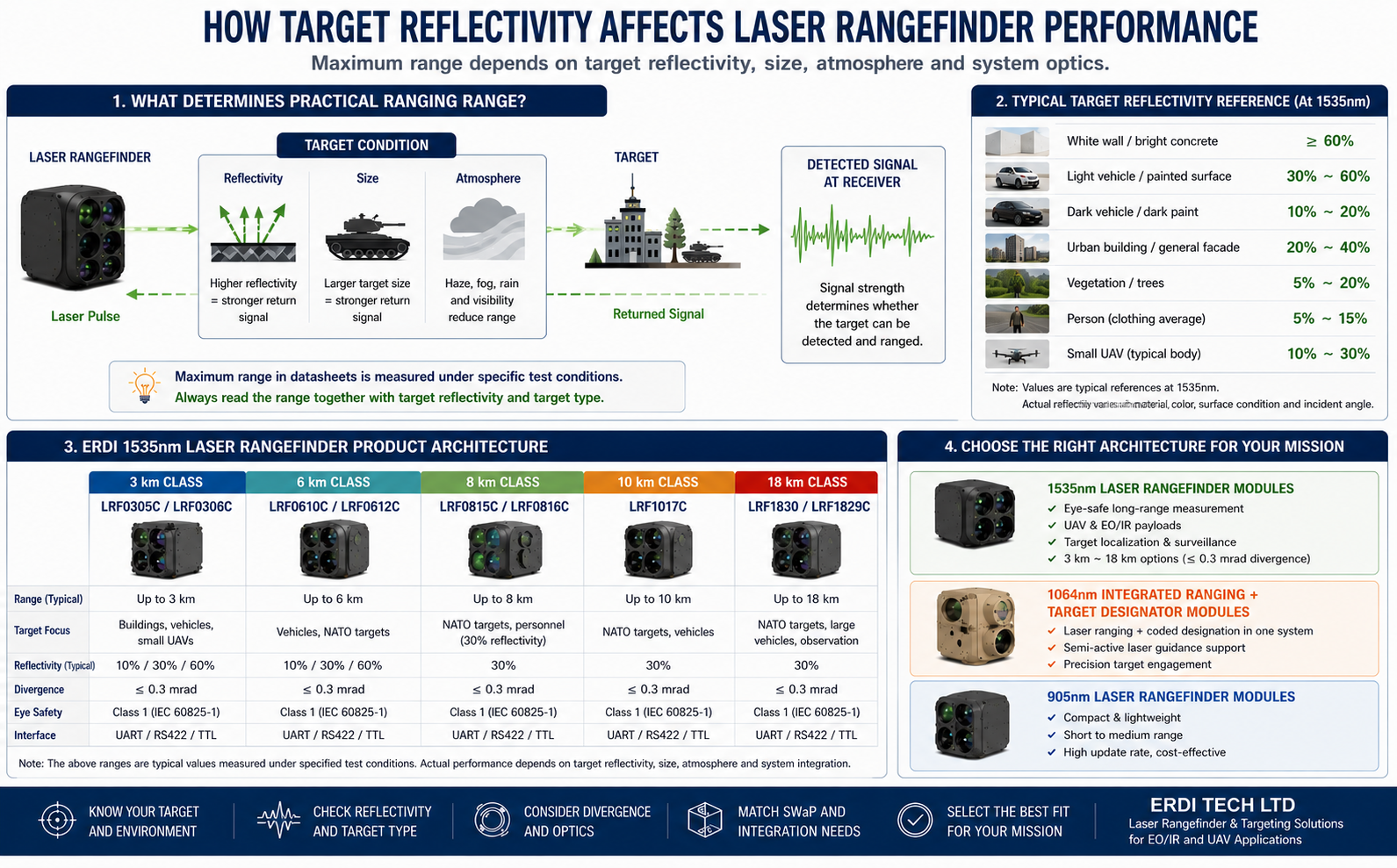
The first thing to understand is that laser range is not a single fixed number. A rangefinder receives only a small portion of the transmitted laser energy after it has traveled to the target and returned to the receiver. Anything that reduces the returned signal can affect whether the system produces a reliable measurement. Several variables therefore matter at the same time.
Target Reflectivity
Target reflectivity is one of the most important factors when evaluating a quoted range. A large, bright building surface and a dark, low-reflectivity object do not present the same measurement conditions to the receiver. Even if both are physically located at the same distance, the amount of laser energy returned toward the rangefinder can be very different. This is why a meaningful range specification should always be considered together with its target condition.
Take the 1535nm ranging module of ERDI as an example. Each model has its ranging performance specified under defined target reflectivity and target conditions. For example, LRF0305C (10Hz) and LRF0306C (3Hz) use different measurement frequencies and provide ranging specifications under defined reflectivity and target-size conditions.
| Target condition | Reflectivity | Maximum specified range |
|---|---|---|
| Building target | 60% | Up to 4 km |
| 2.3 × 2.3 m target | 30% | Up to 3 km |
| 0.5 × 1.7 m target | 30% | Up to 1.5 km |
| 0.2 × 0.3 m target | 30% | Up to 800 m |
These conditions illustrate why a laser rangefinder's maximum range should always be interpreted together with target reflectivity and target size. These parameters can assist engineers in better selecting the appropriate ranging module and completing system integration. Other long-range models also provide parameters for specific target conditions such as NATO-standard targets and personnel targets.
The practical lesson is simple:
Never compare two rangefinder modules by maximum range alone without comparing the measurement conditions behind that number.
For OEM evaluation, the target condition behind a range specification is often more informative than the headline range itself. A 10 km specification measured against a relatively reflective target should not automatically be considered equivalent to a 10 km specification obtained under a lower-reflectivity condition.
Target Size and Target Type
The physical size and characteristics of the target also matter. A large structure presents a very different optical target from a small UAV. A vehicle, a NATO-type target, a person, and a building may all produce different return characteristics. This is one reason OEM engineers should provide the supplier with the intended target type during the selection process. “We need 10 km” is useful information, but “we need 10 km against a vehicle-sized target under defined visibility conditions” is much more useful.
Atmospheric Conditions
Fog, rain, dust, haze, and other atmospheric effects can reduce laser transmission and weaken the returned signal. The effect becomes increasingly important as measurement distance increases because the laser travels through the atmosphere twice: once toward the target and again on the return path.
Consequently, a module capable of measuring a target at a specified range under favorable conditions should not automatically be interpreted as guaranteeing the same performance in every environment.
ERDI's 1535nm Laser Rangefinder Module Range Classes
ERDI TECH's 1535nm laser rangefinder family covers models ranging from approximately 3 km to 18 km. Depending on the model, the specified ranging performance is defined for different target types, target sizes, and reflectivity conditions. OEM integrators can therefore select a module according to the required measurement distance and target scenario.
|
Range class |
Representative ERDI models |
Beam Divergence |
Typical Target / Condition |
|---|---|---|---|
|
Around 3 km |
0.6 mrad ~1 mrad |
NATO, human and UAV targets under 30% reflectivity conditions |
|
|
Around 4~6 km |
0.3 mrad ~ 0.6 mrad |
NATO, human targets under 30% reflectivity, max visibility 12km under 60% reflectivity |
|
|
Around 8 km |
0.3 mrad ~ 0.4 mrad |
Vehicle, NATO, human targets and UAV under 30% reflectivity, max visibility 12km under 60% reflectivity |
|
|
Around 10 km |
0.3 mrad |
NATO under 30% reflectivity, max visibility 12km under 60% reflectivity |
|
|
Around 12~15 km |
0.3 mrad |
Vehicle, NATO targets under 30% reflectivity, max visibility 18km under 60% reflectivity |
|
|
Up to 18 km |
0.3 mrad |
Vehicle(3m*3m) targets under specified reflectivity conditions, max visibility 18km under 30% reflectivity |
The specifications above are based on ERDI TECH's product test data and defined measurement conditions. Actual performance depends on the target, atmospheric conditions, platform stability, and integration environment.
Beam Divergence Becomes More Important as Range Increases
Beam divergence is another specification that deserves more attention than it usually receives.A narrower beam concentrates the transmitted energy into a smaller angular area. As distance increases, even a small angular divergence eventually produces a larger illuminated area. For example, a purely geometric approximation of 0.3 mrad corresponds to roughly 3 m of beam expansion over 10 km. This is only a simplified illustration—the actual beam profile and optical system are more complicated—but it demonstrates why divergence becomes increasingly relevant in long-range applications. This is particularly noticeable when the target is relatively small or when objects surrounding the target may produce unwanted returns.
Many of ERDI's 6–18 km 1535nm rangefinder models use approximately 0.3 mrad beam divergence, while other models in the family use different optical configurations according to their intended range and application. For an OEM engineer, divergence should therefore be evaluated together with:
target size + measurement distance + optical alignment + receiver performance.
It is not meaningful to say that a lower divergence is automatically better for every application. The correct value depends on the complete optical architecture.
Matching the Rangefinder to the Mission
Once the target and required range are defined, module selection becomes much more straightforward.
- For a compact UAV payload requiring several kilometers of measurement range, a smaller 1535nm module may provide the appropriate balance between range, weight, power, and optical performance.
- For longer-range vehicle or NATO-type targets, an OEM may instead need a 6 km, 8 km, 10 km, or longer-range configuration.
- For applications approaching the upper end of the range requirement, such as 18 km-class observation, optical divergence, target characteristics, atmospheric conditions, mechanical stability, and platform pointing accuracy become increasingly important.
This is also where the payload itself becomes part of the ranging system. A rangefinder mounted inside a stabilized EO/IR gimbal must remain mechanically aligned with the imaging channel. If the camera identifies the target but the laser axis is offset, the measured range may correspond to a different point from the one the operator intended to measure. For this reason, boresight stability is an integration requirement, not simply a mechanical detail.
Where 1064nm and 905nm Fit
Although 1535nm is the main focus of ERDI's long-range rangefinder portfolio, other laser architectures are useful for different system requirements.
1064nm Laser Rangefinder & Target Designator
For systems that require both distance measurement and laser target designation, an integrated 1064nm ranging and target designation solution can provide a different architecture. Instead of treating ranging and designation as completely independent payload functions, an integrated system can combine them within the same optical platform where the application requires both capabilities. This is particularly relevant to EO/IR systems designed for target observation, ranging, and laser designation.
For more background on the difference between these functions, see ERDI's related technical article on Laser Target Designator vs Laser Rangefinder.
Laser Rangefinder vs Laser Target Designator: Key Differences for EO/IR Payload Integration
STANAG 3733 Explained: A Practical Guide for Laser Designator Integrators
Laser Target Designator vs Laser Seeker: Understanding Their Roles in Precision Guidance Systems
905nm Laser Rangefinders
905nm remains useful where compact size, lower power consumption, shorter-to-medium measurement distances, or cost-sensitive integration are more important than the extended range typically associated with ERDI's 1535nm family. The right wavelength is therefore not determined by the wavelength alone. It is determined by the complete system requirement.
Related article
ERDI LASER® 905nm Laser Rangefinder Module Selection Guide for OEM Integration
What OEM Engineers Should Provide When Selecting a Module
A supplier can recommend a much more suitable rangefinder when the initial inquiry includes a few basic engineering parameters.
At minimum, it is useful to provide:
- Required measurement range
- Target type
- Approximate target size
- Expected target reflectivity, if known
- Required accuracy
- Measurement/update frequency
- Maximum allowable weight and dimensions
- Available power supply
- Communication interface
- Operating temperature
- Required optical divergence
- UAV, vehicle, fixed, or other platform type
If target reflectivity is not available, the target type and expected operating distance are still valuable starting points. For example, an OEM asking for “8 km rangefinder” may receive several possible solutions. An OEM specifying “8 km against vehicle/NATO-type targets, compact EO/IR gimbal, 0.3 mrad preferred divergence, RS-422 interface, and limited SWaP” has already defined a much more useful engineering problem. That difference can significantly shorten the product-selection process.
Looking for a Specific OEM Configuration?
If you are evaluating a 1535nm laser rangefinder for a UAV, stabilized EO/IR payload, vehicle-mounted system, or other optical platform, you do not need to have every specification finalized before contacting ERDI. Providing the following four items is a useful starting point:
target type + required range + target reflectivity if known + platform/SWaP constraints.
If available, you can also include your preferred interface, beam divergence, accuracy, update rate, and operating temperature.
Based on these requirements, ERDI TECH can help identify the most appropriate module within its 1535nm rangefinder family, or determine whether a 1064nm ranging/designation solution or 905nm rangefinder would be more suitable for the application.
Contact Form
Email: yeva@erditechs.comFrequently Asked Questions
Does target reflectivity affect laser rangefinder performance?
Yes. Reflectivity directly influences the amount of laser energy returned to the receiver. This is why range specifications should always be considered together with the stated target reflectivity and target type.
Why do ERDI's 1535nm modules have different range ratings?
The models are designed for different combinations of measurement distance, target conditions, optical configuration, and system requirements. A 3 km module and an 18 km module are not simply the same design with different output power.
What does 0.3 mrad beam divergence mean for a long-range rangefinder?
It describes the angular spread of the laser beam. At longer distances, a small angular divergence produces a larger illuminated area, making divergence particularly important when measuring relatively small or distant targets.
When should an OEM consider a 1064nm integrated ranging and designation solution?
When the payload needs both laser ranging and target designation functions, integrating the two capabilities into a common optical system can simplify the overall architecture and reduce the need for separate modules.
Why can't the maximum range of two laser rangefinders be compared directly?
Because the stated maximum range is normally associated with specific measurement conditions. Target reflectivity, target size, atmospheric visibility, receiver sensitivity, optical configuration, and measurement criteria can all affect the result.
For example, two modules may both be described as having a 10 km range, while being tested against different target reflectivities or target types. In that case, the two “10 km” figures do not necessarily represent equivalent real-world performance.
For OEM evaluation, comparing the complete test condition together with the range specification is much more meaningful than comparing the headline distance alone.
Conclusion: Select for the Mission, Not Just the Maximum Range
Choosing a laser rangefinder is ultimately less about finding the largest number on a datasheet and more about understanding the conditions behind that number. Target reflectivity, target type, measurement distance, beam divergence, atmospheric conditions, optical alignment, and platform integration all contribute to practical performance.
For long-range UAV and EO/IR applications, 1535nm Er:glass laser rangefinders offer a strong combination of long-range measurement capability, compact integration, and the potential to meet applicable laser safety requirements when the complete system is designed and classified accordingly. ERDI TECH's 1535nm family spans approximately 3 km to 18 km, with different models developed for different target and range requirements. Many of the 6–18 km models use approximately 0.3 mrad beam divergence, supporting the optical requirements of longer-range EO/IR payloads.
For applications requiring laser ranging together with target designation, ERDI also develops 1064nm integrated ranging and laser target designation solutions. For more compact or shorter-range applications, 905nm modules provide another option.
The best module is therefore not necessarily the one with the longest advertised range. It is the one whose range specification, target conditions, optical characteristics, SWaP, and interfaces match the system being built.
For OEM teams evaluating a new EO/IR payload, providing the intended target, required distance, and platform constraints is usually the best place to start. ERDI TECH LTD can help evaluate these requirements and identify a suitable laser rangefinder architecture for the application.