Introduction
When designing an electro-optical/infrared (EO/IR) payload, engineers often face a practical question: Should the system integrate a laser rangefinder, a laser target designator, or both? Although these two functions are frequently mentioned together, they solve fundamentally different engineering problems.
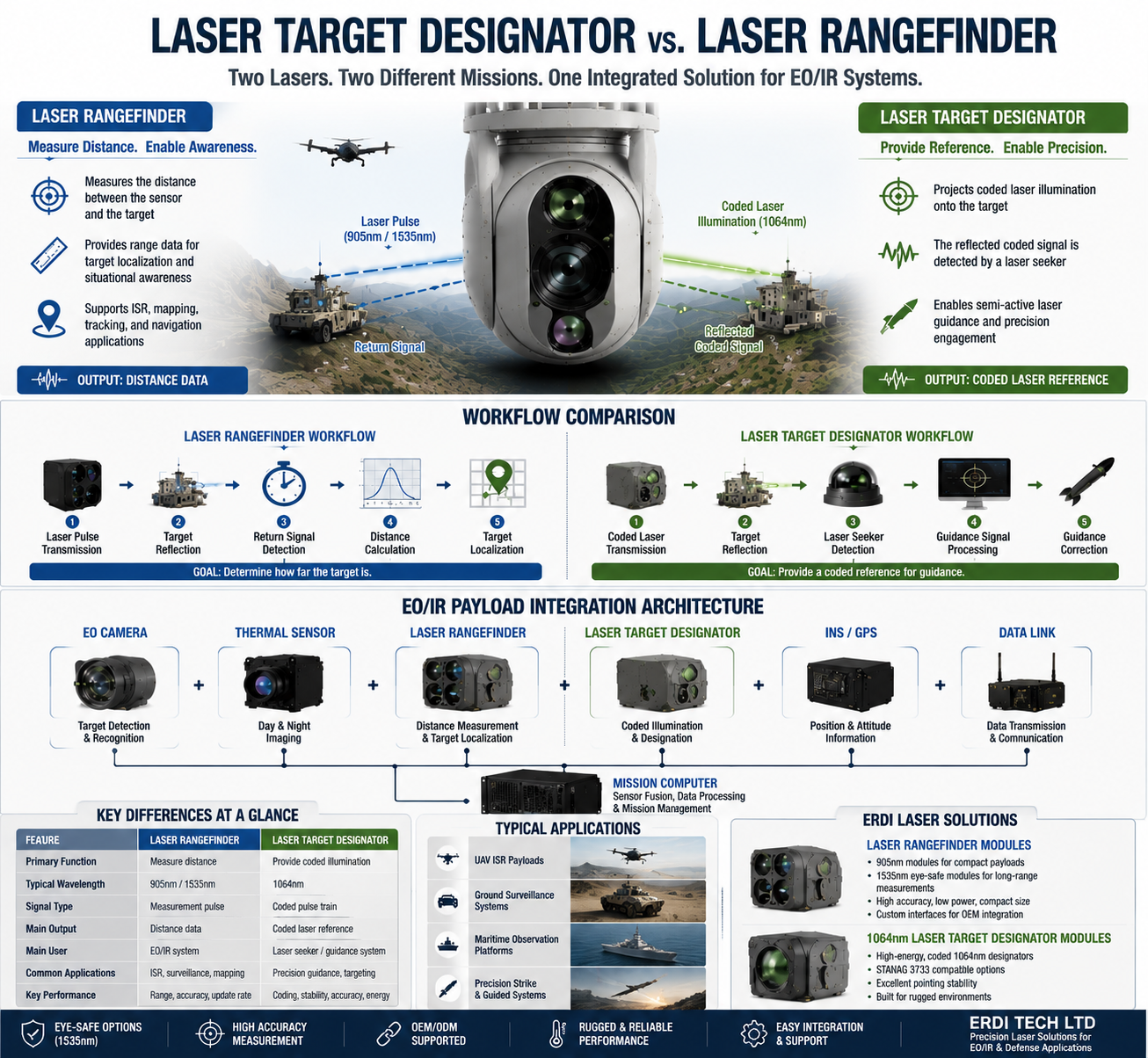
A laser rangefinder answers a measurement question:
“How far is the target?”
A laser target designator answers a guidance question:
“Which exact point should a compatible seeker track?”
The difference is not simply about laser wavelength or output power. It affects the entire system architecture, including optical alignment, signal processing, communication interfaces, and mission capability. In modern UAV payloads, vehicle-mounted observation systems, and stabilized EO/IR platforms, laser modules are no longer standalone components. They work together with visible cameras, thermal imagers, inertial navigation systems (INS), GPS, and onboard processing units to create a complete sensing and targeting workflow. From an engineering perspective, the confusion between laser rangefinding and laser designation usually comes from their similar form factor: both rely on short laser pulses, both require precise optical alignment, and both are commonly integrated into compact gimbals. However, their operational purposes are completely different.
A laser rangefinder function provides the missing distance dimension for an imaging system. Cameras can identify objects and determine their position within an image, but they cannot directly measure depth. By using time-of-flight (TOF) measurement, a rangefinder calculates target distance and allows the system to combine laser data with GPS, INS, and line-of-sight information to generate accurate target coordinates.
A laser target designator function, on the other hand, provides a coded laser reference that allows a compatible semi-active laser (SAL) seeker to recognize and track a designated target point. Its performance depends heavily on factors such as pulse coding, beam divergence, pointing stability, and compatibility with the guidance system.
As compact payload requirements evolve, integrating both functions into a single module has become a preferred technical path for advanced EO/IR platforms.
At ERDI TECH LTD, we work with developers of UAV payloads, EO/IR systems, and custom optoelectronic platforms that require compact and reliable laser integration. Through practical module development and OEM customization experience, we have seen that selecting the correct laser architecture at the beginning of a payload design can significantly influence system performance, integration complexity, and future scalability. In particular, our 1064nm laser target designator module combines both rangefinding and designation capabilities in one unit, making it an ideal choice for small-to-medium strike and reconnaissance payloads.
This article explains the engineering differences between laser rangefinding and laser target designation functions, how they operate within EO/IR architectures, and why advanced platforms often include both capabilities — either as separate modules or as a single integrated unit.
Quick Answer: Laser rangefinders measure target distance, while laser target designators provide coded laser references for compatible tracking systems. The two functions can be deployed as separate modules or combined into one integrated unit. ERDI TECH’s 1064nm laser target designator integrates both rangefinding and designation functions to support target localization and precision guidance in a single compact package.
Laser Rangefinder: Adding the Missing Distance Dimension to EO/IR Systems
A camera can show what a target is and where it appears in the image, but it cannot directly provide reliable distance information. For EO/IR payload developers, this limitation becomes critical when the system needs to generate accurate target coordinates, support autonomous decision-making, or maintain precise situational awareness.
A laser rangefinder module provides this missing distance dimension by measuring the time required for a laser pulse to travel to the target and return to the receiver. This time-of-flight (TOF) measurement allows the payload system to calculate target distance with high accuracy and combine it with other sensor data.
In a typical EO/IR architecture, the laser rangefinder works together with:
- Electro-optical and infrared cameras for target detection and identification
- GPS for geographic positioning
- INS for platform attitude measurement
- Gimbal angle information for line-of-sight calculation
Together, these inputs enable the system to convert an image-based observation into accurate three-dimensional target coordinates.
For UAV payloads, vehicle-mounted observation systems, and stabilized electro-optical platforms, the role of a laser rangefinder is not simply “measuring distance.” It is a key component that improves target localization capability and extends the operational value of the entire sensor system.
Selecting the Right Laser Rangefinder Module for Integration
For OEM engineers, maximum ranging distance is only one part of the selection process. A suitable laser rangefinder module must also match the payload’s size, power budget, communication architecture, and environmental requirements.
Key factors typically include:
- Measurement range and accuracy — Performance should be evaluated based on actual target conditions, including reflectivity and visibility, rather than only maximum advertised range.
- Update rate — Higher measurement frequency can improve tracking performance for dynamic targets but may increase power and processing requirements.
- Communication interface — UART, TTL, RS-422, CAN, and Ethernet options should align with the host payload architecture.
- Size, weight, and power (SWaP) — Especially important for small and medium UAV platforms.
The choice of laser wavelength is also an important design consideration.
905nm laser rangefinder modules are widely used in compact applications because of their mature semiconductor technology, small form factor, and cost advantages.
For longer-range EO/IR applications, 1535nm eye-safe laser rangefinder modules are increasingly adopted because they offer excellent eye-safety characteristics and allow engineers to achieve higher ranging performance while meeting laser safety requirements.
At ERDI TECH LTD, we develop both 905nm and 1535nm laser rangefinder modules for OEM integration into UAV payloads, EO/IR systems, and custom optoelectronic platforms. Our engineering focus is not only on laser performance, but also on practical integration requirements such as mechanical compatibility, communication interfaces, and system-level reliability.
Laser Target Designator: Coded Laser Reference with Integrated Ranging Capability
Unlike a dedicated rangefinder module, a laser target designator system’s primary function is to project a precisely controlled, coded laser signal onto a target point so that a compatible receiving system can recognize and track the reflected laser energy. In a semi-active laser (SAL) guidance architecture, the external designator provides the laser illumination, while the seeker on the guided platform detects the reflected signal and uses it to maintain tracking. The designator therefore acts as a reference source within the overall optical guidance chain.
A typical operational workflow can be described as: Detect → Identify → Range & Localize → Designate → Reflect → Seeker Acquisition → Guidance
In real mission scenarios, rangefinding and designation operate sequentially: ranging first confirms target distance and generates precise coordinates, before designation begins to guide the weapon. Because the two functions are highly complementary, integrating them into a single module delivers significant engineering benefits.
Because the system depends on accurate recognition of the reflected laser signal, a laser target designator must achieve more than simply generating high optical power. The quality and stability of the laser output directly influence system reliability.
Key Engineering Factors for Laser Target Designator Integration
For OEM developers integrating a laser target designator into an EO/IR payload, several technical factors require careful evaluation.
- Pulse Coding Compatibility
The laser signal is typically modulated using a specific pulse coding pattern. This allows the receiving system to distinguish the intended laser signal from background optical noise or other laser sources. Coding compatibility — for example, compliance with STANAG 3733 standards — is therefore one of the first considerations when selecting a designator module.
- Beam Divergence and Pointing Accuracy
A designator must maintain the laser spot at the intended location over the operating distance. Beam divergence affects spot size at range, while optical alignment and mechanical stability determine whether the laser remains accurately boresighted with the imaging sensor. In stabilized payloads, even small angular deviations can create significant pointing errors at long distances.
-
Wavelength Selection and System Compatibility
1064nm laser technology remains widely used in laser designation applications because of its mature technology ecosystem, established optical components, and compatibility with many existing laser guidance architectures. The wavelength choice is not only a laser source decision — it is closely related to the requirements of the receiving seeker or detection system.
1064nm Integrated Rangefinder & Designator Module: A Streamlined EO/IR Integration Solution
In traditional architectures, rangefinding and designation require two separate modules, which adds extra mechanical design work, dual boresight alignment procedures, and additional data synchronization effort — all while occupying more payload space.
- Factory-prealigned boresight: The ranging and designation optical paths are precision-aligned during manufacturing, so customers do not need to perform line-of-sight calibration after integration, greatly reducing assembly complexity and alignment error risk.
- Superior SWaP optimization: Shared optical and electronic circuitry results in significantly smaller size, lower weight and lower total power consumption than two separate modules, making it ideal for small-to-medium UCAVs and compact EO/IR gimbals.
- Simplified system integration: A single communication interface handles both ranging data output and designation control, reducing internal wiring and system synchronization development work.
- Enhanced stability and reliability: A unified thermal and mechanical structure delivers better optical stability under vibration and temperature variation than discrete dual-module solutions.
For OEM customers, the ideal designation solution depends not only on laser output specifications, but also on how effectively the module integrates with the complete payload architecture. The integrated module reduces integration barriers and shortens development cycles at the system level.
Laser Rangefinder vs Laser Target Designator: Key Technical Differences
Although both functions emit laser pulses, they serve completely different purposes inside an EO/IR system. The simplest way to understand the difference is:
- A laser rangefinder measures distance between the platform and the target.
- A laser target designator provides a coded laser reference that allows a compatible system to identify and track a designated point.
For OEM engineers, choosing between them depends on the intended system function: measurement and localization, or laser designation and guidance support. The two functions can also be combined into a single integrated module.
|
Feature |
Dedicated Laser Rangefinder Module |
ERDI 1064nm Integrated Rangefinder & Designator Module |
|---|---|---|
|
Primary Function |
Measure target distance |
Coded laser illumination + target distance measurement (2-in-1) |
|
Main Purpose |
Target localization and situational awareness |
Precision laser designation + target ranging & localization |
|
Output |
Distance measurement data |
Distance measurement data + coded optical reference signal |
|
Working Principle |
Time-of-flight measurement |
Pulse-coded laser reflection + time-of-flight ranging |
|
Common Wavelengths |
905nm, 1535nm |
1064nm |
|
Key Performance Factors |
Range, accuracy, update rate, power consumption |
Coding scheme, pulse energy, divergence, pointing stability, ranging accuracy |
|
Typical Integration |
UAV payloads, EO/IR observation systems |
Strike-reconnaissance UAVs, compact EO/IR systems with laser guidance capability |
The important engineering point is that these two functions solve different problems and cannot replace one another, but they can be implemented in a single integrated module.
A laser rangefinder improves the system’s understanding of the target by adding accurate distance information.
A laser target designator improves the system’s ability to provide a precise optical reference for another compatible component.
An integrated module delivers both capabilities in a more compact, integration-friendly form factor.
Why Modern EO/IR Payloads Include Both Laser Capabilities
Advanced EO/IR payloads are increasingly designed as complete sensor systems rather than collections of independent devices. In many applications, the operational workflow requires multiple functions:
- Detection and identification: Visible and infrared cameras locate and classify objects.
- Range measurement and localization: A laser rangefinder provides distance data, allowing the system to calculate accurate target coordinates.
- Laser designation when required: A laser target designator provides a coded reference for compatible external systems.
- Data fusion and system coordination: GPS, INS, and onboard processing combine all sensor information into a unified operational picture.
Boresight Alignment: All optical channels in an EO/IR payload must maintain accurate alignment. The camera, thermal sensor, rangefinder, and designator must share a consistent line of sight. Even small alignment errors can result in significant position deviation at extended distances.
Mechanical Stability: UAV and vehicle-mounted systems experience vibration, shock, temperature variation and continuous movement. The payload structure must maintain optical alignment under changing operating conditions. Discrete modules carry a higher risk of relative displacement.
Data Synchronization: Accurate target localization depends on the timing relationship between image capture, laser measurement, INS data and GPS information. Poor synchronization can reduce coordinate accuracy even when individual sensors perform correctly, and more modules mean higher synchronization complexity.
SWaP Optimization: For small and medium UAV platforms, size, weight, and power consumption remain major design constraints. Two separate laser modules consume valuable payload resources.
Integrated Module: An Optimized Solution
To address the limitations of discrete architectures, integrated rangefinder-designator modules offer a more efficient approach. By combining both optical paths in a single mechanical package with factory-calibrated boresight and internal timing synchronization, they preserve full functionality while significantly reducing customer mechanical design, alignment and synchronization effort — and delivering a much smaller footprint.
- Dedicated ranging solutions: 905nm and 1535nm laser rangefinder modules for pure reconnaissance and observation payloads
- Integrated solution: 1064nm combined rangefinder & designator module for compact payloads requiring guidance capability
Our engineering approach focuses on balancing optical performance, integration requirements, and system-level reliability.
OEM Considerations When Selecting Laser Modules for EO/IR Integration
For OEM developers, selecting a laser module is not only about choosing the longest ranging distance or the highest laser output. The right solution depends on how well the module fits the complete payload architecture. Before selecting a laser solution, engineers typically evaluate several system-level factors.
For Dedicated Laser Rangefinder Modules
- Measurement Performance: The required range should be considered together with real operating conditions, including target reflectivity, atmospheric visibility, optical system design and required measurement accuracy. A module’s maximum range specification is only one reference point; actual mission performance depends on the complete optical system.
- Interface and Integration: Communication compatibility is essential for efficient payload development. Common interfaces include UART, TTL, RS-422, CAN and Ethernet. Clear communication protocols and integration documentation can significantly reduce development time.
- Size, Weight and Power Requirements: For UAV and compact EO/IR payloads, SWaP constraints directly affect system design. A compact laser rangefinder module allows engineers to add accurate ranging capability without significantly increasing payload size or power consumption.
For Laser Target Designator Modules
Evaluation priorities are different. Engineers usually focus on pulse coding compatibility, laser output stability, beam divergence, optical alignment accuracy and long-term mechanical stability. If using a discrete dual-module approach, engineers must also evaluate mechanical fit, boresight alignment feasibility and data synchronization between the two units.
For payloads with limited space that require both ranging and designation capability, the 1064nm integrated rangefinder-designator module is generally the preferred choice, as factory alignment and internal synchronization greatly reduce system integration effort and shorten development cycles.
At ERDI TECH LTD, we develop compact 905nm and 1535nm dedicated laser rangefinder modules as well as 1064nm integrated rangefinder-designator modules for OEM applications. Our support covers not only laser specifications, but also practical integration requirements such as communication interfaces, mechanical dimensions, and customization needs. For system developers, early communication during the design stage can help identify the most suitable laser architecture before major payload decisions are finalized.
Frequently Asked Questions
Can a laser rangefinder replace a laser target designator?
No. A laser rangefinder and a laser target designator perform different functions. A laser rangefinder measures target distance through time-of-flight measurement, while a laser target designator provides a coded laser reference for compatible tracking systems. They are complementary technologies rather than replacements for each other, though they can be combined into a single integrated module.
Why do EO/IR payloads need a laser rangefinder?
EO/IR cameras provide visual information but cannot directly measure target distance. A laser rangefinder adds accurate range data, allowing the system to combine distance, sensor angle, GPS, and INS information to calculate more precise target coordinates.
Why are 1535nm laser rangefinder modules widely used for long-range applications?
1535nm laser rangefinder modules are popular for long-range applications because they offer favourable eye-safety characteristics and support higher ranging performance while meeting laser safety requirements. This makes them suitable for applications such as UAV payloads, long-range observation systems, and compact EO/IR platforms.
Why are 1064nm lasers commonly used in laser target designators?
1064nm technology benefits from a mature laser ecosystem, established optical components, and broad compatibility with many existing laser designation systems. The 1064nm wavelength is also well suited for combined ranging and designation functionality in an integrated module. The final wavelength selection depends on the requirements of the complete guidance and detection architecture.
Is there a single module that combines both rangefinder and designator functions?
Yes. ERDI TECH LTD’s 1064nm laser target designator uses an integrated architecture that delivers both laser rangefinding and coded laser designation in one unit. With factory precision boresight alignment, it greatly reduces payload integration complexity, making it especially suitable for space-constrained small-to-medium EO/IR platforms and strike-reconnaissance UAVs.
Can a single EO/IR payload integrate both a laser rangefinder and a laser target designator?
Conclusion: Choosing the Right Laser Technology for EO/IR Systems
Laser rangefinding and laser target designation are often discussed together because both use laser technology, but their roles inside an EO/IR system are fundamentally different.
A laser target designator provides a controlled coded laser reference, extending the capability of an optical platform when external laser recognition is required.
ERDI TECH LTD provides compact laser solutions for OEM integration, including 905nm and 1535nm dedicated laser rangefinder modules, and 1064nm integrated laser rangefinder & target designator modules. By combining optical performance with integration-focused engineering support, ERDI helps system developers build reliable laser-enabled EO/IR platforms.
Related Articles
The Role of Laser Rangefinders in ISR and ISTAR Target Acquisition
Exploring 1064nm Solid-State Laser Target Designator
Laser Target Designator vs Laser Seeker: Understanding Their Roles in Precision Guidance Systems
STANAG 3733 Explained: A Practical Guide for Laser Designator Integrators
Engineering Team | ERDI TECH LTD
ERDI TECH engineers specialize in compact laser modules for EO/IR payload integration, including dedicated laser rangefinders and 1064nm integrated rangefinder-designator modules for UAV and customized optoelectronic systems.
📧 Email: yeva@erditechs.com
📱 WhatsApp: +86 18123396539