
Introduction
ERDI 905nm Series Product Quick Selection Table
| Requirement | Recommended Series |
|---|---|
| Lowest cost | A |
| Most universal OEM | D |
| Lightest 2000m | E |
| Ultra-short range 0.1m | SPD |
| Single-photon detection | SPD |
| Attitude + ranging | SPD1200S2G |
| Above 50Hz | VB/H |
| 10kHz ultra-high frequency | H |
| Centimeter-level accuracy | VB/H |
| UAV gimbals | E/SPD1200S2G |
| Thermal weapon sights | A/E |
| Robot navigation | SPD |
| Industrial automation | VB/H |
In the 21st century, laser rangefinder modules have become indispensable core sensing components in modern electro-optical systems, UAV gimbals, thermal imaging devices, intelligent surveillance platforms, robotics, and industrial automation equipment. Among various laser ranging technologies, 905nm laser rangefinder modules have become the preferred solution across industries due to their superior balance of performance, size, power consumption, integration flexibility, and cost-effectiveness.
- UAV gimbals
- Thermal imaging devices
- Night vision systems
- Border surveillance systems
- Robotics
- Surveying equipment
- Industrial automation platforms
This article will help you find the most suitable laser rangefinder module for your project in just a few minutes.
I. Core Technical Advantages of 905nm Laser Rangefinder Modules
1. Full Range Coverage (0.1 m – 2000 m)
- Standard compact embedded modules (A/B/C/D/E): 4 m – 2000 m
- High-frequency laser rangefinder modules: 0.05 m – 1500 m
- SPD single-photon modules: Minimum ranging as low as 0.1 m, covering 0.1 m – 1200 m
2. Lightweight and Highly Integrated Design
- Weight range: approximately 1 g – 23 g
- Multiple structural forms: cylindrical / square / packaged design
- Support for embedded installation and electro-optical system integration
3. Low Power Consumption Design
- Average power consumption: approximately 0.45 W – 1.8 W
- Standby power consumption as low as milliwatt level
- Support for low-voltage (3.3V–5V) power supply
4. High Refresh Rate and Dynamic Measurement Capability
- Standard compact embedded modules
- A Series: 1–3 Hz (stable static measurement)
- B/C/D/E Series: 2–10 Hz adaptive (general industrial applications, maximum customizable 30Hz)
- High-frequency laser rangefinder modules: 50Hz~10kHz (dynamic radar measurement)
- SPD single-photon modules: 2~20Hz adaptive (single-photon level high-sensitivity ranging and spatial perception capability)
5. High Reliability and Stable Ranging Performance
- Ranging success rate ≥ 98%, false alarm rate ≤ 1% for stable and reliable data output
- High-frequency H Series supports 100 kLux super strong ambient light immunity
- MTBF ≥ 1500 hours, average mean time between failures exceeding 62 days
- Passed 1000g/ms shock test and 2.5g vibration test
- Operating temperature: -20°C to +60°C (some models can be extended to -40°C)
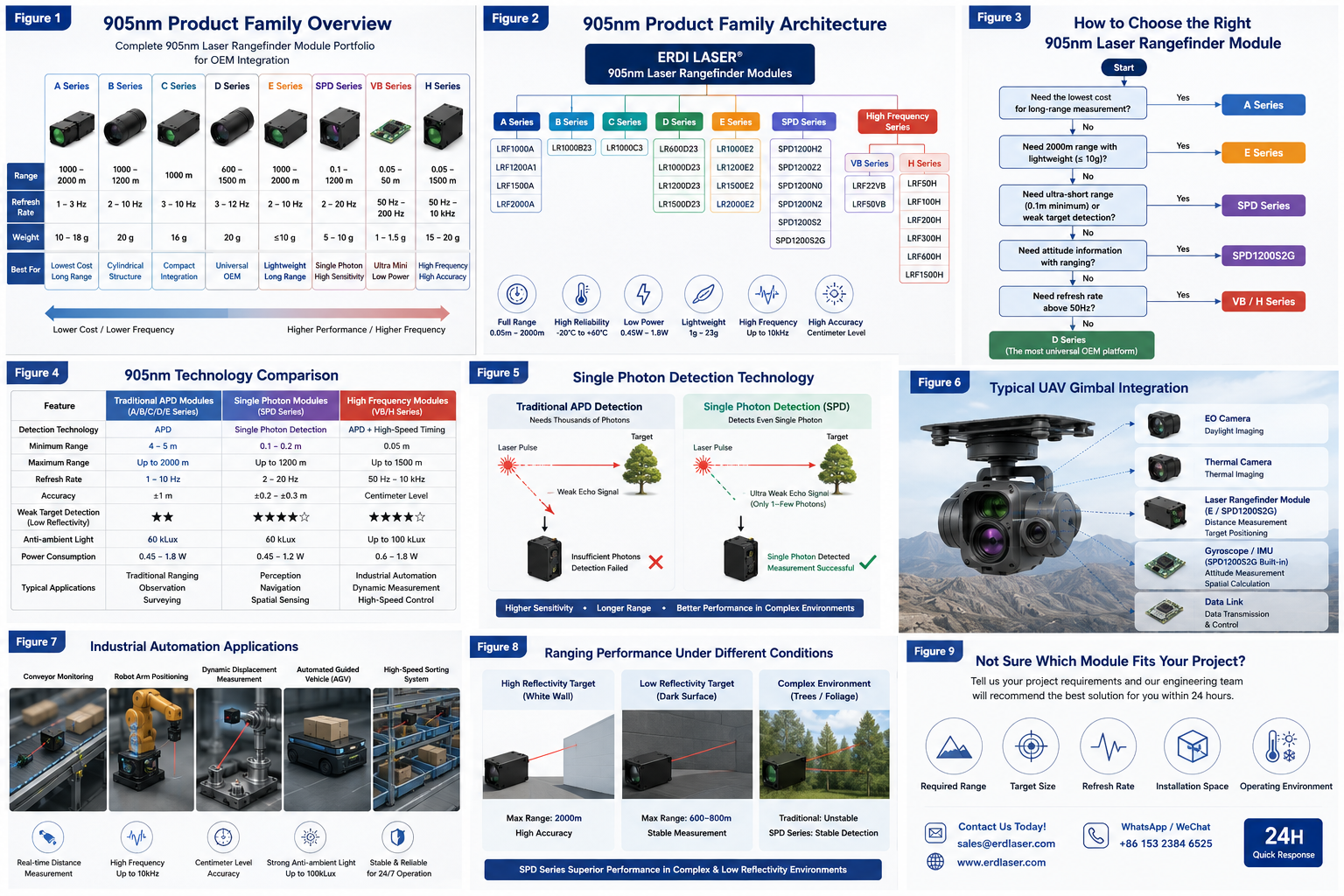
II. ERDI LASER® 905nm Product Family Overview
ERDI 905nm Product Family
|
Product Series |
Typical Ranging Range |
Standard Refresh Rate |
Core Technical Features |
|---|---|---|---|
|
A Series |
1000-2000m |
1-3Hz |
Mature and stable, lowest cost |
|
B Series |
1000-1200m |
2-10Hz |
Cylindrical structure, industrial-grade reliability |
|
C Series |
1000m |
3-10Hz |
Rectangular compact, easy to integrate |
|
600-1500m |
3-12Hz |
Universal OEM platform, widest coverage |
|
|
1000-2000m |
2-10Hz |
Ultra-lightweight long range, ≤10g |
|
|
0.1-1200m |
2-20Hz |
Single-photon detection, ultra-high sensitivity |
|
|
High-Frequency VB/H Series |
0.05-1500m |
50Hz-10kHz |
Ultra-high refresh rate, centimeter-level accuracy |
A Series
B Series
C Series
D Series
E Series
SPD Series
High-Frequency Series
- H
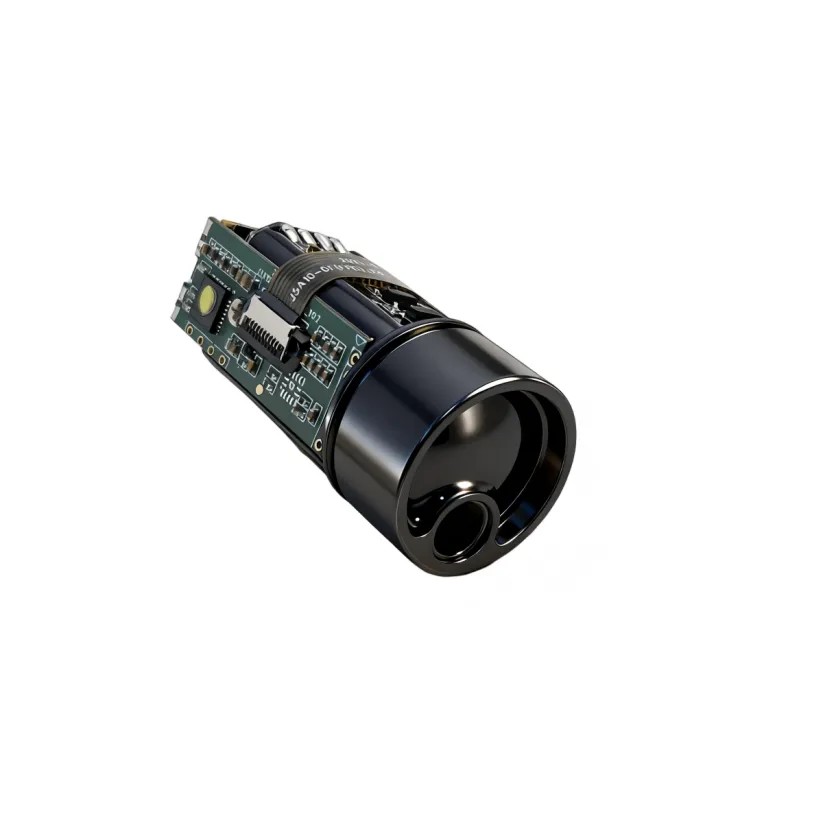
A Series – Mature and Stable Classic OEM Ranging Solution
.jpg?w=823&h=823)
.jpg?w=823&h=823)
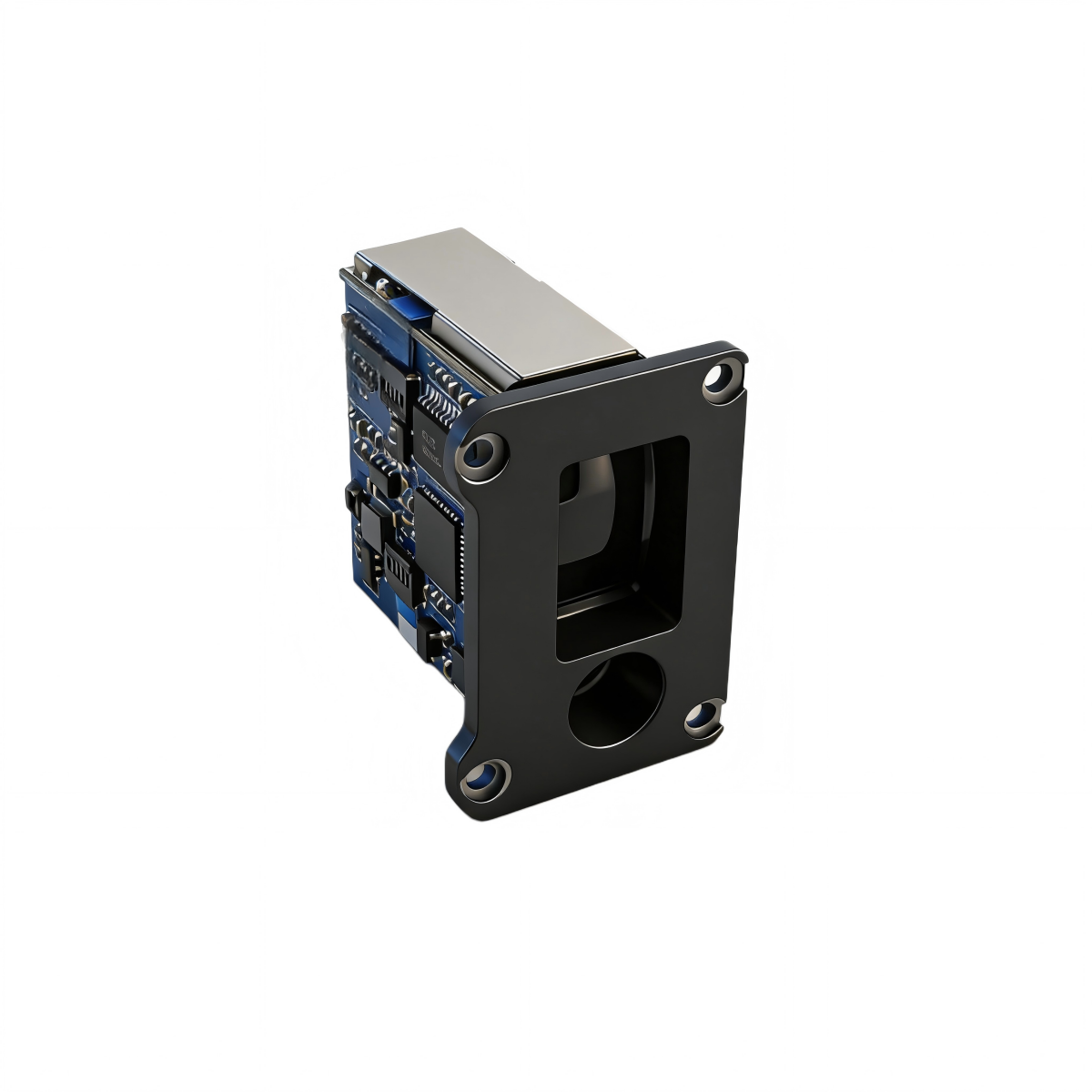
B/C Series – 1000m Industrial Application Modules with Different Structural Designs
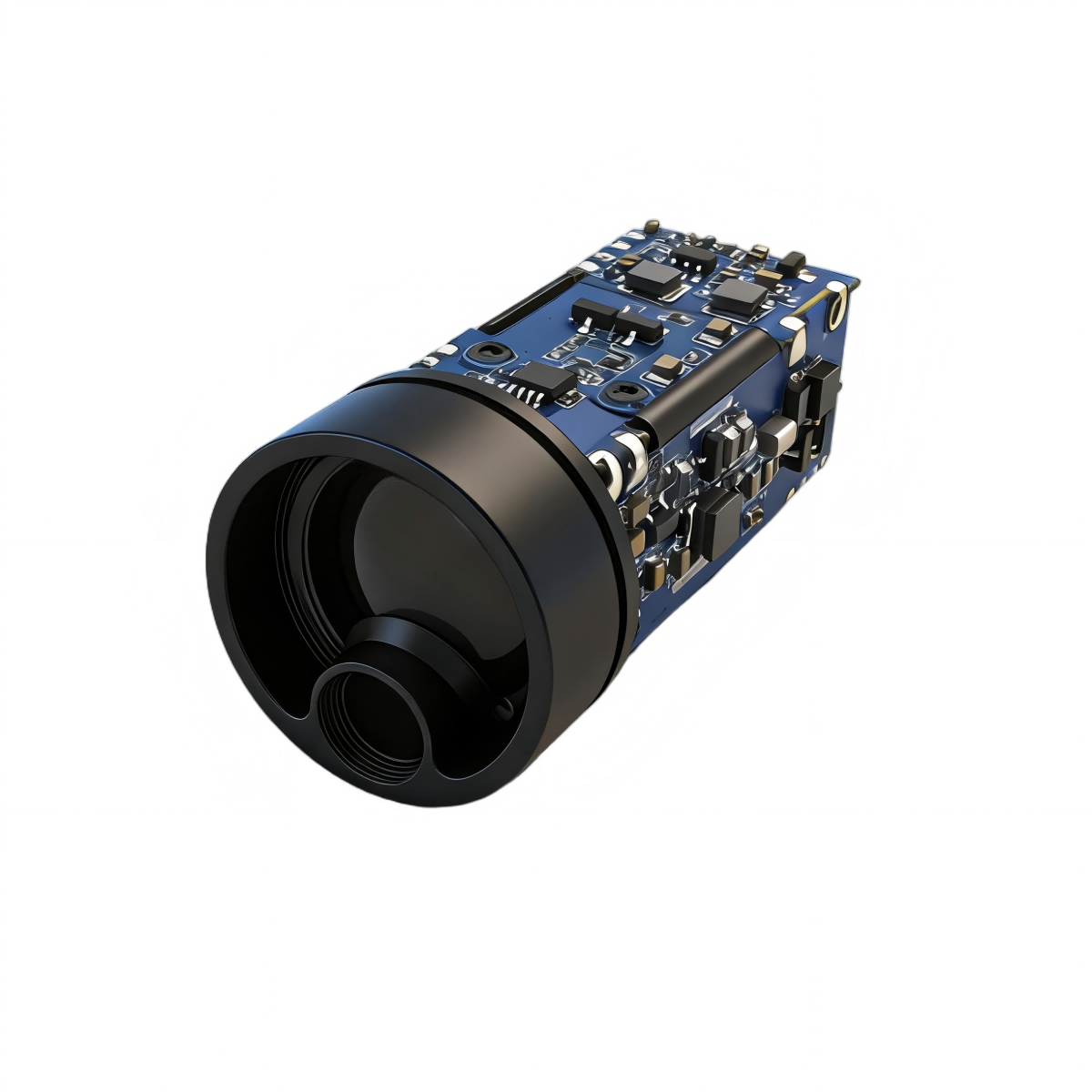
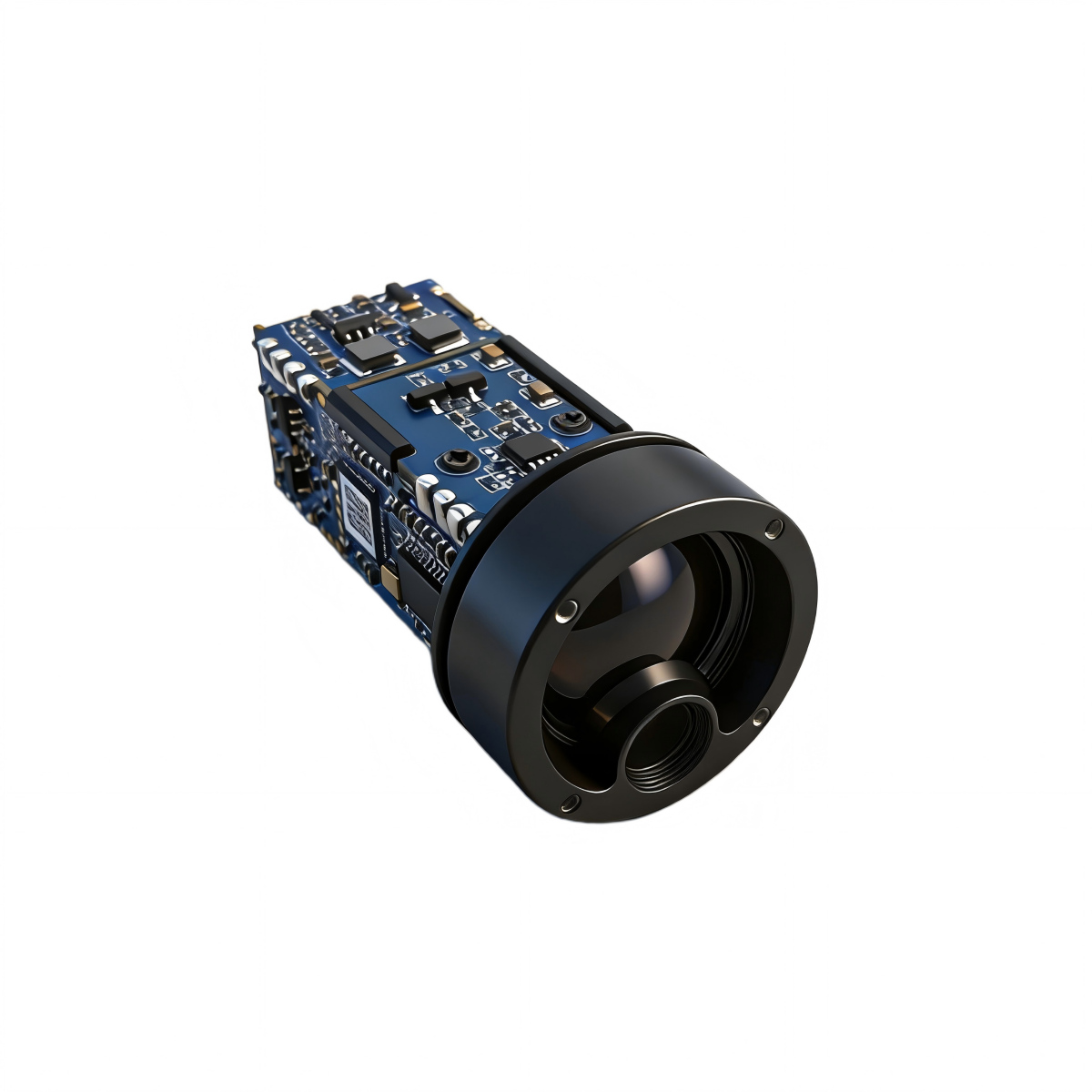
D Series – 600m~1500m Cylindrical Structure OEM Modules
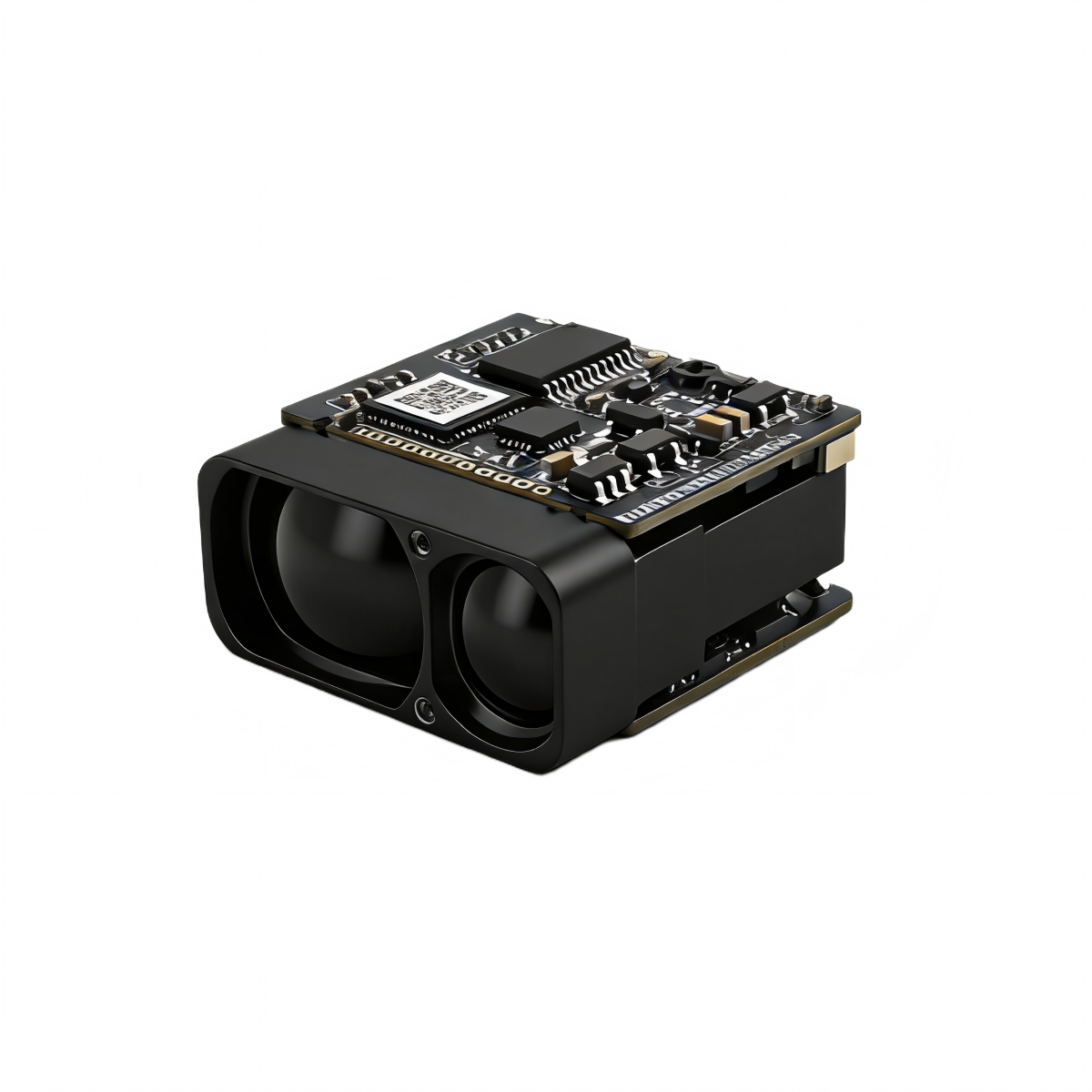
E Series – 1000m~2000m Rectangular High-Performance Miniaturized Modules
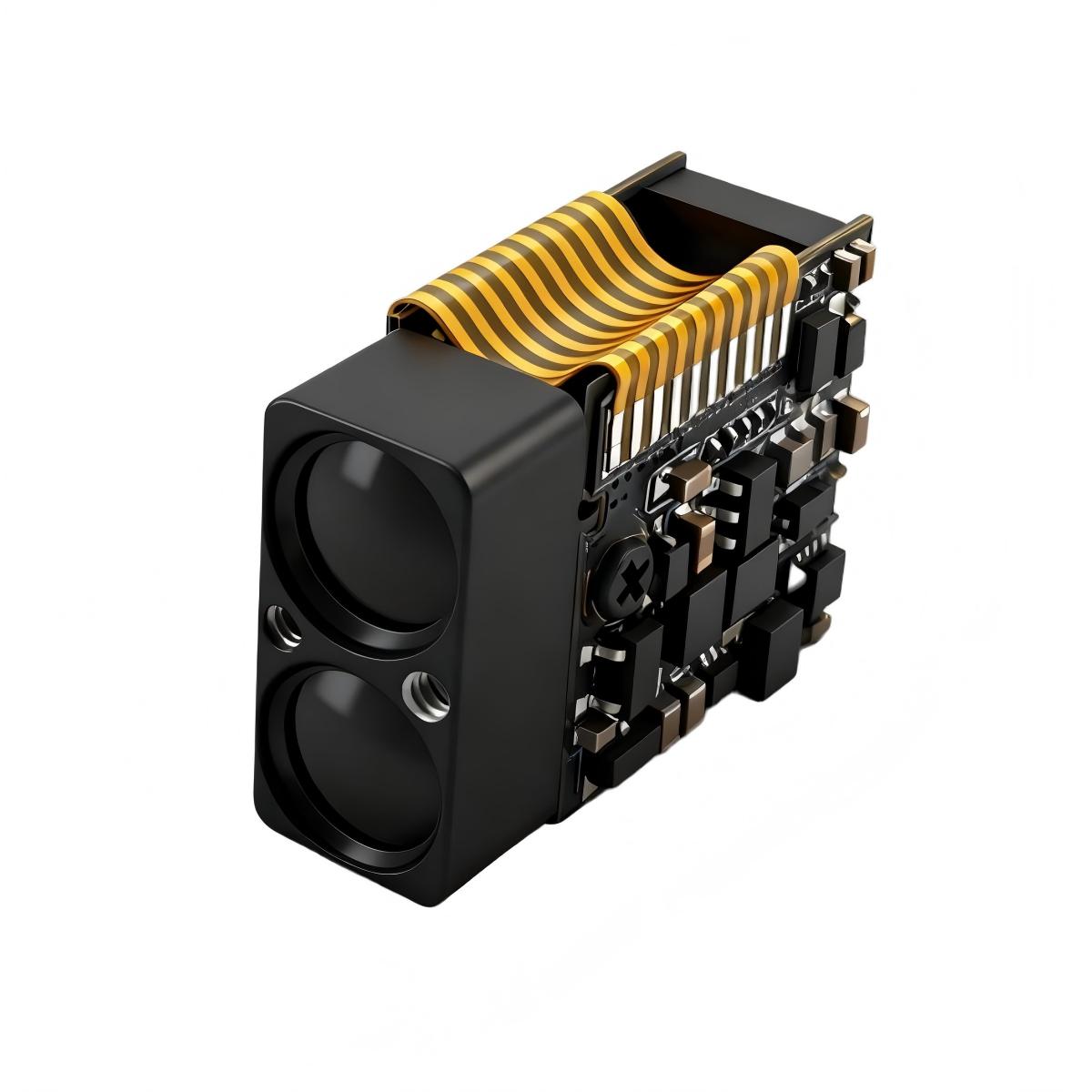
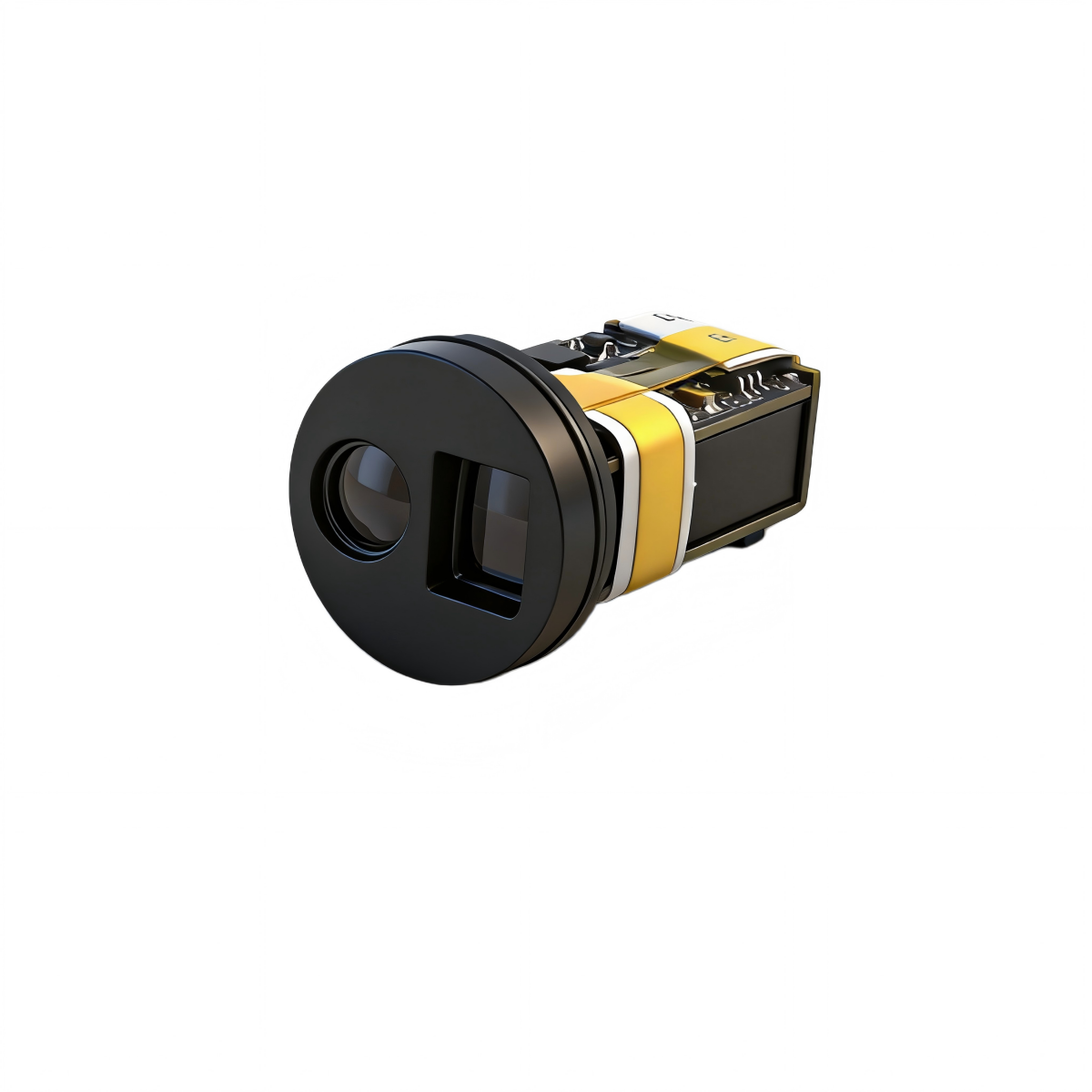
SPD Series – Single-Photon Technology Opens a New Generation of 905nm Ranging Platform
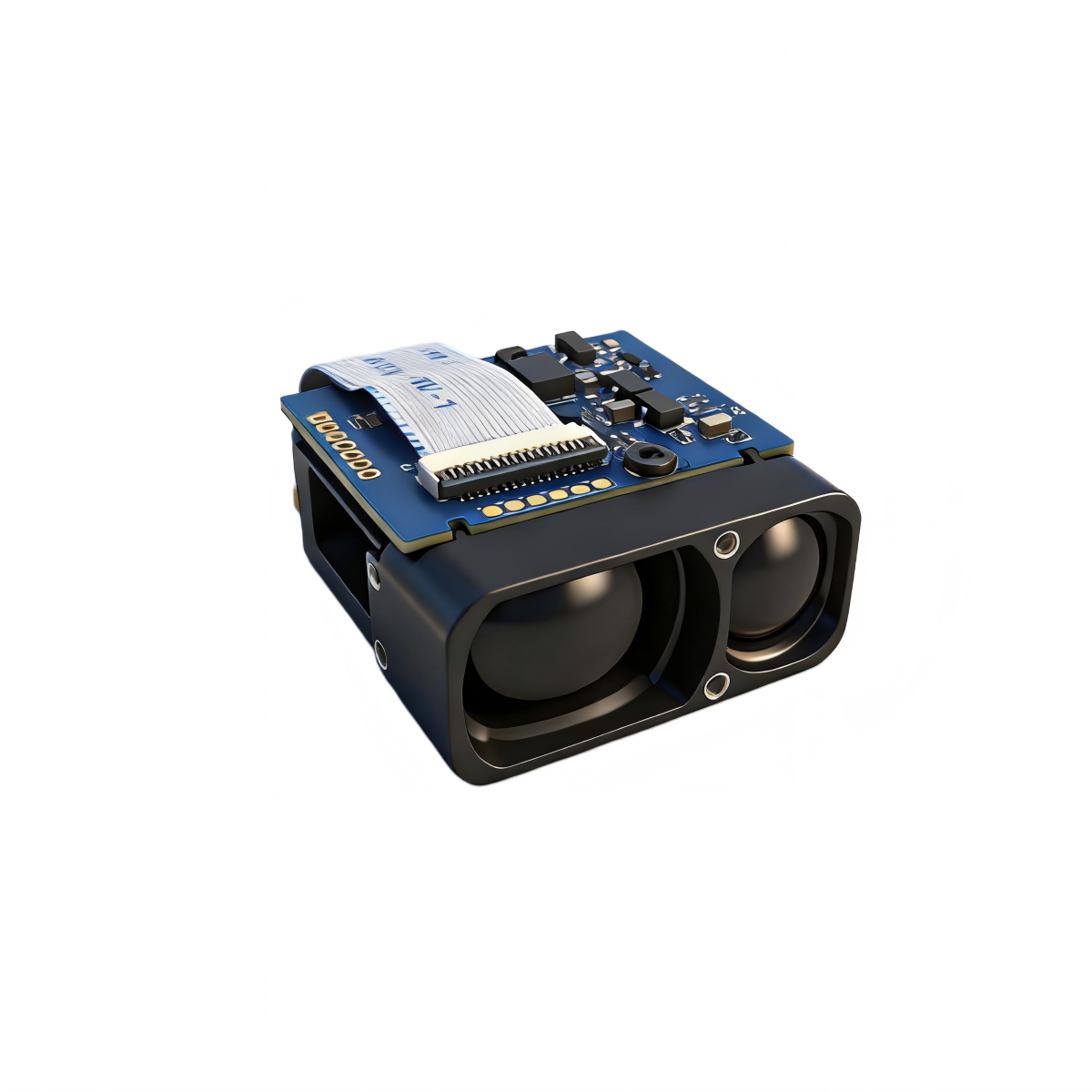
For a long time, the vast majority of 905nm laser ranging modules have adopted Avalanche Photodiode (APD) reception technology, a solution that has become highly mature through long-term practical application. However, with the development of emerging applications such as intelligent sensing and spatial positioning, traditional APD reception solutions are facing new challenges.
(1) Single-Photon Level Detection Capability (Single-Photon Sensitive Architecture)
(2) Short-Range Ranging Capability (Starting from 0.1 m)
(3) High-Precision Spatial Measurement Capability
From an industry development perspective, laser ranging technology is gradually evolving from a "distance measurement tool" to a "spatial perception sensor," and single-photon detection technology is a critical foundation driving this transformation. For this reason, the SPD series is more than just a high-performance 905nm laser ranging module—it represents the development direction of future intelligent perception platforms.
| Model Number | Core Differentiator | Ranging Range | Core Accuracy | Weight | Form Factor | Unique Key Feature | Typical Application |
|---|---|---|---|---|---|---|---|
| SPD1200H2 | Entry-level ultra-light high-precision model | 0.2m – 1200m (Max 1500m at night) | ±0.3m @ ≤100m | ≤6g | Cylindrical | 2Hz – 15Hz adaptive ranging frequency, low power consumption | UAV, industrial OEM integration |
| SPD1200Z2 | High-frequency high-precision model | 0.2m – 1200m (Max 1500m at night) | ±0.2m @ ≤200m | ≈6g | Rectangular | 2Hz – 20Hz adaptive frequency, optional baud rate | High-speed UAV, AGV, fast-moving robot |
| SPD1200N0 | Small divergence angle ultra-light sealed model | 0.2m – 1200m (Max 1500m at night) | ±0.3m @ ≤100m | ≈5g | Cylindrical with sealing groove | <4.5mrad ultra-narrow laser beam, dual-gear adaptive frequency | Outdoor surveillance, EO payload, harsh environment |
| SPD1200N2 | Small divergence angle PMMA lens compact model | 0.2m – 1200m (Max 1500m at night) | ±0.3m @ ≤100m | ≈5g | Rectangular | <4.5mrad narrow beam, PMMA optical lens, wide temperature stability | Compact space integration, industrial IoT, miniaturized devices |
| SPD1200S2 | Super close-range high-precision industrial model | 0.1m – 1200m (Max 1400m) | ±0.2m @ ≤400m | ≈10g | Square | 0.1m ultra-short minimum ranging distance, 2Hz – 20Hz adaptive frequency | Close-range precision measurement, robotics, industrial automation |
| SPD1200S2G | Gyroscope-equipped EO payload dedicated model | 0.1m – 1200m (Max 1400m) | ±0.2m @ ≤400m | ≈10g | Square | Built-in gyroscope, Euler angle measurement, spatial two-point distance solving | EO payload, photoelectric pod, dynamic ranging system |
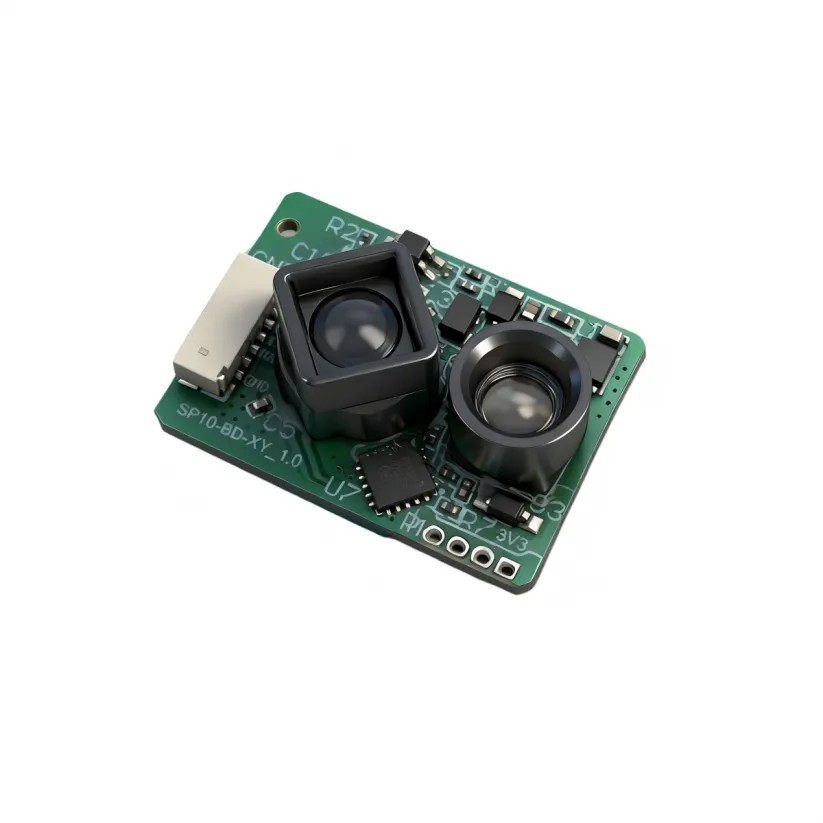
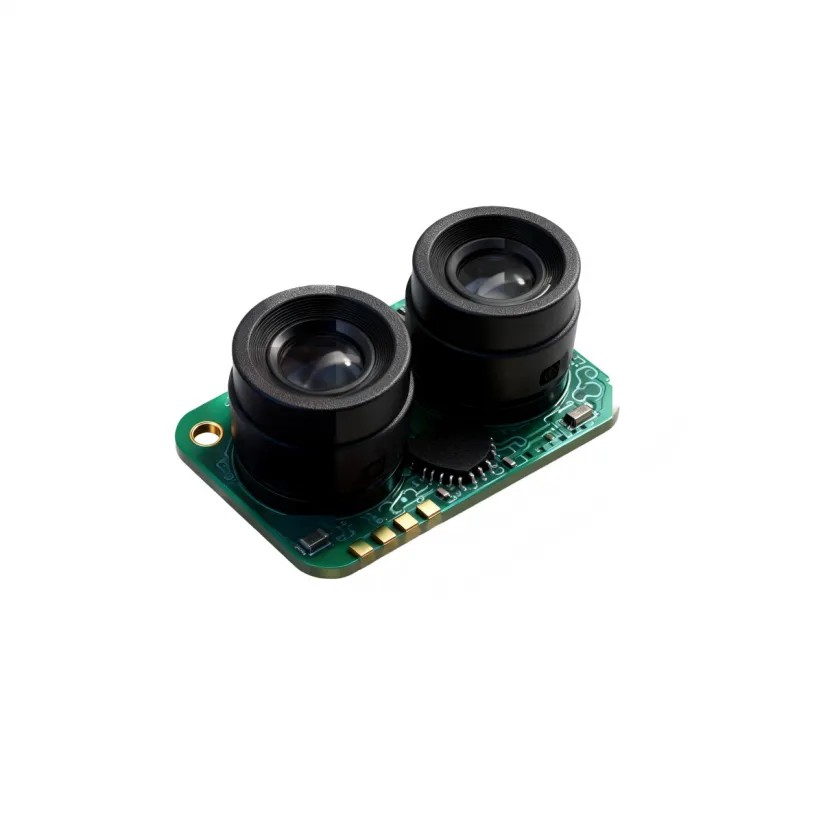
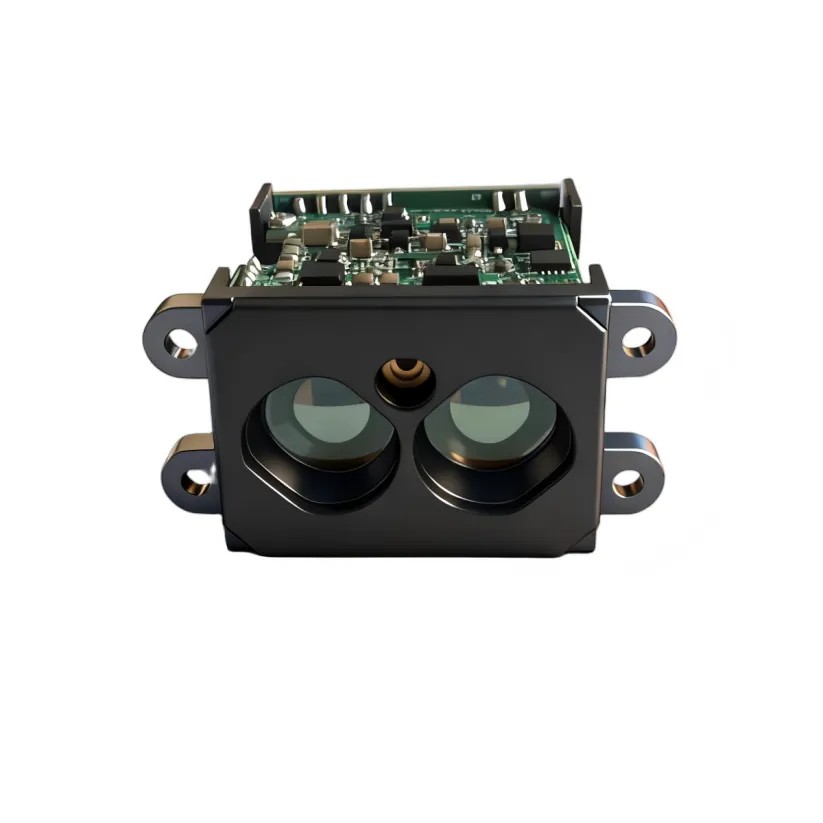
High-Frequency Laser Rangefinder Modules – High-Speed Dynamic Measurement, Centimeter-Level Precision Perception
.jpg?w=713&h=713)
The high-frequency 905nm laser rangefinder module is a new generation of industrial-grade product line created specifically for high-speed dynamic measurement and centimeter-level precision perception. It covers the full range from 0.05m to 1500m, with a maximum ranging frequency of up to 10kHz, making it one of the series with the widest frequency coverage and highest accuracy among similar products on the market.
-
50Hz~10kHz ultra-high frequency coverage
-
0.05m ultra-short minimum ranging, centimeter-level high accuracy
-
100KLux super strong ambient light immunity for all-weather stable operation
-
UART/IIC communication interface, compatible with various systems
-
1g to 1.5g lightweight design with industrial-grade shock and vibration resistance
VB Series
|
Wavelength |
905nm |
905nm |
|
Module |
||
|
Measuring Range |
0.05m~20m (90%reflectivity) 0.05m~10m (10%reflectivity) |
0.05m~50m (90%reflectivity) 0.05m~20m (10%reflectivity) |
|
Frequency |
200Hz (Alternative100/50/20/10/1Hz) |
100Hz |
|
Accuracy |
±5cm (<5m ) 1% (≥5m) |
±5cm (<5m ) 1% (≥5m) |
|
Ambient Light Immunity |
||
|
Supply Voltage |
3 ~ 3.6VDC |
3.3~5VDC |
|
Communication Interface |
UART/IIC |
UART/IIC |
|
Dimension |
21x 15 x 7.43 mm |
18.7 x 11.8 x 13.3mm |
|
Weight |
1.5g |
1.3g |
|
Operating Temperature |
-20℃ ~ +60℃ |
-20℃ ~ +60℃ |
H Series
| Wavelength |
905nm |
905nm |
905nm |
905nm |
905nm |
905nm |
|
Module |
||||||
|
Measuring Range |
0.05m~50m (90%reflectivity) 0.05m~15m (10%reflectivity) |
0.05m~100m (90%reflectivity) 0.05m~30m (10%reflectivity) |
0.05m~200m (90%reflectivity) 0.05m~70m (10%reflectivity) |
0.05m~300m (90%reflectivity) 0.05m~100m (10%reflectivity) |
0.05m~600m (90%reflectivity) 0.05m~200m (10%reflectivity) |
0.05m~1500m (90%reflectivity) 0.05m~300m (10%reflectivity) |
|
Frequency |
20Hz~10KHz (Default: 1KHz) |
20Hz~10KHz (Default: 1KHz) |
20Hz~10KHz (Default: 1KHz) |
1KHz or 50Hz (Switch automatically to match the intensity of reflected signals) |
1KHz or 50Hz (Switch automatically to match the intensity of reflected signals) |
1KHz or 50Hz (Switch automatically to match the intensity of reflected signals) |
|
Accuracy |
±5cm(<10m) , 1%(≥10m)(2σ) |
±10cm (<10m), 1% (≥10m) |
±10cm (<10m), 1% (≥10m) |
±10cm (<10m), 1% (≥10m) |
±10cm (<10m), 1% (≥10m) |
±10cm (<10m), 1% (≥10m) |
|
Ambient Light Immunity |
100KLux |
100KLux |
100KLux |
100KLux |
100KLux |
|
|
Supply Voltage |
9~36VDC |
9 ~ 36VDC |
9 ~ 36VDC |
9 ~ 36VDC |
9 ~ 36VDC |
9 ~ 36VDC |
|
Communication Interface |
UART |
UART/IIC |
UART/IIC |
UART/IIC |
UART/IIC |
UART/IIC |
|
Dimension |
38 x 20 x 30 mm |
33 x 34 x 18 mm |
33 x 34 x 18 mm |
33 x 34 x 18 mm |
33 x 34 x 18 mm |
33 x 34 x 18 mm |
|
Weight |
15±2g |
20±2g |
20±2g |
20±2g |
20±2g |
20±2g |
|
Operating Temperature |
-20℃~+60℃ (No condensation,indicator red light automatically turns off when under -20℃) |
-20℃ ~ +60℃ |
-20℃ ~ +60℃ |
-20℃ ~ +60℃ |
-20℃ ~ +60℃ |
-20℃ ~ +60℃ |
III. How to Select
Ranging Distance Selection (It is recommended to maintain a certain margin based on the required ranging range)
|
Requirement |
Recommended Model |
|---|---|
|
20m |
LRF22VB |
|
50m |
LRF50VB/LRF50H |
|
100m |
LRF100H |
|
200m |
LRF200H |
|
300m |
LRF300H |
|
600m |
LRF600H/LR600D23 |
|
1000m |
LRF1000A/LR1000B23/LR1000C3/LR1000D23 |
|
1200m |
LRF1200A1/LR1200D23/LR1200E2/SPD Series |
|
1500m |
LRF1500A/LR1500D23/LR1500E2 |
|
2000m |
LRF2000A/LR2000E2 |
Accuracy Selection
Centimeter-Level Accuracy (±5cm~±10cm)
Only choice: High-Frequency VB/H Series
- VB Series: ±5cm (<5m) + 1% (≥5m)
- H Series: ±5cm~±10cm (<10m) + 1% (≥10m)
Sub-Meter Level Accuracy (±0.2m~±0.3m)
First choice: SPD Single-Photon Series
- SPD1200H2/N0/N2/S2: ±0.3m (@≤100m)
- SPD1200Z2/S2G: ±0.2m (@≤200m/400m)
Meter-Level Accuracy (±1m)
First choice: Classic A/B/C/D/E Series
- All series have ±1m level accuracy, with some models supporting segmented accuracy
Frequency Selection
- Low frequency (1~3Hz): A Series, covering 1000m~2000m ranging
- Medium frequency (2~20Hz): B/C/D/E/SPD Series, covering 600m~2000m ranging
- High frequency (50Hz~10KHz): High-Frequency LRFVB/H Series, covering 10m~1500m ranging
Size and Weight Selection
(<2g) Choice: High-Frequency VB Series, 10~50m short-distance measurement
- LRF10VB: 1g, 12×7.5×9.1mm
- LRF22VB: 1.5g, 21×15×7.43mm
- LRF50VB: 1.3g, 18.7×11.8×13.3mm
(2g~10g) First choice: SPD Single-Photon Series, 1200m ranging capability, OEM module with both size and performance
- SPD1200N0 (cylindrical)/N2 (square): ≈5g
- SPD1200H2 (cylindrical)/Z2 (rectangular): ≤6g
- SPD1200S2/S2G (square): ≈10g
(10g~20g) First choice: High-Frequency H Series, maximum 10KHz high-frequency ranging, 100KLux environmental adaptability
- LRF50H: 15±2g
- LRF100H~LRF1500H: 20±2g
Second choice: Classic B/C/D Series
- B Series: Cylindrical 1000m ranging module, 20g
- C Series: Square 1000m ranging module, 16g
- D Series: Cylindrical 600m~1500m ranging module, 20g
Application Scenario Selection
-
Classic A Series: Lowest cost mature long-range solution, designed for static mass OEM
-
Classic B/C Series: 1000m standard industrial models, providing both cylindrical and rectangular structure options
-
Classic D Series: Universal OEM benchmark, balancing performance and cost, covering most standard industrial needs
-
Classic E Series: The only series focusing on ≤10g ultra-light + 2000m long range, designed for mid-to-high-end lightweight long-distance equipment
-
SPD Single-Photon Series: The only series focusing on single-photon high sensitivity + 0.1m short range + sub-meter level accuracy, designed for high-end perception in complex environments
-
High-Frequency VB Series: The only series focusing on 1g level ultra-lightweight + 0.05m ultra-short range, designed for micro battery-powered devices
-
High-Frequency H Series: The only series focusing on 10kHz ultra-high frequency + centimeter-level accuracy + 100KLux anti-glare, designed for high-speed industrial dynamic scenarios
Recommended Models for UAV Gimbals (EO/IR Gimbal)
For systems requiring target positioning and spatial coordinate calculation, the SPD1200S2G is currently the only ranging + attitude integrated module on the market that can be made within 10g, weighing less than half of a separate rangefinder plus gyroscope combination; the LR1500D23 is more suitable for large industrial UAVs, with a more robust structure and more suitable for OEM integration solutions.
Recommended Models for Thermal Weapon Sights and Night Vision Observation Equipment
Recommended Models for Handheld Laser Rangefinders
Recommended Models for Robot Navigation, UAV Obstacle Avoidance and Intelligent Perception
Recommended Models for High-Speed Industrial Measurement and Dynamic Control Systems
- High-Frequency VB/H Series
IV. Conclusion
- Target distance
- Target size
- Installation space
- Update frequency requirement
- Working environment
Contact Form
Email: yeva@erditechs.comFrequently Asked Questions (FAQ)
What is a 905nm laser rangefinder module?
A 905nm laser rangefinder module is a compact distance measurement sensor that uses a 905nm pulsed laser and Direct Time-of-Flight (DToF) technology to calculate the distance between the sensor and a target. Due to its excellent balance of performance, size, power consumption, and cost, 905nm technology has become the most widely adopted laser ranging solution for UAVs, thermal imaging systems, robotics, industrial automation equipment, and electro-optical platforms.
What is the maximum range of a 905nm laser rangefinder module?
The maximum ranging distance depends on the module design, target reflectivity, and environmental conditions. ERDI's 905nm laser rangefinder portfolio covers applications from ultra-short-range sensing at 0.05m to long-range measurement up to 2000m. Models such as the LRF2000A and LR2000E2 are designed for long-distance electro-optical observation and surveillance systems.
Which 905nm laser rangefinder module is best for UAV gimbals?
For most UAV EO/IR gimbal applications, the LR1500E2 and LR2000E2 are recommended because they combine long-range performance with an ultra-lightweight design of approximately 10g. For advanced target location systems requiring distance and attitude information simultaneously, the SPD1200S2G offers integrated laser ranging and gyroscope functions within a single compact module.
What is the difference between APD and Single Photon Detection (SPD)?
Traditional laser rangefinder modules typically use Avalanche Photodiode (APD) receivers, which provide reliable performance for standard ranging tasks. Single Photon Detection (SPD) technology is significantly more sensitive and can detect extremely weak return signals. This allows SPD modules to perform better in low-reflectivity environments, cluttered backgrounds, forests, urban areas, and other challenging scenarios where conventional APD-based systems may struggle.
Which laser rangefinder module supports ultra-short-distance measurement?
For applications requiring measurement below one meter, the SPD Series is the preferred solution. Models such as SPD1200S2 and SPD1200S2G can measure distances starting from 0.1m, making them suitable for robotics, obstacle avoidance, autonomous navigation, intelligent sensing, and precision industrial positioning systems.
Which ERDI laser rangefinder module provides the highest measurement frequency?
The High-Frequency H Series offers the highest measurement frequency in the ERDI product portfolio. Depending on the model, ranging frequencies can reach up to 10kHz, equivalent to 10,000 distance measurements per second. This makes the H Series particularly suitable for dynamic motion tracking, industrial automation, vibration monitoring, high-speed sorting systems, and real-time control applications.
Which laser rangefinder module provides centimeter-level accuracy?
The VB Series and H Series are designed for applications requiring centimeter-level ranging accuracy. Typical accuracy reaches ±5cm to ±10cm at short distances, making these modules ideal for industrial measurement, automated equipment, robotics, and precision positioning systems where rapid and accurate distance feedback is essential.
Which laser rangefinder module is best for robot navigation and obstacle avoidance?
For autonomous mobile robots (AMRs), AGVs, UAV obstacle avoidance systems, and intelligent perception platforms, the SPD Series is generally the preferred choice. Its 0.1m minimum ranging capability, high sensitivity, and strong performance in low-reflectivity environments enable reliable operation in complex indoor and outdoor scenarios.
Which laser rangefinder module supports attitude measurement and target location?
The SPD1200S2G is ERDI's dedicated ranging and attitude measurement solution. In addition to distance measurement, it integrates a gyroscope capable of providing Euler angle information, allowing the system to calculate target coordinates and spatial positioning data. This makes it highly suitable for EO/IR payloads, surveillance towers, observation systems, and target location platforms.
Can ERDI provide OEM and ODM customization?
Yes. ERDI LASER® provides comprehensive OEM and ODM services for system integrators and equipment manufacturers. Customization options include ranging distance, communication interface, mechanical structure, optical configuration, firmware protocols, environmental specifications, and platform integration support. Engineering teams can also provide application-specific recommendations based on target size, operating environment, installation space, and update frequency requirements.
How do I choose the right laser rangefinder module for my project?
The selection process should consider several factors simultaneously, including required ranging distance, target size, installation space, refresh rate, accuracy requirements, and operating environment. In general, A Series focuses on cost-effective long-range measurement, D Series serves as a universal OEM solution, E Series prioritizes lightweight long-range integration, SPD Series targets advanced perception applications, and VB/H Series focuses on high-speed dynamic measurement and industrial automation.