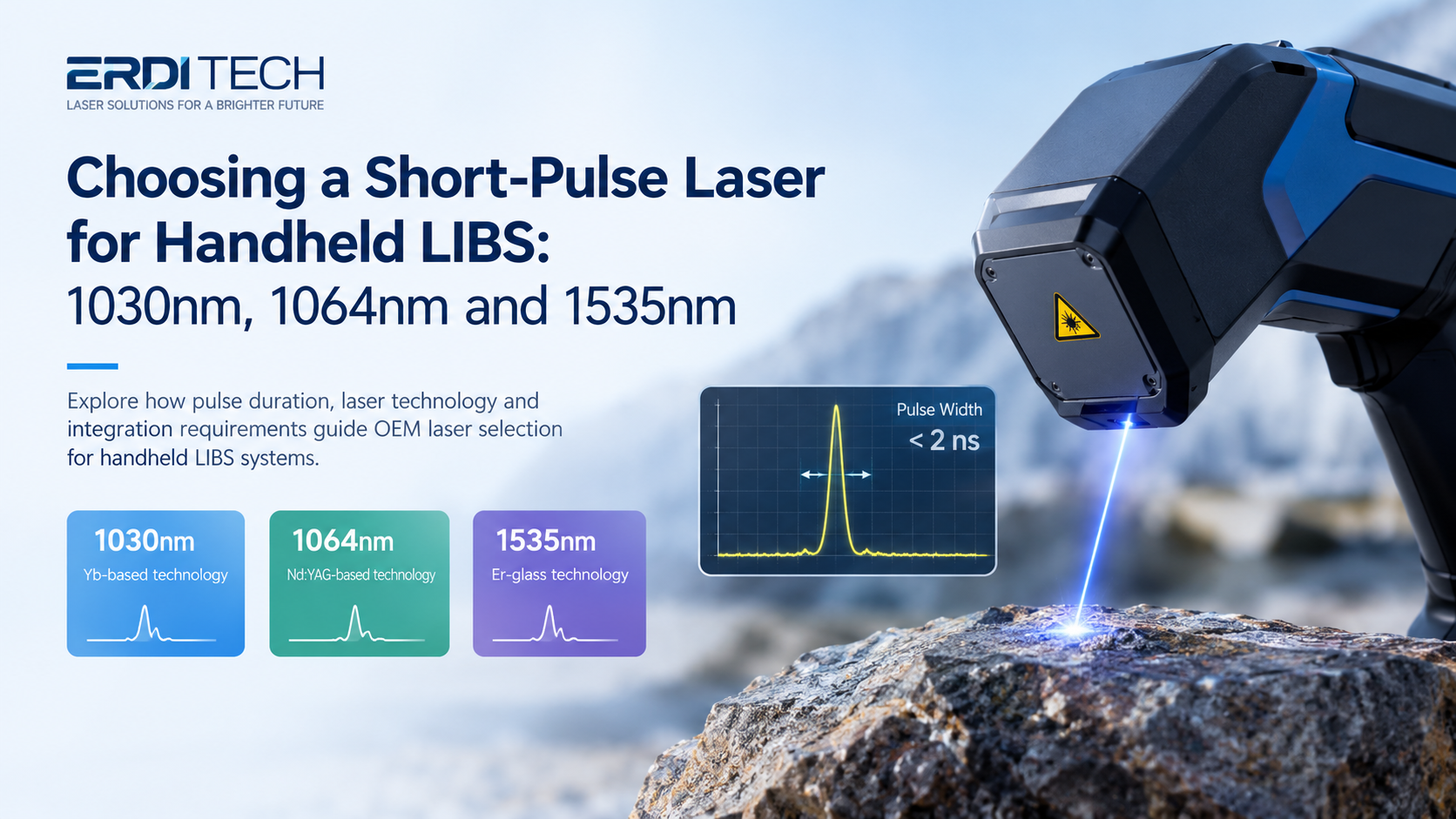
Selecting a laser source for a handheld laser-induced breakdown spectroscopy (LIBS) system requires more than choosing a wavelength. Pulse duration, pulse energy, beam characteristics, and integration requirements all influence the suitability of a laser for the final instrument.
When 1030nm, 1064nm, and 1535nm are all potential options, the selection process should start with the application's mandatory performance requirements. This article explains how to evaluate these wavelengths and why short-pulse capability can be an important factor in choosing a laser source for handheld LIBS development.
Why Laser Requirements Matter in Handheld LIBS
Handheld LIBS systems use focused laser pulses to ablate a small amount of material and generate plasma. The emitted light is then analyzed to identify the material's elemental composition.
In a portable analyzer, the laser must provide suitable pulse performance while fitting the instrument's mechanical, electrical, and optical design. The most appropriate source is therefore not necessarily the one with the highest pulse energy or the shortest pulse duration, but one that meets the application's requirements and can be integrated into the complete system.
1030nm, 1064nm and 1535nm: How to Choose a Wavelength
The three wavelengths represent different laser-source options, but wavelength alone does not determine whether a laser is suitable for LIBS. The actual pulse specifications, laser architecture, and application results must also be considered.
1030nm: An Option for Short-Pulse Laser Systems
Lasers around 1030nm are commonly associated with ytterbium-based laser technologies. Depending on the design, these systems can support short-pulse operation and different combinations of pulse energy and repetition rate.
For handheld LIBS development, the key consideration is whether a specific 1030nm laser can meet the required pulse duration, energy, and operating frequency within the available system budget and space.
1064nm: Evaluating Short-Pulse Performance
The 1064nm wavelength is widely used in solid-state laser systems, including Nd technologies. It is an established option for laser applications that require carefully specified pulse characteristics.
For projects requiring a pulse width below 2ns, the important question is whether the selected laser configuration can achieve that target while meeting the other performance and integration requirements.
ERDI has developed a 1064nm laser solution with a pulse width below 2ns. This makes it a candidate for LIBS projects with demanding short-pulse requirements. Its suitability for a particular instrument should be evaluated against the required pulse energy, repetition rate, beam characteristics, and system design.
1535nm: Evaluate the Specific Laser Configuration
ERDI's 1535nm erbium-glass laser portfolio includes compact pulsed sources used in laser ranging and other optical systems. However, a laser designed for ranging should not automatically be assumed to meet the pulse requirements of a LIBS application.
For example, ERDI's published ER900 specification lists a pulse energy of 900μJ and a pulse duration of 7ns. This specific configuration does not meet a requirement for a pulse width below 2ns.
This does not establish a universal limitation for every possible 1535nm laser design. It illustrates why engineers should compare the actual specifications of available laser configurations rather than selecting a source based on wavelength alone.
The practical selection principle is straightforward: first identify which laser configurations meet the application's mandatory pulse requirements, then compare their energy, repetition rate, cost, and integration feasibility.
Why Pulse Duration Matters in Laser Selection
Pulse duration describes how long the laser pulse lasts. Together with pulse energy, it determines the temporal characteristics of the energy delivered to the sample.
For a given pulse energy, a shorter pulse generally produces higher peak power. However, peak power alone does not determine LIBS performance. The sample material, focused spot size, optical alignment, and experimental conditions also influence ablation and the resulting emission spectrum.
When a project specifies a pulse width below 2ns, this requirement can significantly narrow the range of suitable laser configurations. Engineers should first confirm that a candidate source meets the pulse-width target, then evaluate whether it can also provide the required pulse energy and repetition rate.
ERDI's 1064nm short-pulse solution offers an option for this type of evaluation.
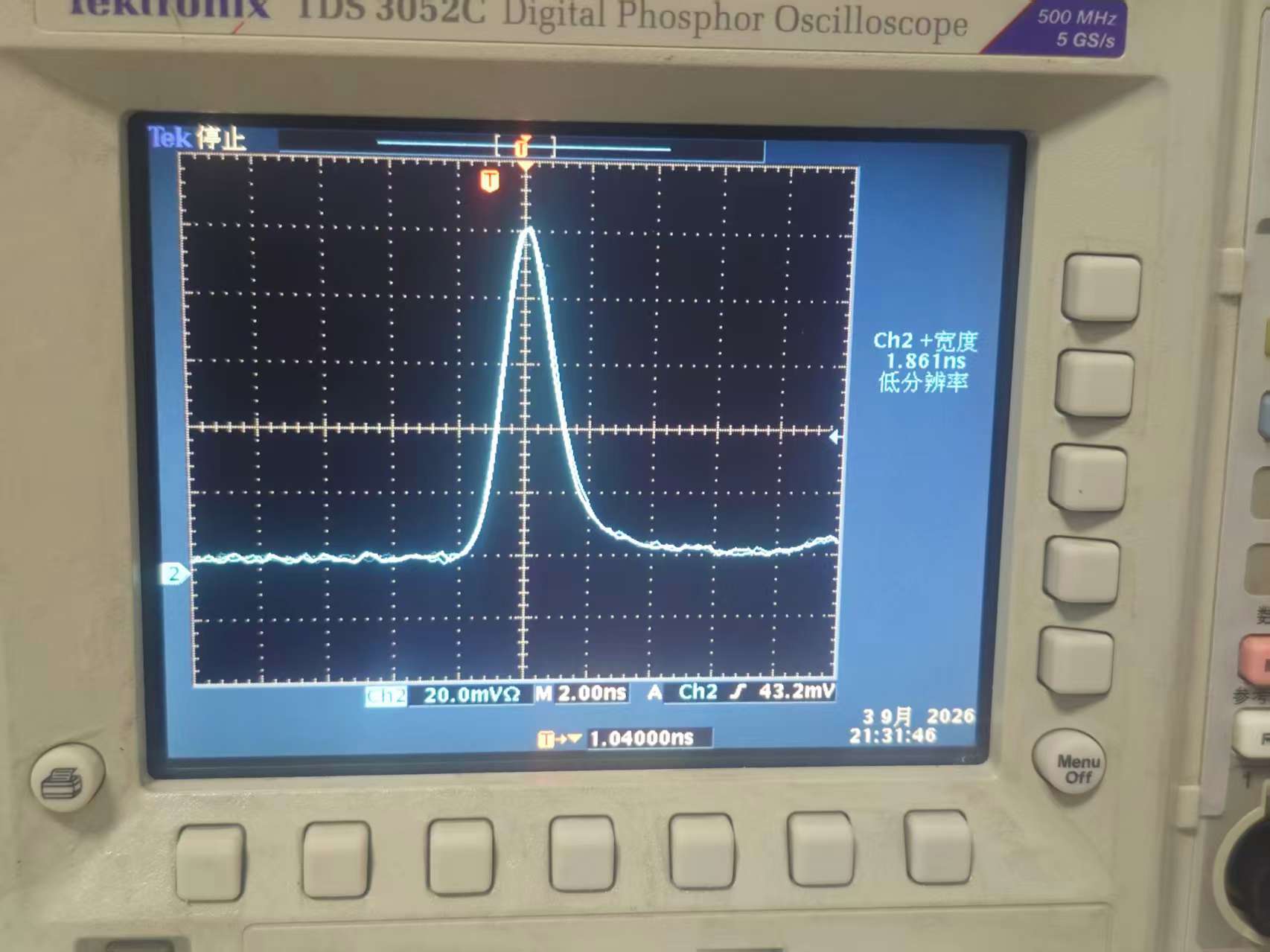
The image can document the demonstrated pulse-width capability. It should not, by itself, be interpreted as evidence of a particular pulse energy, peak power, or LIBS analytical result unless those parameters are also documented.
For a meaningful evaluation, the selected laser should ultimately be tested with representative samples under the intended operating conditions. This helps determine whether the laser and optical configuration produce suitable, repeatable spectra for the target application.
From Laser Specifications to Handheld System Integration
Meeting the required pulse specifications is only one part of handheld LIBS development. The laser source must also fit the instrument's overall design.
Mechanical integration: The laser head must fit within the available space while allowing appropriate optical alignment and focusing.
Power supply: The electrical system must support the laser's voltage, current, and operating requirements. The dimensions of the power electronics should be assessed alongside those of the laser head.
Thermal management: Repeated operation generates heat, so the design must support stable operation under the intended environmental conditions.
Optical configuration: Focusing optics, spot size, working distance, and sample positioning influence the energy delivered to the material and should be validated as part of the complete system.
For OEM developers, assessing these factors early can help identify integration constraints before the instrument design is finalized. A laser that meets the optical requirements may still need further engineering work to fit the complete device.
Evaluating a Laser Source for Your LIBS Project
A structured evaluation helps narrow the options without relying on wavelength alone.
- Define the mandatory specifications. Establish the required wavelength range, pulse duration, pulse energy, repetition rate, and beam characteristics.
- Screen candidate laser configurations. Confirm which options meet the non-negotiable performance requirements.
- Assess system integration. Evaluate laser head dimensions, power supply, thermal conditions, focusing optics, and available space.
- Validate analytical performance. Test representative materials and evaluate the resulting spectra and repeatability under the intended operating conditions.
- Review production feasibility. Consider cost targets, manufacturing consistency, and the requirements for scaling from prototype development to volume production.
For handheld LIBS projects that require a pulse width below 2ns, ERDI's 1064nm short-pulse laser solution is a candidate for technical evaluation. The final selection should be based on the complete set of application requirements and validation results.
ERDI TECH supports laser source evaluation for OEM applications. If you are developing a handheld LIBS analyzer, share your target wavelength, pulse width, pulse energy, repetition rate, laser head dimensions, and power requirements with our team.
Contact ERDI TECH to discuss a laser source for your LIBS project.
Email: yeva@erditechs.com
WhatsApp: +86 18123396539