When developing a LiDAR, laser rangefinder, or other optical sensing system, choosing the right laser source is more than a matter of selecting the highest available pulse energy. A 1535nm laser source has to work as part of the complete sensing architecture. Pulse energy, repetition rate, pulse width, beam characteristics, optical aperture, package size, power requirements, and environmental conditions can all affect the final system performance. For applications that require long-range sensing, compact integration, and an eye-safe system design, a 1535nm erbium glass laser can be an attractive solution.
However, a laser source that works well for a long-range laser rangefinder may not be the best choice for a high-speed LiDAR system. Likewise, increasing pulse energy does not automatically result in longer detection range if the receiver, optics, or signal processing becomes the limiting factor.
This guide explains the key parameters engineers should consider when selecting a 1535nm laser source and how to match different laser configurations to LiDAR, laser rangefinders, UAV payloads, and other optical sensing applications.
Why Consider a 1535nm Erbium Glass Laser Source?
1535nm erbium glass lasers are widely used as pulsed laser sources for ranging and sensing because they can combine eye-safe system design considerations, compact solid-state architecture, and scalable pulse energy. For system designers, several characteristics are particularly important.
Eye-Safe Operation: The 1535nm wavelength is widely used in eye-safe laser systems because it falls within a wavelength region where the human eye has significantly different transmission characteristics compared with shorter near-infrared wavelengths.
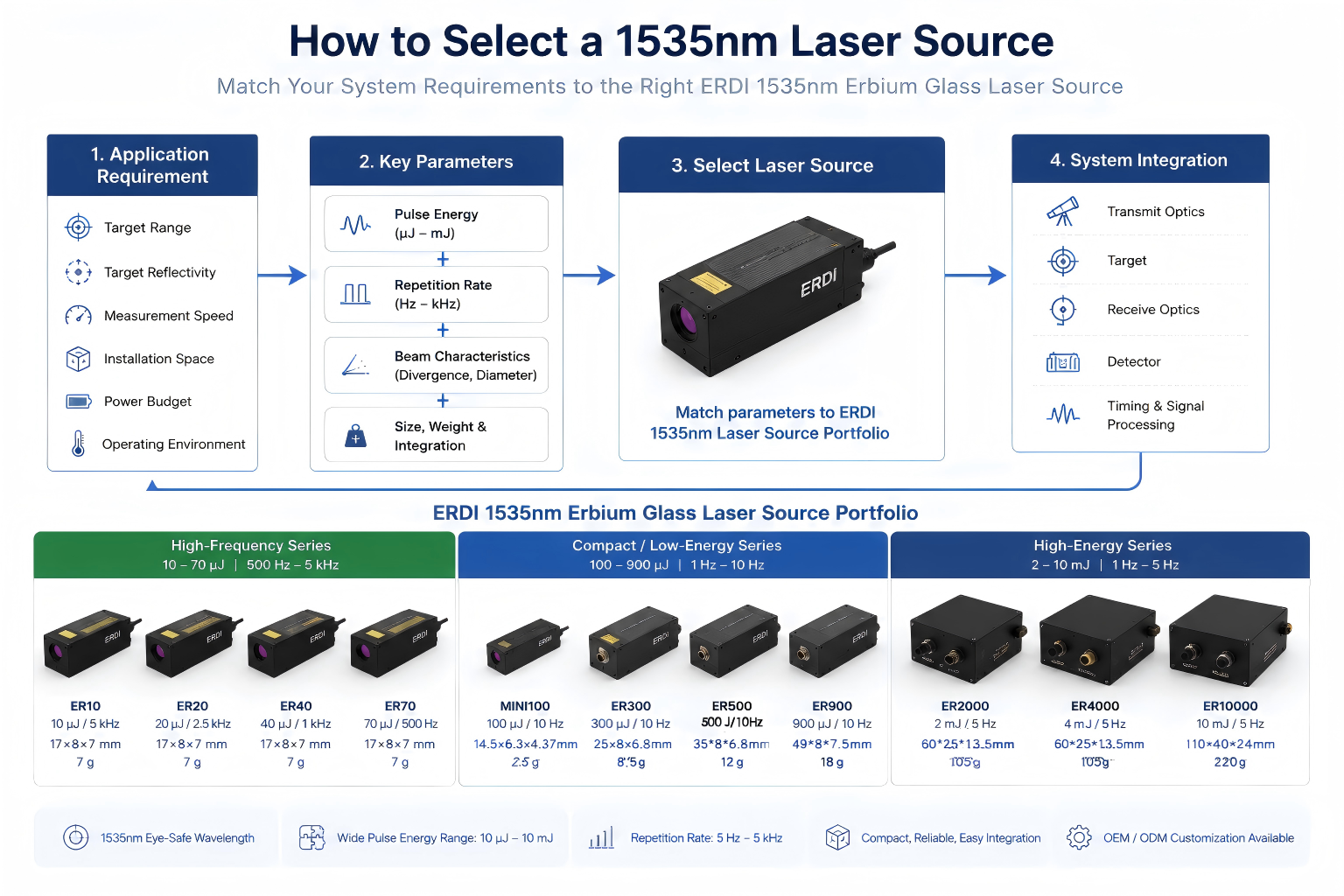
Scalable Pulse Energy: Different sensing applications require different levels of transmitted optical energy. ERDI's 1535nm erbium glass laser portfolio covers approximately 10 μJ to 10 mJ pulse energy, allowing engineers to select a source according to the required range, measurement rate, and system architecture.
Compact Solid-State Integration
- UAV payloads
- compact LiDAR sensors
- handheld laser rangefinders
- EO/IR payloads
- portable optical instruments
- embedded sensing systems
What Determines the Right 1535nm Laser Source?
There is no single "best" 1535nm laser source for every application. The appropriate configuration depends on what the system needs to achieve. Compared with 905nm laser sources, 1535nm is often considered when eye-safe system design, longer-range sensing, and higher permissible transmitted energy are important design considerations.
Four parameters are especially important during the initial selection.
1. Pulse Energy
Pulse energy is the amount of optical energy delivered by a single laser pulse. In a time-of-flight ranging or LiDAR system, the required pulse energy depends on factors such as:
- Required detection range
- Target reflectivity
- Target size
- Atmospheric conditions
- Transmit optical aperture
- Receiver aperture
- Detector sensitivity
- Optical losses
- Signal processing capability
Higher pulse energy can provide a stronger transmitted signal, but it does not automatically produce better system performance. Increasing pulse energy can also increase requirements for power consumption, thermal management, mechanical design, and optical components. A better approach is to determine the required system performance first and then select an appropriate pulse-energy range.
2. Repetition Rate
Repetition rate determines how frequently the laser can transmit pulses. For high-speed LiDAR or scanning systems, repetition rate can be more important than maximum pulse energy.
For example, a laser operating at several kilohertz can provide many more measurement opportunities per second than a high-energy source operating at only a few hertz. This creates a fundamental design trade-off:
Higher pulse energy is generally associated with lower repetition rates, while high-speed sensing often prioritizes repetition rate and compactness.
ERDI's high-frequency series illustrates this approach. The ER10, ER20, ER40, and ER70 provide approximately 10–70 μJ pulse energy with repetition rates ranging from hundreds of Hz to several kHz. The series uses a compact approximately 17 × 8 × 7 mm package and is designed for applications where measurement speed, scanning frequency, and integration are important.
The key question for engineers is therefore not:
"What is the highest pulse energy available?"
but:
"How much energy does each measurement need, and how many measurements does the system need to make per second?"
3. Pulse Width and Beam Characteristics
Pulse width affects the temporal characteristics of the transmitted signal and can influence timing resolution in time-of-flight ranging. However, its practical impact depends on the detector, timing electronics, and signal-processing architecture.
Beam characteristics determine how efficiently the transmitted optical energy is delivered through the optical system. Important parameters include beam mode, beam diameter, beam divergence, and beam quality.
4. Size, Weight, and Integration Requirements
A laser source may have excellent optical specifications but still be unsuitable if it cannot fit into the available mechanical or electrical architecture. This is particularly important for UAV payloads and compact optical systems, where every gram and every millimeter can affect the final product design.
For example, ERDI's high-frequency ER10–ER70 series uses an approximately 17 × 8 × 7 mm package and weighs approximately 7 g. At the smaller end of the energy range, the MINI-100 measures approximately 14.5 × 6.3 × 4.37 mm and weighs approximately 2.5 g. At higher pulse-energy levels, larger packages may be necessary to accommodate the laser architecture and associated thermal and mechanical requirements.
This illustrates a fundamental engineering principle:
Laser source selection is always a balance between optical performance and system-level constraints.
A Practical Starting Point for 1535nm Laser Selection
| Application Priority | ERDI Laser Range | Typical Use |
|---|---|---|
| High measurement rate | 10–70 μJ | LiDAR and scanning |
| Compact integration | 100–900 μJ | Laser rangefinders and embedded systems |
| Higher transmitted energy | 2–10 mJ | Long-range sensing |
These ranges are intended as a starting point. The final laser selection should be based on detection range, measurement rate, optical architecture, target characteristics, and system constraints.
Matching a 1535nm Laser Source to Your Application
Once the main system requirements have been defined, selecting an appropriate 1535nm laser source becomes much more straightforward. Different applications tend to prioritize different combinations of pulse energy, repetition rate, size, and beam characteristics.
High-Speed LiDAR and Scanning
High-speed LiDAR systems typically prioritize measurement frequency and scanning speed. In these applications, a high-repetition-rate laser with moderate pulse energy can be more useful than a high-energy source operating at a low repetition rate.
ERDI's ER10–ER70 series is designed around this type of requirement, covering approximately 10–70 μJ pulse energy with repetition rates from hundreds of hertz to several kilohertz. The compact package is also suitable for systems where the transmitter must be integrated into a small optical or mechanical assembly.
For high-speed LiDAR, engineers should pay particular attention to:
- Repetition rate
- Pulse-to-pulse stability
- Beam quality
- Timing performance
- Thermal management
- Optical alignment
- Data-processing capability
The laser is only one part of the measurement-speed chain.
Compact Laser Rangefinders and Embedded Systems
Compact laser rangefinders have a different set of priorities. The transmitter needs to provide sufficient energy for the required range while remaining small and lightweight enough to fit into the complete instrument. This is where compact 1535nm laser sources such as the MINI-100 can be particularly useful.
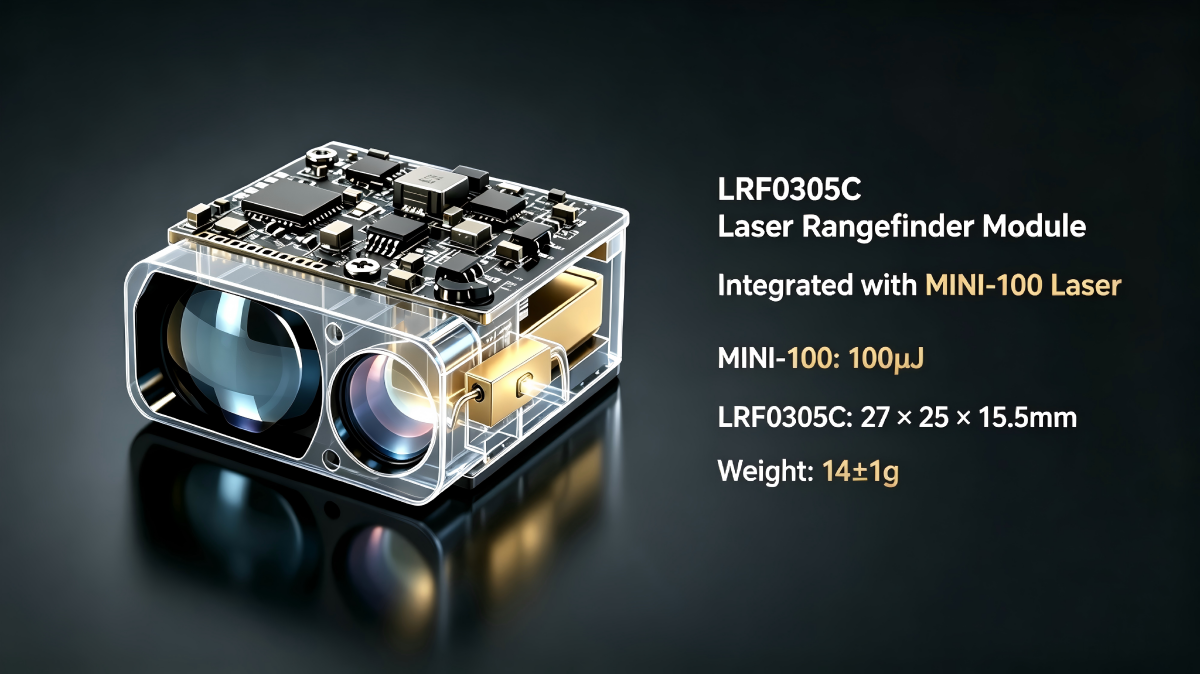
ERDI's LRF0305C and LRF0306C provide a practical example of this architecture. Both modules use the MINI-100 as their core 1535nm laser source and combine the transmitter with the optical, electronic, and ranging components required for a compact integrated system. The modules have dimensions of no more than approximately 27 × 25 × 15.5 mm and a total weight of approximately 14 g. Under specified test conditions, they can provide ranging performance up to approximately 3 km against NATO standard targets.
The LRF0305C and LRF0306C also illustrate how two systems using the same basic laser-source architecture can be optimized for different measurement requirements. The LRF0305C is designed for a higher 10 Hz measurement frequency, while the LRF0306C operates at approximately 3 Hz.
UAV Payloads
UAV payloads place particularly strong constraints on size, weight, power consumption, and optical integration. A 1535nm laser source may be attractive when the payload requires an eye-safe system design together with longer-range ranging capability. The appropriate source depends on the payload's required range, measurement rate, available optical aperture, and mechanical constraints.
For stabilized EO/IR or ranging payloads, reducing transmitter size and weight can also leave more space and payload capacity for optics, detectors, stabilization mechanisms, and other mission electronics.
Long-Range Sensing
Long-range applications may require substantially more pulse energy, particularly when the system needs to detect distant or relatively low-reflectivity targets.
ERDI's high-energy 1535nm series includes the ER2000, ER4000, ER8000, and ER10000, covering approximately 2–10 mJ pulse energy. These sources are intended for systems where higher transmitted pulse energy is an important part of the overall ranging architecture.
However, increasing pulse energy should not be treated as the only method of increasing detection range.
The final performance of a long-range system can also be strongly influenced by:
- Transmit aperture
- Receive aperture
- Receiver sensitivity
- Detector performance
- Optical losses
- Atmospheric attenuation
- Target reflectivity
- Beam divergence
- Signal processing
- Timing accuracy
In some cases, improving the receiver or optical system can produce a greater improvement than simply increasing transmitter energy.
What Information Should You Provide When Selecting a 1535nm Laser Source?
You do not necessarily need to know the exact pulse energy before contacting a laser manufacturer. If you can provide the following information, the appropriate laser-source range can often be identified much more quickly:
- Required detection range
- Target type and approximate reflectivity
- Required measurement frequency
- Optical aperture
- Available installation space
- Maximum allowable weight
- Operating temperature
- Power supply requirements
- Electrical interface
- Beam divergence requirements
- Application type
For example, a basic requirement such as:
"We need a compact 1535nm laser source for a UAV laser rangefinder with a 3 km target range and a 10 Hz measurement rate."
already provides useful information for narrowing down the appropriate laser architecture.
The manufacturer can then evaluate pulse energy, repetition rate, beam characteristics, package size, and interface requirements together.
Choosing the Right 1535nm Laser Source
The right 1535nm laser source is not necessarily the one with the highest pulse energy, the highest repetition rate, or the smallest package. It is the source that provides the required optical performance while fitting the complete system architecture.
For high-speed LiDAR, repetition rate and compact integration may be the primary considerations. For compact laser rangefinders, the balance between pulse energy, size, weight, and ranging performance may be more important. For long-range sensing, higher pulse energy may become a major design consideration, but receiver sensitivity, optical aperture, atmospheric conditions, and target reflectivity must also be evaluated.
The key is to select the laser from the requirements of the complete system:
Required Range → Target → Measurement Rate → Optical Architecture → Pulse Energy → Repetition Rate → Beam Characteristics → Size & Weight
This approach can help engineers avoid both over-specifying the laser and selecting a source that becomes the performance bottleneck of the system.
Need Help Selecting a 1535nm Laser Source?
If you are developing a LiDAR, laser rangefinder, UAV payload, EO/IR system, or another optical sensing product, ERDI TECH can help evaluate the laser-source requirements from the system level.
You can provide information such as:
- Target range
- Target type
- Measurement frequency
- Optical aperture
- Available installation space
- Weight limitations
- Operating environment
- Electrical requirements
Based on these requirements, ERDI can recommend a suitable standard 1535nm erbium glass laser source or discuss a customized OEM/ODM configuration when a standard model does not meet the system requirements.
ERDI TECH — 1535nm Erbium Glass Laser Sources for LiDAR, Laser Ranging and Optical Sensing