Application of 1535 nm Erbium Glass Laser in the Field of LIBS
The 1535 nm erbium glass (Er:Glass) laser, as a new type of solid-state laser, holds broad application prospects in the field of laser-induced breakdown spectroscopy (LIBS). This article primarily introduces the application of the 1535 nm Erbium Glass laser in LIBS.
Definition of Laser-Induced Breakdown Spectroscopy (LIBS)
LIBS is a spectral analysis technique used for elemental analysis. It employs high-energy pulsed lasers to generate plasma on the sample surface. The elemental composition and content of the sample are then determined by analyzing the spectral lines emitted during the plasma’s energy transitions, as captured by a spectrometer.
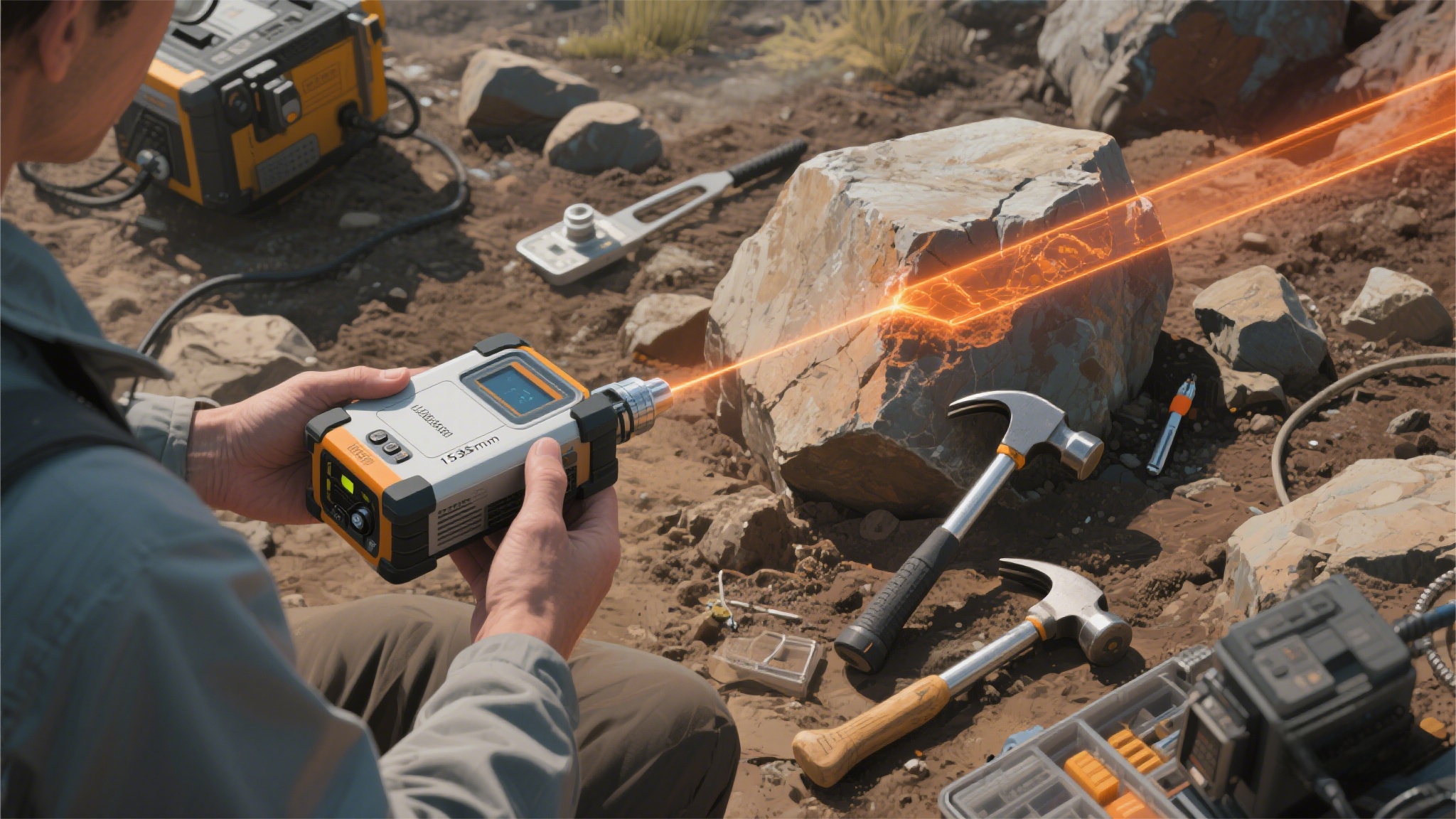
Key features of LIBS include simultaneous multi-element analysis, non-contact measurement, fast response time, and a wide detection range. A typical LIBS system comprises a laser source, sample processing and delivery system, and a spectral acquisition and analysis unit. LIBS is widely applied in fields such as materials science, environmental monitoring, geological exploration, biomedical research, and the preservation of cultural relics.
Adaptability of the 1535 nm rbium Glass laser in LIBS
Firstly, according to the definition of LIBS, the technique requires a high-energy pulsed laser to excite plasma in the sample. The 1535 nm Erbium Glass laser meets this requirement by providing sufficient energy and appropriate pulse duration. For instance, ERDI TECH LTD ER1000-03 model can deliver 1 mJ of pulse energy with a pulse width of 7 ns, which is suitable for generating the plasma necessary for LIBS analysis. This enables accurate detection of elemental type and content.
Secondly, the 1535 nm wavelength falls within the eye-safe range. Compared with the commonly used 1064 nm laser, which poses a higher risk to the human eye, the 1535 nm laser significantly improves operational safety. This is particularly valuable for handheld LIBS systems used in diverse environments, especially where there may be non-professionals or large groups of people.
Finally, the 1535 nm Erbium Glass laser developed by ERDI TECH LTD utilizes semiconductor packaging technology. It is compact and lightweight, with the lightest model weighing only 6 g. This makes it ideal for integration into handheld LIBS devices, improving portability, usability, and enabling faster elemental analysis.
Conclusion
With its unique performance characteristics and design advantages, the 1535 nm Erbium Glass laser shows great potential in the LIBS field, particularly in handheld applications that require adaptability to complex environments. In the future, it is expected that the 1535 nm Erbium Glass laser will further advance the application of LIBS technology across a wider range of industries.