When selecting a 1535nm laser source for LiDAR or laser ranging, pulse energy is often one of the first specifications engineers look at. But higher pulse energy is not automatically better.
A system designed for high-speed measurement may prioritize repetition rate and compact packaging, while a long-range sensing system may require higher energy per pulse. The right choice depends on the complete transmitter, receiver, optics, target, and measurement requirements.
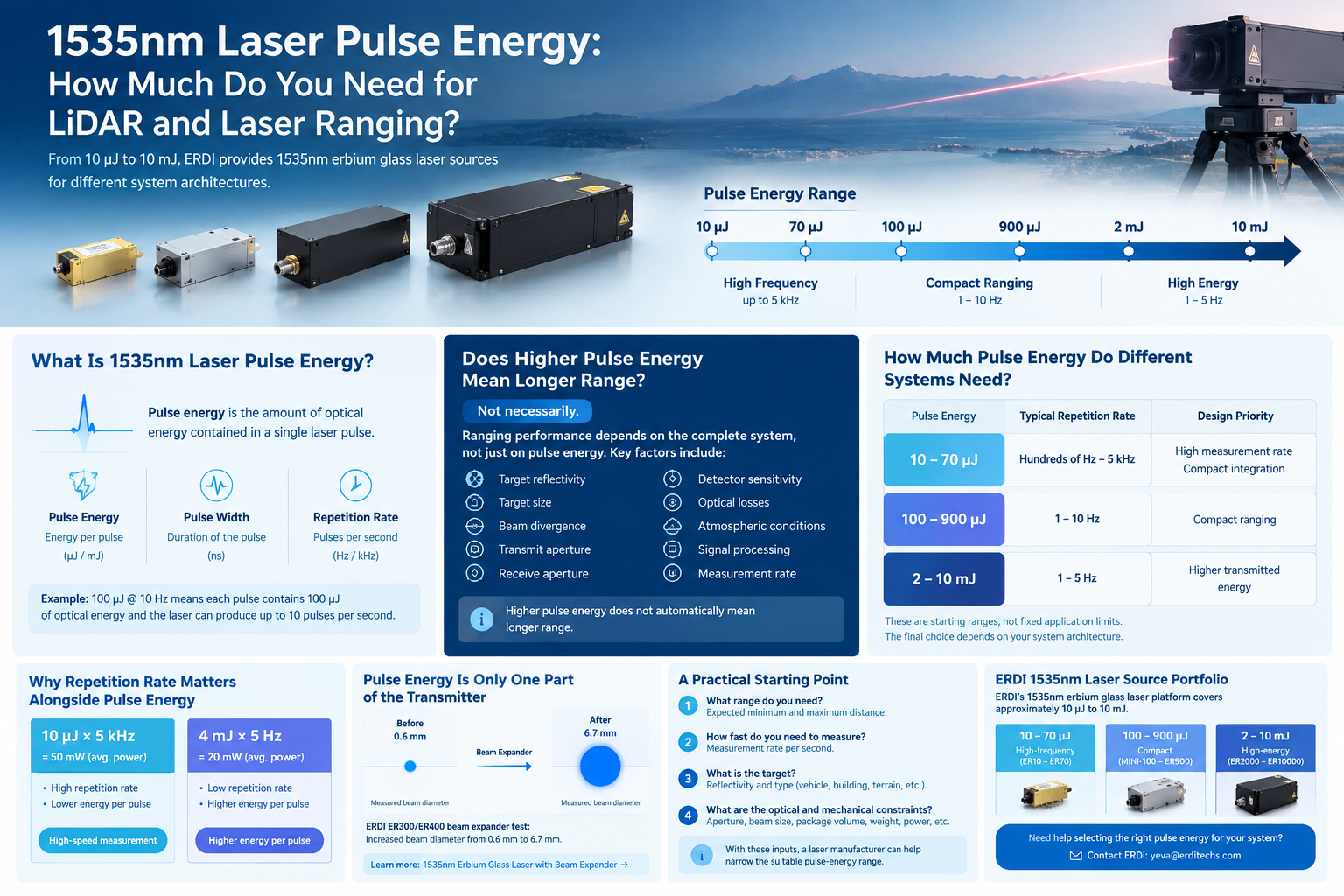
ERDI's 1535nm erbium glass laser portfolio covers pulse energies from 10 μJ to 10 mJ, providing different configurations for high-frequency sensing, compact laser ranging, and higher-energy applications.
What Is 1535nm Laser Pulse Energy?
Pulse energy is the amount of optical energy contained in a single laser pulse, usually expressed in microjoules (μJ) or millijoules (mJ).
For example:
- 100 μJ = 0.1 mJ per pulse
- 1 mJ = 1,000 μJ
- 4 mJ = 4,000 μJ
Pulse energy should be considered together with pulse width and repetition rate.
For example, a laser delivering 100 μJ at 10 Hz has a very different operating profile from a laser delivering 10 μJ at 5 kHz, even though both operate in the same wavelength range.
This is why selecting a laser source based only on the μJ or mJ value can lead to an unsuitable transmitter design.
Does Higher Pulse Energy Mean Longer Range?
Not necessarily.
Higher pulse energy can provide more transmitted optical energy, but ranging distance is a system-level result. It also depends on factors such as:
- Target reflectivity
- Target size
- Beam divergence
- Transmit aperture
- Receiver aperture
- Detector sensitivity
- Optical losses
- Atmospheric conditions
- Signal processing
This means that simply replacing a 500 μJ source with a 2 mJ source does not guarantee a proportional increase in measurement distance.
For a laser rangefinder or LiDAR system, the more useful question is:
What pulse-energy range provides sufficient signal while meeting the system's size, speed, power, and optical requirements?
This is also why laser-source selection should be considered together with the receiver and optical system rather than based on transmitter energy alone. ERDI's existing laser-source selection guide follows the same system-level approach.
How Much Pulse Energy Do Different Systems Need?
There is no universal pulse-energy value for every 1535nm ranging system.
As a practical starting point, ERDI's laser portfolio can be viewed in three broad energy ranges.
|
Pulse Energy |
Typical Repetition Rate |
Typical Design Focus |
|---|---|---|
|
10–70 μJ |
Hundreds of Hz–5 kHz |
High measurement rate, compact integration |
|
100–900 μJ |
1–10 Hz |
Compact and medium-energy ranging |
|
2–10 mJ |
1–5 Hz |
Higher energy per pulse |
These are starting ranges, not fixed application limits. The final choice depends on the complete system architecture.
10–70 μJ: When Measurement Rate Matters
For high-speed sensing and scanning applications, repetition rate can be more important than maximum pulse energy.
ERDI's high-frequency 1535nm series covers approximately 10–70 μJ with repetition rates from hundreds of hertz up to 5 kHz. The ER10, for example, provides ≥10 μJ pulse energy at 5 kHz in a compact 17 × 8 × 7 mm, 7 g package.
This type of source can be considered when the system prioritizes:
- High measurement frequency
- Fast scanning
- Compact transmitter design
- Low source weight
- Integration into small optical assemblies
The key point is that a high-speed LiDAR system does not necessarily benefit from simply maximizing energy per pulse. It may need to balance pulse energy with the number of measurements available each second.
100–900 μJ: When Compact Ranging Needs More Energy
The next range covers compact and medium-energy 1535nm sources.
This range can be relevant to:
- Compact laser rangefinders
- Embedded optical systems
- UAV payloads
- Portable sensing equipment
- Customized ranging transmitters
Here, the design often requires a balance between transmitted energy and physical integration.
For example, ERDI's compact MINI-100 provides ≥100 μJ pulse energy in a package of approximately 14.5 × 6.3 × 4.37 mm and weighs approximately 2.5 g. This illustrates why pulse energy should be evaluated together with package size and weight when developing embedded optical equipment.
The appropriate point within this range depends on the required range, optical architecture, and measurement rate rather than on pulse energy alone.
2–10 mJ: When Higher Transmitted Energy Is Required
At the mJ level, the design emphasis shifts toward delivering significantly more optical energy in each pulse.
ERDI's high-energy 1535nm series covers approximately 2–10 mJ, with typical repetition rates of 1–5 Hz.
For example, the ER4000 provides:
- ≥4 mJ pulse energy
- 12 ns pulse width
- 1–5 Hz repetition rate
- TEM00 output
- ≤4 mrad divergence
- 60 × 25 × 13.5 mm package
- 105 g weight
Higher pulse energy can be useful when the transmitter architecture requires greater energy per pulse. However, it should not be interpreted as a guaranteed increase in ranging distance. The final performance still depends on the optical system, receiver, target and operating environment.
Why Repetition Rate Matters Alongside Pulse Energy
Pulse energy tells you how much energy is transmitted in one pulse. Repetition rate tells you how often those pulses are transmitted.
These two parameters can lead to very different system characteristics.
For example:
10 μJ × 5 kHz = 50 mW average optical power
while:
4 mJ × 5 Hz = 20 mW average optical power
The second laser has much more energy in each individual pulse, but the first produces measurements much more frequently.
This distinction matters in system design.
A scanning or high-speed LiDAR system may benefit from a high repetition rate and moderate pulse energy. A ranging system focused on individual long-distance measurements may place more emphasis on pulse energy per measurement.
Therefore, pulse energy and repetition rate should be evaluated together, rather than comparing either specification in isolation.
Pulse Energy Is Only One Part of the Laser Transmitter
The same pulse energy can behave very differently in two optical systems.
Beam diameter, divergence, optical aperture, and downstream optics determine how the transmitted energy is distributed and propagated.
This becomes particularly important for longer-range applications.
ERDI recently tested beam expansion on its ER300/ER400 1535nm laser platform. The measured beam diameter increased from 0.6 mm to 6.7 mm, representing more than an 11× increase in measured beam diameter.
The result does not mean that the laser produces more pulse energy. Instead, it demonstrates how the laser source and transmitter optics can be designed together to obtain a different beam configuration.
For engineers working on a customized transmitter, pulse energy therefore needs to be considered alongside:
Pulse Energy + Beam Diameter + Divergence + Optical Aperture
Learn more about the ERDI beam-expansion test in:
1535nm Erbium Glass Laser with Beam Expander: From 0.6 mm to 6.7 mm
How to Choose a Starting Pulse-Energy Range
You do not necessarily need to determine the exact laser pulse energy before contacting a laser manufacturer.
For an initial evaluation, four questions are particularly useful:
1. What detection range is required?
Define the expected measurement distance and whether it is a typical or maximum target range.
2. How fast does the system need to measure?
A 5 Hz system and a 5 kHz system have very different laser-source requirements.
3. What is the target?
Target reflectivity and size can significantly affect the returned signal.
4. What are the optical and mechanical constraints?
Transmitter aperture, receiver aperture, available space, weight, power, and beam requirements can all influence the suitable source.
For example, a requirement such as:
1535nm laser source, 3 km target range, 10 Hz measurement rate, compact UAV payload
is already enough to start narrowing the appropriate laser architecture.
The exact pulse-energy requirement can then be evaluated together with the transmitter optics and receiver.
A Practical Way to Think About 1535nm Laser Pulse Energy
Instead of asking:
“What is the most powerful 1535nm laser available?”
a better engineering question is:
“What pulse-energy range matches the requirements of my complete sensing system?”
A useful starting point is:
10–70 μJ
→ When high measurement rate and compact integration are priorities
100–900 μJ
→ When compact ranging requires more energy per pulse
2–10 mJ
→ When higher transmitted energy is an important part of the ranging architecture
ERDI's 1535nm Erbium Glass Laser Portfolio
ERDI develops 1535nm erbium glass laser sources covering approximately 10 μJ to 10 mJ, with different combinations of pulse energy, repetition rate, package size, beam characteristics, and environmental performance.
The portfolio broadly includes:
- 10–70 μJ: high-frequency laser sources up to 5 kHz
- 100–900 μJ: compact and medium-energy sources
- 2–10 mJ: high-energy laser sources at 1–5 Hz
This range allows system developers to start from the requirements of their application rather than adapting the application to a single fixed laser configuration.
For engineers developing LiDAR, laser rangefinders, UAV payloads, EO/IR systems, or other optical sensing equipment, ERDI can evaluate the laser source together with the required optical and mechanical integration.
Conclusion
The right 1535nm laser pulse energy is not simply the highest value available.
For high-speed sensing, tens of microjoules combined with a high repetition rate may be the more relevant design direction. Compact ranging systems may require hundreds of microjoules, while higher-energy architectures may use several millijoules per pulse.
The final selection should consider pulse energy together with measurement rate, target characteristics, beam parameters, optical architecture, receiver performance, size, and power requirements.
If you are unsure which pulse-energy range fits your system, provide the required range, target type, measurement rate, optical constraints, and package requirements. These specifications give a laser manufacturer a much better starting point for selecting the appropriate 1535nm source.
ERDI TECH develops 1535nm erbium glass laser sources from μJ-level high-frequency designs to mJ-level high-energy configurations for LiDAR, laser ranging, and optical sensing.