For a compact 1535nm erbium glass laser, pulse energy is only one part of the optical design. The output beam characteristics also matter when the laser is integrated into a ranging, sensing, LiDAR, or other electro-optical system.
A small beam diameter can be useful for compact laser source design, but some applications require a larger output beam and a different optical configuration. Beam expansion provides a way to modify the output beam while maintaining the advantages of a compact 1535nm laser source.
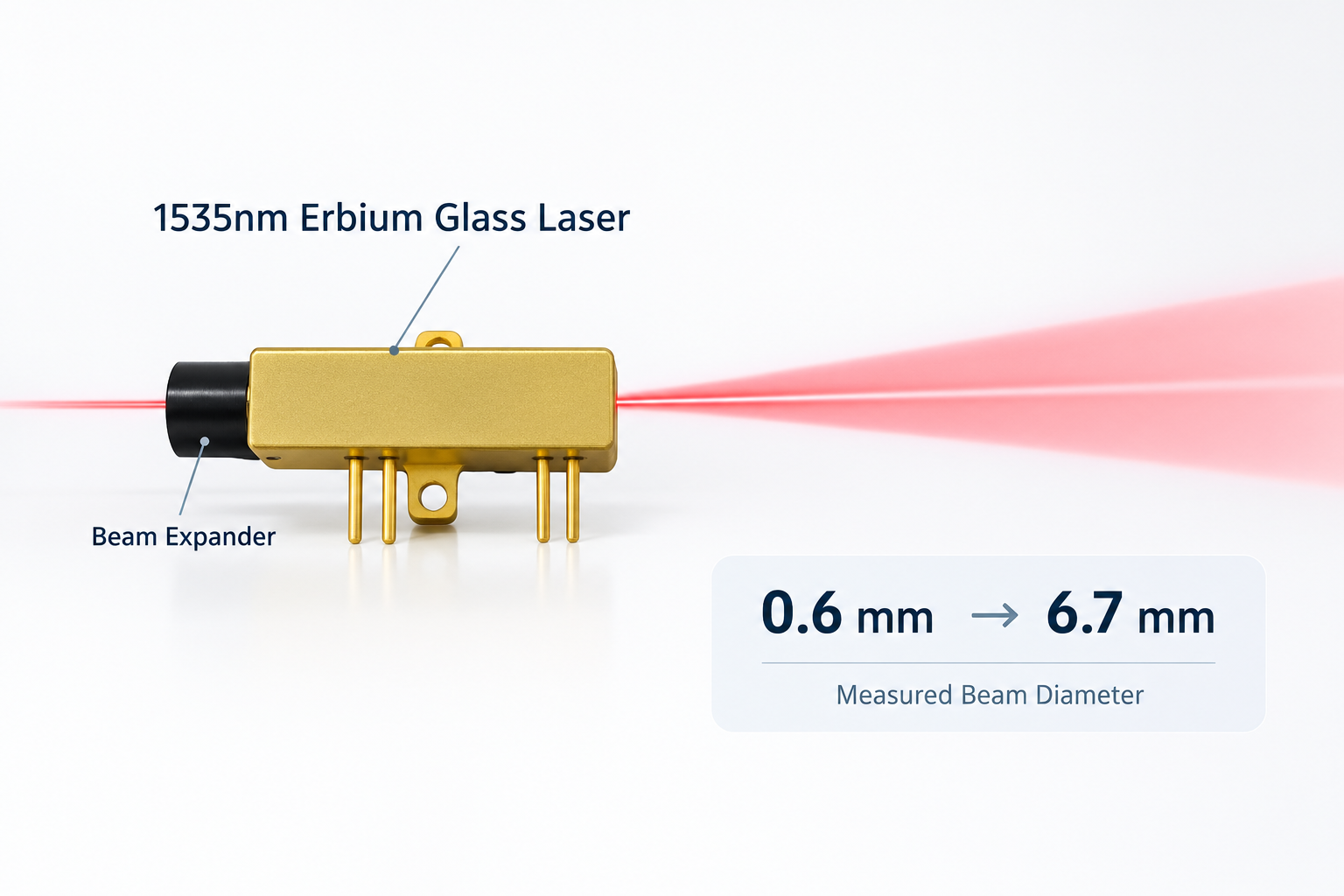
ERDI TECH has recently completed beam expansion testing with its 1535nm ER300/ER400 laser platform. In the test, the measured beam diameter increased from 0.6 mm before beam expansion to 6.7 mm after beam expansion, representing more than an 11× increase in beam diameter.
This result provides a practical basis for developing more flexible 1535nm laser transmitter configurations for ranging and other long-distance sensing applications.
Why Expand the Beam of a 1535nm Erbium Glass Laser?
A 1535nm erbium glass laser can provide a compact source of pulsed laser energy for applications such as laser ranging and optical sensing. However, the laser source is only one part of the complete optical path.
When the laser beam leaves a compact laser source, its beam diameter and divergence determine how the beam propagates through the transmitter optics and into the environment.
For some systems, the original beam diameter may be smaller than the preferred input or output aperture of the following optical components. In other systems, engineers may want to optimize the beam characteristics for a particular propagation distance or transmitter design.
A beam expander changes this optical configuration by increasing the beam diameter.
In simplified optical terms:
Beam diameter increases → beam divergence can decrease
This relationship is an important reason why beam expansion is often considered when designing long-range laser transmitters.
However, beam expansion is not simply a matter of making the beam as large as possible. The expansion ratio, optical aperture, beam quality, alignment, mechanical package, and downstream optics all need to be considered together.
ERDI's 1535nm Laser Beam Expansion Test
The most direct way to evaluate a beam-expansion design is to compare the measured beam before and after the optical system.
ERDI's recent test used the ER300/ER400 1535nm erbium glass laser platform.
Measured Beam Diameter
| Configuration | Measured Beam Diameter |
|---|---|
| Before beam expansion | 0.6 mm |
| After beam expansion | 6.7 mm |
| Increase in beam diameter | More than 11× |
The measured result shows a clear change in the output beam size. The original beam diameter was approximately 0.6 mm. After the beam-expansion optics were introduced, the measured beam diameter increased to approximately 6.7 mm.
This is approximately a 12× beam-expansion configuration when expressed as an optical design ratio, while the measured diameter values themselves correspond to an increase of more than 11×.
The difference between an optical expansion ratio and the measured beam-diameter ratio is worth noting. Actual optical performance can be affected by beam quality, optical design, alignment, aperture, and measurement conditions. For this reason, measured beam data is more meaningful than relying on an expansion ratio alone.
What Does a Larger Beam Diameter Change?
Increasing the beam diameter does not mean that the laser simply becomes more powerful. The pulse energy of the laser source remains an important independent parameter. Instead, beam expansion changes how the available laser energy is distributed spatially and how the beam interacts with the downstream optical system.
For an ideal beam expander, the basic relationship can be simplified as:
D₂ ≈ M × D₁
where:
- D₁ is the input beam diameter
- D₂ is the output beam diameter
- M is the beam expansion ratio
Under ideal optical conditions, beam divergence has an approximately inverse relationship with the expansion ratio:
θ₂ ≈ θ₁ / M
where θ represents beam divergence.
These are simplified optical relationships rather than guaranteed specifications for a practical laser assembly. Real performance depends on factors such as beam quality, optical aberrations, aperture, alignment, and the design of the beam-expanding optics.
For this reason, the 0.6 mm to 6.7 mm result from ERDI's test should be understood as a measured beam-diameter result, rather than a direct measurement of divergence reduction.
Why Beam Expansion Can Be Useful for Laser Ranging
For laser ranging, the laser transmitter needs to deliver sufficient optical energy toward the target while maintaining an appropriate beam profile over the required propagation distance.
As a laser beam travels through space, divergence causes its footprint to increase with distance. A properly designed beam expander can reduce the output divergence of the optical system, allowing the beam to spread more slowly.
This can be particularly useful for applications where the laser needs to maintain a more concentrated beam over a longer propagation path.
The practical benefit is therefore not simply:
“A larger beam reaches farther.”
Instead, the optical system can be designed around a larger output beam and lower divergence, helping control how the laser energy is distributed over distance.
This distinction is important when selecting a 1535nm laser source. Pulse energy, beam diameter, divergence, transmitter aperture, target characteristics, receiver performance, and atmospheric conditions all contribute to the final system performance.
Beam Expansion Is Not Only About Long-Range Applications
Beam expansion is often associated with long-distance laser propagation, but its value is not limited to maximum range.
Different ranging systems have different optical architectures and operating-distance requirements. A beam-expanding configuration can give system designers more flexibility when matching the laser source with the transmitter optics.
For applications that require closer-range operation, the optical relationship between the transmitter and receiver also becomes important. Beam diameter, optical alignment, field of view, receiver aperture, and the geometry between the transmitting and receiving paths can all influence the usable measurement range.
Therefore, beam expansion should be considered as part of the complete optical design rather than as an independent component.
For an appropriately designed system, the larger beam can provide additional flexibility when optimizing the transmitter for different measurement distances.
Why Pulse Energy and Beam Diameter Should Be Considered Together
When selecting a 1535nm erbium glass laser, it is easy to focus primarily on pulse energy.
For example, a 300 μJ laser source and a 500 μJ laser source provide different levels of pulse energy. However, pulse energy alone does not determine how efficiently the laser beam propagates toward a target.
The optical characteristics should also be considered.
Pulse energy
Pulse energy determines how much optical energy is contained in each laser pulse.
Beam diameter
Beam diameter determines the initial spatial size of the beam and affects how the beam couples into downstream optics.
Beam divergence
Divergence determines how quickly the beam expands as it propagates.
Transmitter aperture
The optical aperture needs to accommodate the expanded beam while maintaining the required optical performance.
These parameters work together.
For long-range laser ranging and sensing, a practical laser transmitter therefore needs to balance pulse energy, beam diameter, divergence, optical aperture, repetition rate, and system size rather than optimizing only one parameter.
300 μJ-Class 1535nm Lasers for Ranging Applications
ERDI's 1535nm erbium glass laser platform includes several pulse-energy configurations, including the 300 μJ-class ER300 and 400 μJ-class ER400.
The 300 μJ class is particularly useful for compact laser ranging and sensing systems where the laser needs to balance optical output with size, weight, repetition rate, and system integration requirements.
For a complete ranging system, the laser source is normally combined with appropriate transmitter optics and a receiver system.
This is also where beam expansion becomes relevant.
Instead of treating the laser source as an isolated component, engineers can consider the laser and beam-expanding optics together as part of the transmitter optical path.
The result is a more flexible approach to designing a 1535nm laser system around the required beam characteristics.
From a Compact Laser Source to an Optimized Laser Transmitter
A compact 1535nm erbium glass laser is the starting point of the optical transmitter, not necessarily the complete transmitter itself.
The development of beam expansion adds another level of optical configuration:
1535nm Erbium Glass Laser
↓
Beam Expansion
↓
Beam Diameter Optimization
↓
Transmitter Optics
↓
Laser Ranging / LiDAR / Sensing
This approach allows engineers to select the laser source according to pulse energy and repetition-rate requirements, then optimize the output beam according to the optical architecture of the final system.
For OEM and integration projects, this can be more useful than selecting a laser based only on pulse energy.
What to Consider When Selecting a 1535nm Laser with Beam Expander
If you are evaluating a 1535nm laser with beam-expanding optics, several parameters should be considered before selecting the configuration.
1. Pulse Energy
Determine the optical energy required for the intended application.
2. Beam Diameter
Check the original beam diameter and the required output beam diameter after expansion.
3. Expansion Ratio
The required expansion ratio should match the downstream optical design rather than being selected only for the largest possible beam.
4. Beam Divergence
Consider the target divergence of the complete transmitter optical system. If divergence is a critical requirement, it should be verified through measurement rather than estimated only from the nominal expansion ratio.
5. Repetition Rate
The laser repetition rate should match the ranging, scanning, or sensing requirements of the system.
6. Optical Aperture
The expanded beam needs sufficient optical aperture to avoid unwanted clipping and preserve the intended beam characteristics.
7. Package Size and Integration
Adding beam-expanding optics changes the size and mechanical requirements of the optical assembly. Weight, mounting, alignment, and environmental requirements should therefore be considered at the system level.
ERDI's 1535nm Erbium Glass Laser Development
ERDI TECH develops 1535nm erbium glass lasers covering different pulse-energy and repetition-rate requirements, from compact laser sources to higher-energy configurations for demanding ranging and sensing applications.
The successful ER300/ER400 beam-expansion test adds another optical configuration to this platform.
The measured increase from 0.6 mm to 6.7 mm demonstrates that the compact laser output can be optically expanded to a substantially larger beam diameter.
For customers developing laser ranging, LiDAR, remote sensing, or other electro-optical systems, this provides another option for optimizing the laser transmitter around the required beam characteristics.
The appropriate configuration will depend on the required pulse energy, repetition rate, beam diameter, divergence, optical aperture, package size, and operating environment.
Conclusion
Beam expansion is more than simply adding an optical component after a laser source. It can be an important part of the transmitter design when the application requires a different beam diameter or lower-divergence optical configuration.
ERDI's latest test with its 1535nm ER300/ER400 laser platform increased the measured beam diameter from 0.6 mm to 6.7 mm, demonstrating more than an 11× increase in beam diameter.
The result provides a practical foundation for further optimization of 1535nm laser transmitters for ranging, LiDAR, and other sensing applications.
If you are evaluating a 1535nm erbium glass laser with beam expander, ERDI TECH can discuss the required pulse energy, repetition rate, beam diameter, expansion ratio, optical configuration, and integration requirements for your application.
Anchor: