
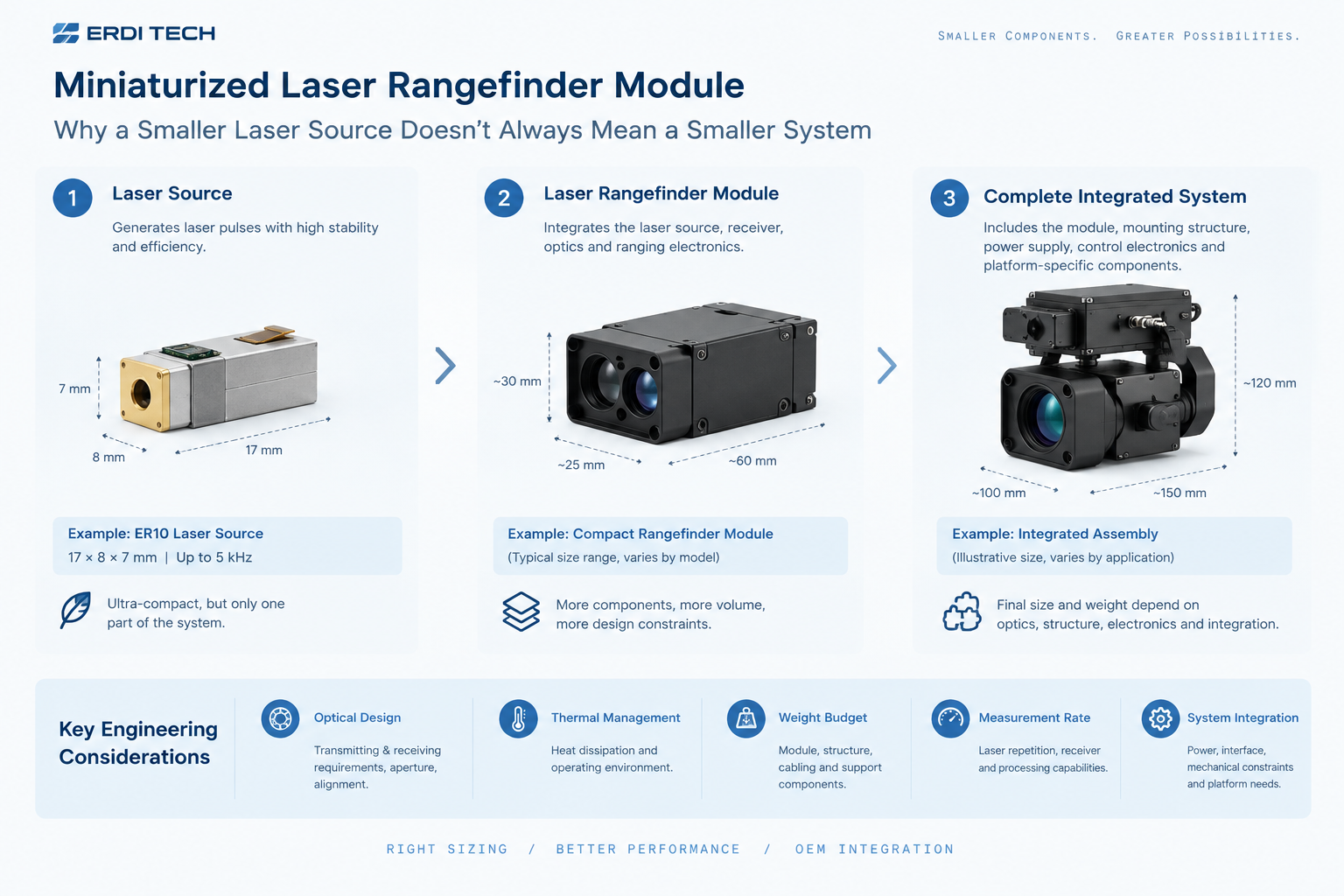
Miniaturization is an important design goal for laser rangefinder modules used in UAV payloads, electro-optical systems, and other space-constrained platforms. A smaller module can simplify mechanical integration, reduce payload demands, and create more flexibility for system designers.
However, reducing the size of a laser component does not automatically make the complete ranging system smaller or improve its overall performance. Optical requirements, receiver design, electronics, thermal management, and mechanical interfaces all influence the final result.
For OEM engineers, the real challenge is not simply finding the smallest laser rangefinder module. It is determining how much miniaturization the application requires and which performance requirements must be maintained.
What Does Miniaturization Really Mean?
Before setting a size target, it is important to distinguish between three levels of miniaturization:
- Laser source: The component that generates the laser pulses.
- Laser rangefinder module: An integrated unit that combines the required transmitting, receiving, and ranging functions.
- Complete system: The module together with its mounting structure, power supply, control electronics, and other platform-specific components.
These levels have different design constraints. A compact laser source may occupy very little space, but the complete ranging system still needs sufficient room for its receiver, processing electronics, optical alignment, and mechanical interfaces.
For example, ERDI TECH's ER10 laser source measures approximately 17 × 8 × 7 mm and supports repetition rates of up to 5 kHz. This illustrates how compact the laser-source component can be.
However, these dimensions describe the laser source itself, not a complete laser rangefinder module. The final system dimensions depend on the additional components and the requirements of the intended application.
For OEM projects, defining the required dimensions at the correct system level is the first step toward a realistic miniaturization target.
Why a Smaller Laser Source Does Not Guarantee a Smaller System
The laser source is only one part of a ranging system. Reducing its footprint may create valuable design flexibility, but other components can still determine the overall size.
Optical design and receiver requirements
A rangefinder must transmit laser pulses toward a target and collect the returning signal. The optical design must therefore accommodate both the transmitting and receiving paths.
The receiver's aperture, detector characteristics, optical alignment, and signal-processing requirements all influence the system design. Reducing the available optical space may introduce additional design constraints, depending on the ranging requirements and target conditions.
This does not mean that a smaller optical system must perform worse. Rather, it means that miniaturization needs to be evaluated alongside the required ranging performance.
Mechanical structure and thermal management
A compact module must also fit the platform's mounting geometry and withstand its operating environment.
Mounting points, connectors, cable routing, structural support, and thermal paths may require space beyond the module's nominal dimensions. Depending on the application, these supporting elements can affect the size and weight of the final assembly.
A useful design question is therefore not just, "How small is the module?" but also, "How much space and weight does the integrated assembly require?"
Three Engineering Trade-Offs in Compact Rangefinder Design
Miniaturization is best evaluated through the relationships between system constraints rather than by considering individual specifications in isolation.
Trade-off 1: Package size versus optical requirements
A smaller package can make integration easier, but the transmitting and receiving optics must still meet the application's requirements.
For example, a design intended for a compact payload may have different optical and structural constraints from a system designed for longer-range measurements. The appropriate solution depends on the target, operating environment, available optical space, and required ranging performance.
The goal is to establish the minimum practical package size that meets the application requirements, rather than minimizing dimensions without considering system performance.
Trade-off 2: Module weight versus total payload weight
A lighter rangefinder module can help reduce payload mass. However, module weight alone does not determine the weight of the final installation.
Mounting hardware, power conversion, interface boards, protective housings, and other supporting components may contribute to the total. A design that reduces module weight but requires substantial additional hardware may deliver less overall benefit than expected.
For UAV and other weight-sensitive applications, engineers should evaluate the complete integrated assembly and its effect on the platform's payload budget.
Trade-off 3: Laser repetition rate versus effective measurement rate
A laser source's repetition rate describes how frequently it can emit pulses under specified operating conditions. It should not automatically be treated as the effective measurement update rate of the complete rangefinder.
The system's measurement behavior also depends on receiving and processing capabilities, target conditions, and the operating logic used by the application.
For compact systems, these requirements should be evaluated together. Selecting a source with a high repetition rate does not, by itself, establish that the integrated system will deliver the required measurement performance.
The same principle applies to other specifications: component-level capabilities should be verified against the requirements of the complete system.
When Long-Range Performance Changes the Design Priority
Not every application prioritizes minimum size and weight above all other considerations.
A compact UAV payload may place strict limits on dimensions and mass. A long-range observation system, by contrast, may place greater emphasis on achieving the required detection distance under specified target and environmental conditions.
These different priorities can lead to different design decisions.
ERDI TECH's 1570 nm long-range laser rangefinder provides an example of a system designed for demanding long-distance applications. Its product documentation specifies a ranging capability of up to 70 km, while ERDI's published test demonstration documents a measurement at 50 km against a building approximately 4 × 6 m in size.
The specified maximum capability and the published test result represent different types of information. Actual ranging performance depends on the target, atmospheric conditions, and test configuration.
This example illustrates a broader engineering principle: the best design is determined by the mission requirements, not by a single metric such as minimum weight or maximum range.
For OEM teams, defining the intended operating conditions early helps establish which trade-offs are acceptable and which are not.
For further details, see ERDI TECH's 1570 nm long-range laser rangefinder test.
How to Define a Useful Miniaturization Target
A practical miniaturization project should begin with system requirements rather than a preferred component size.
Step 1: Define the available installation space.
Specify the maximum length, width, height, total weight, mounting geometry, and any restrictions imposed by neighboring components.
Step 2: Establish the required ranging performance.
Identify the working distance, target characteristics, measurement update rate, and operating conditions. These requirements provide the basis for evaluating whether a compact design is suitable.
Step 3: Set electrical and interface requirements.
Define the available power supply, communication interface, control requirements, and any integration constraints. Confirm which functions are included in the module and which must be provided by the host system.
Step 4: Evaluate the complete assembly.
Consider the module together with its mounting structure, cabling, power electronics, and other necessary components. This provides a more realistic estimate of the final size and weight.
Step 5: Validate the design under representative conditions.
Prototype testing should verify mechanical fit, interface compatibility, and ranging performance under conditions relevant to the intended application. Where necessary, evaluate performance across different targets and environmental conditions.
This process helps OEM teams distinguish between a component that is physically compact and a solution that meets the requirements of the actual platform.
What OEM Teams Should Validate Before Finalizing a Design
Before selecting a miniaturized laser rangefinder module, OEM engineers should confirm five key areas:
- Space and weight: Maximum allowable module dimensions and integrated assembly weight.
- Ranging requirements: Working distance, target characteristics, and required measurement behavior.
- Optical performance: Requirements for the transmitting and receiving optical systems.
- Electrical and communication interfaces: Power supply, control signals, and data communication.
- Verification conditions: Environmental limits and the tests required to demonstrate suitability.
Providing these details early can help a manufacturer evaluate whether an existing module is suitable or whether a customized integration approach is necessary.
For projects involving UAV gimbals and EO/IR platforms, the mechanical and electrical integration considerations discussed in ERDI TECH's UAV gimbal integration guide may also be relevant.
Conclusion
Miniaturizing a laser rangefinder module is not simply a matter of reducing the dimensions of the laser source. The complete system must balance optical requirements, ranging performance, weight, mechanical constraints, and electrical integration.
For OEM engineers, the most effective approach is to define the requirements at the system level, identify which performance characteristics are essential, and validate the integrated design under representative operating conditions.
ERDI TECH develops laser sources and laser ranging solutions for OEM integration. If you are working on a space-constrained optical system, share your target dimensions, weight limits, ranging requirements, and interface specifications with our team.
Discuss Your Miniaturized Laser Ranging Project
Are you developing a compact optical system with strict size and weight limits?
Share your available installation space, target ranging distance, required measurement rate, and interface requirements with ERDI TECH. Our team can help evaluate a suitable laser source or laser rangefinder module for your OEM integration project.
Email: yeva@erditechs.com
WhatsApp: +86 18123396539