
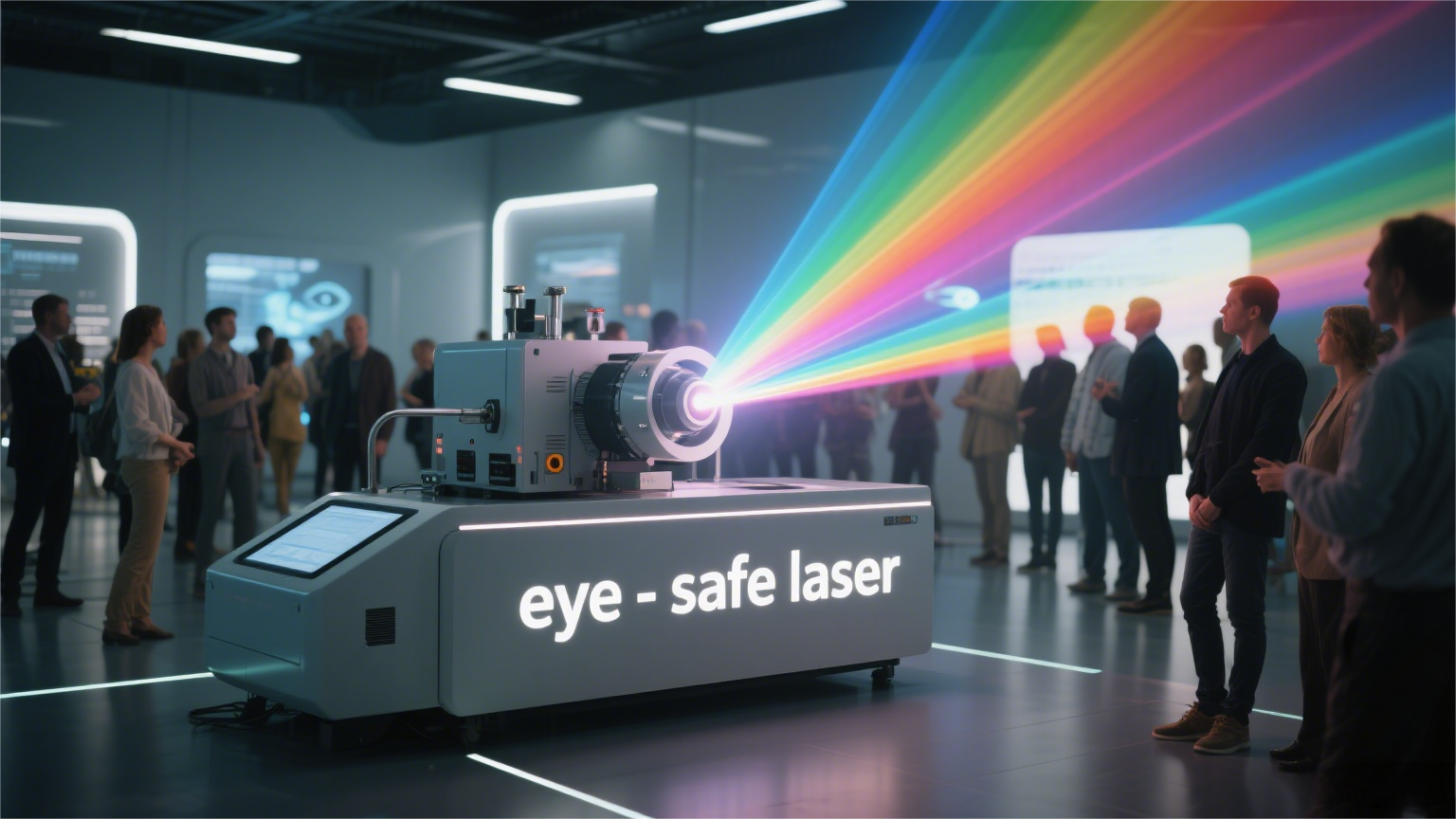
In an era driven by laser-enabled innovation—spanning industrial machining, medical cosmetology, consumer electronics, and scientific research—one crucial concern often gets overlooked: eye safety. From handheld pointers to industrial cutting systems, lasers carry risks that demand global awareness and control.
This article breaks down how lasers can harm the human eye, explains what makes a laser "eye-safe," and introduces the international standards designed to protect us.
I. How Lasers Can Damage the Eyes
Lasers are dangerous to the human eye due to their high brightness, directionality, and monochromaticity. Even low-power lasers can pose serious threats.
Retina: The Most Vulnerable Zone
-
The cornea and lens act like a magnifying lens, focusing light onto the retina—the most light-sensitive tissue in the eye.
-
When a laser beam enters the eye, it concentrates energy into a tiny point, potentially causing retinal burns or irreversible vision loss.
Laser Wavelengths and Injury Risks
-
400–1400 nm (visible to near-infrared): Known as the “retinal hazard region”—lasers in this range pass through the eye and strike the retina directly.
-
1064 nm IR light, used in many lasers, is especially risky because it’s invisible—users don’t blink or turn away in time.
-
<400 nm (UV) and >1400 nm (IR): Mostly absorbed by the cornea or lens, potentially causing cataracts, burns, or long-term degradation.
II. Laser Safety Standards: International Guidelines You Can Trust
To control these risks, international organizations developed laser safety classifications that evaluate hazards based on wavelength, power output, and exposure time.
Global Standards to Know:
-
IEC 60825 (International Electrotechnical Commission): The most widely adopted classification for laser product safety.
-
ANSI Z136.1 (USA): Offers safety thresholds and defines eye-safe wavelength ranges, particularly relevant for military, industrial, and educational use.
Laser Safety Classification Overview:
| Class | Output Power (CW) | Risk Level | Description | Common Uses |
|---|---|---|---|---|
| Class 1 | ≤ 0.39 mW | No Risk | Safe for all exposure conditions. | CD/DVD drives, barcode scanners |
| Class 2 | ≤ 1 mW | Low Risk | Blink reflex offers brief protection. Avoid prolonged exposure. | Laser pointers, basic rangefinders |
| Class 3R | 1–5 mW | Moderate Risk | Hazardous to view directly. Diffuse reflections usually safe. | Lab tools, surveying |
| Class 3B | 5–500 mW | High Risk | Can cause severe eye injury. Use protective eyewear. | Medical lasers, industrial inspection |
| Class 4 | > 500 mW | Extreme Risk | Direct and indirect exposure dangerous. Can ignite materials. | Laser cutting, military lasers |
III. What Makes a Laser “Eye-Safe”?
Wavelength Selection: Safety by Absorption
-
The safest wavelengths fall above 1400 nm, including 1535 nm erbium-glass lasers.
-
These are absorbed by the cornea and lens, never reaching the retina.
-
Widely used in military rangefinders, eye-safe LIDAR, and medical applications.
Controlled Output Power
-
Even an eye-safe wavelength can cause injury at high power.
-
Manufacturers must regulate pulse energy, beam diameter, and exposure duration to comply with safety limits.
Optical Design & Beam Divergence
-
Eye-safe lasers often incorporate beam expansion, diffusers, or divergent optics to reduce energy density.
-
This helps protect against accidental exposure in open environments or during operation in public spaces.
IV. Why Eye Safety Standards Matter More Than Ever
As lasers are integrated into autonomous vehicles, wearable devices, cosmetic tools, and consumer gadgets, eye safety is a shared responsibility between manufacturers, regulators, and users.
Global Standardization Drives Innovation
-
Harmonized standards (IEC, ANSI, GB) eliminate trade barriers and boost user confidence.
-
Collaboration between nations will further improve cross-border safety compliance.
Eye-Safe Lasers Are the Future
-
In defense, 1535nm erbium-glass rangefinders allow soldiers to measure long distances without risking retinal damage.
-
In public spaces, eye-safe LIDAR sensors protect pedestrians, drivers, and workers.
Frequently Asked Questions (FAQ)
Q1: What lasers are commonly encountered in daily life?
A: Laser printers, barcode scanners, remote controls, rangefinders, and laser pointers. Even these low-power devices should be used responsibly.
Q2: How do I know if a laser is eye-safe?
A: Look for information on wavelength, output power, and safety class (e.g., "Class 1", "IEC 60825-1 compliant") in the product’s specs or manual.
Q3: What should I do if I suspect laser eye exposure?
A: Avoid rubbing your eyes. Seek medical help immediately and provide the laser’s details (wavelength, power, duration) to your doctor.
Recommended Resources
-
IEC 60825-1: International Safety of Laser Products
-
ANSI Z136.1: American National Standard for Safe Use of Lasers
-
GB 7247.1-2012: China’s National Laser Product Safety Requirements
-
Laser Eye Protection Guide: How to choose the right safety eyewear
-
OSHA Laser Safety Standards
-
SPIE & OSA Safety Webinars
Conclusion
As laser innovation accelerates, so does the responsibility to ensure its safe use. With proper standards, design, and awareness, eye-safe lasers are redefining how we balance technological power and human health.
Let’s enjoy the benefits of lasers—safely and responsibly.
Want to learn more about safe and advanced laser technology?
Visit www.erditechs.com to explore our 1535nm eye-safe lasers, rangefinder modules, and laser safety innovations.