
Estimated reading time: 6 minutes
Last updated: March 2026
Introduction
In many sensing systems, timing is often treated as a secondary parameter compared to measurement accuracy or detection range. That assumption works in controlled environments, but it tends to break down in real-world operation. In practice, timing stability often determines whether a system behaves predictably over long periods. Real-time ranging data is rarely used on its own — it feeds tracking loops, flight control systems, or sensor fusion pipelines, all of which assume a consistent temporal structure.
Once timing becomes inconsistent, even highly accurate measurements can introduce uncertainty into downstream estimation. This issue is easy to overlook during short-duration testing, but becomes more visible in continuous operation.
Timing Stability Is Not Just About Latency
Latency describes how long it takes for a system to produce a measurement. Timing stability, on the other hand, is about whether that delay stays consistent from one cycle to the next. Two systems can have the same average latency — for example, 50 ms — but behave very differently if one of them fluctuates between 40 ms and 70 ms.
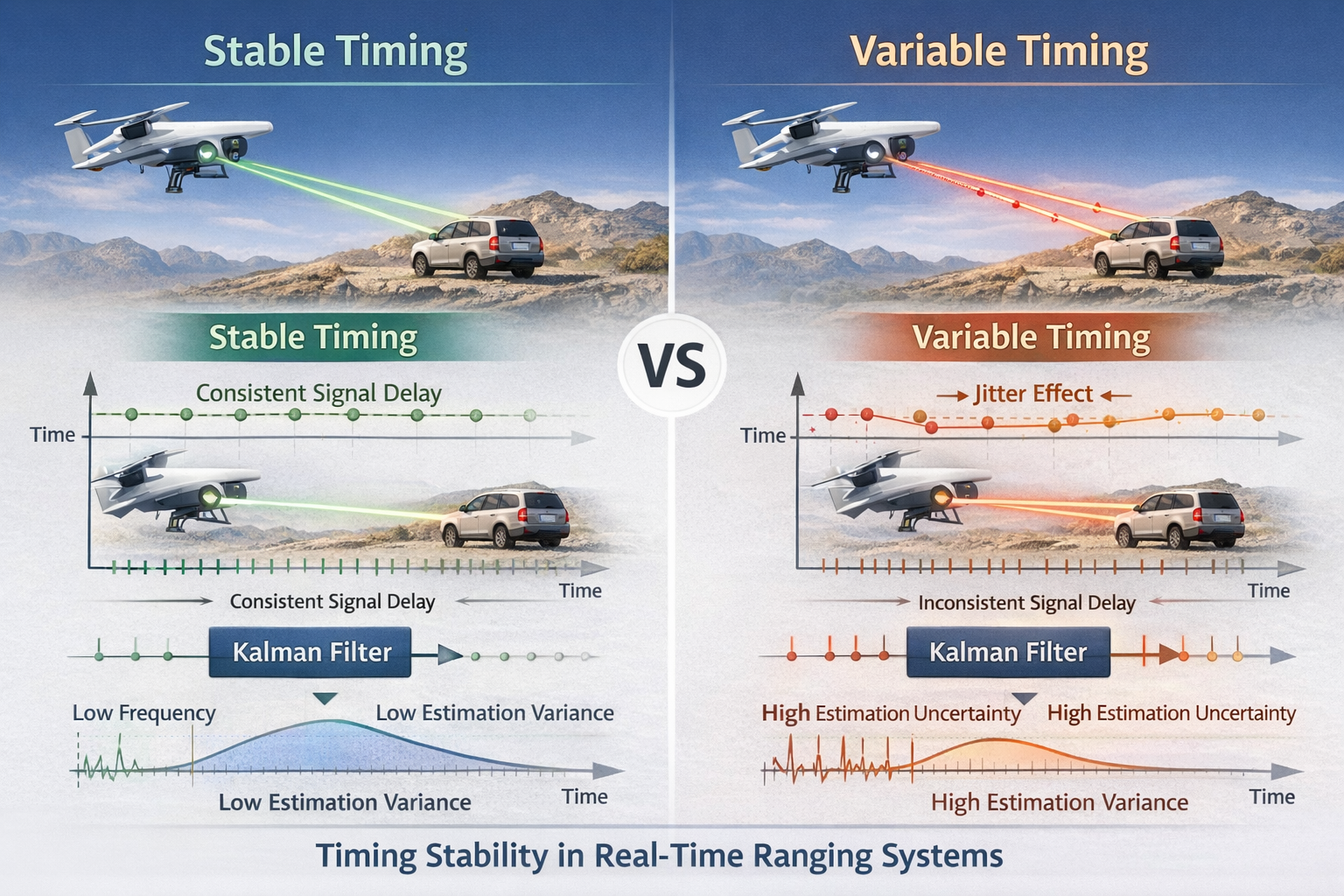
From the perspective of a tracking or control algorithm, this variation matters more than the absolute delay. When measurement timestamps are inconsistent, estimation frameworks may interpret the variation as motion uncertainty rather than timing error. In Kalman filter-based systems, this can directly affect prediction and correction balance.
In practice, fixed delay is usually easier to compensate for than variable delay.
Where Timing Instability Comes From
Timing variation is typically not caused by a single factor. It builds up across the entire sensing pipeline. At the front end, signal acquisition may vary due to changing environmental conditions or adaptive exposure strategies. In laser ranging systems, weak return signals can extend detection or validation time.
Processing stages can also introduce variability. Algorithms with dynamic filtering depth or conditional execution paths may produce inconsistent processing time depending on input data quality. Further downstream, communication interfaces (UART, CAN, Ethernet) may introduce jitter when bandwidth is shared with other system components.
In multi-sensor setups, clock drift between modules can add another layer of timing misalignment, especially when synchronization is not hardware-based. Individually, these effects are small. Combined, they can produce noticeable timing instability at the system level. Similar timing consistency challenges have also been discussed in aerospace systems, where measurement timing directly affects navigation and control stability (NASA).
Impact on Tracking and Estimation
Most real-time estimation frameworks assume that each measurement corresponds to a well-defined point in time. As timing jitter increases, that assumption becomes weaker. In tracking applications, unstable timing can appear as artificial motion noise. A stationary or smoothly moving target may seem to accelerate or oscillate due to inconsistent measurement intervals.
In UAV navigation, for example, this can affect altitude hold or obstacle avoidance behaviour, even when range accuracy remains high;in sensor fusion systems, misalignment between data streams (e.g., LiDAR, IMU, EO sensors) can reduce confidence in measurement consistency. Fusion algorithms often treat this as increased uncertainty rather than a timing issue.
Over time, these effects may degrade system stability more than small errors in measurement accuracy.
What Happens During Real Integration
Timing-related issues often do not appear during lab validation. Under controlled conditions, processing load is stable, communication is predictable, and system clocks remain synchronized. Timing behaviour looks clean and repeatable. Once deployed, the situation changes. CPU load varies, communication channels become congested, and environmental factors affect signal processing time. In several UAV and electro-optical integration cases, reducing algorithm complexity or simplifying data flow has led to more stable system behaviour than attempting to further improve measurement precision.
In other words, stability sometimes benefits more from simplification than from optimization.
Designing for Timing Stability
Improving timing stability is usually an architectural problem rather than a parameter tuning issue. In practical system design, engineers often focus on reducing variability instead of minimizing delay. Typical approaches include:
- Keeping time-critical processing paths fixed and deterministic
- Avoiding algorithms with highly variable execution time
- Using shared or hardware-synchronized clocks across modules
- Separating high-priority sensor data from non-critical communication traffic
These choices help maintain consistent timing, even if the overall latency is not minimized. In many applications, a system running at 10 Hz with stable timing will outperform a 20 Hz system with significant jitter. Research in real-time sensing and control systems (IEEE) shows that timing jitter can significantly affect estimation stability, even when measurement accuracy remains high.
Conclusion
Timing stability is a fundamental but often overlooked aspect of real-time laser ranging performance. When measurement timing becomes inconsistent, downstream systems may interpret this as uncertainty, affecting tracking accuracy and control behaviour. In many cases, the impact is more significant than small differences in range precision.
As sensing systems become more integrated — especially in UAVs, robotics, and electro-optical tracking — maintaining predictable timing is increasingly important.
In practical engineering terms, consistent timing is not just a performance detail. It is what allows the rest of the system to function reliably.
Related articles: