
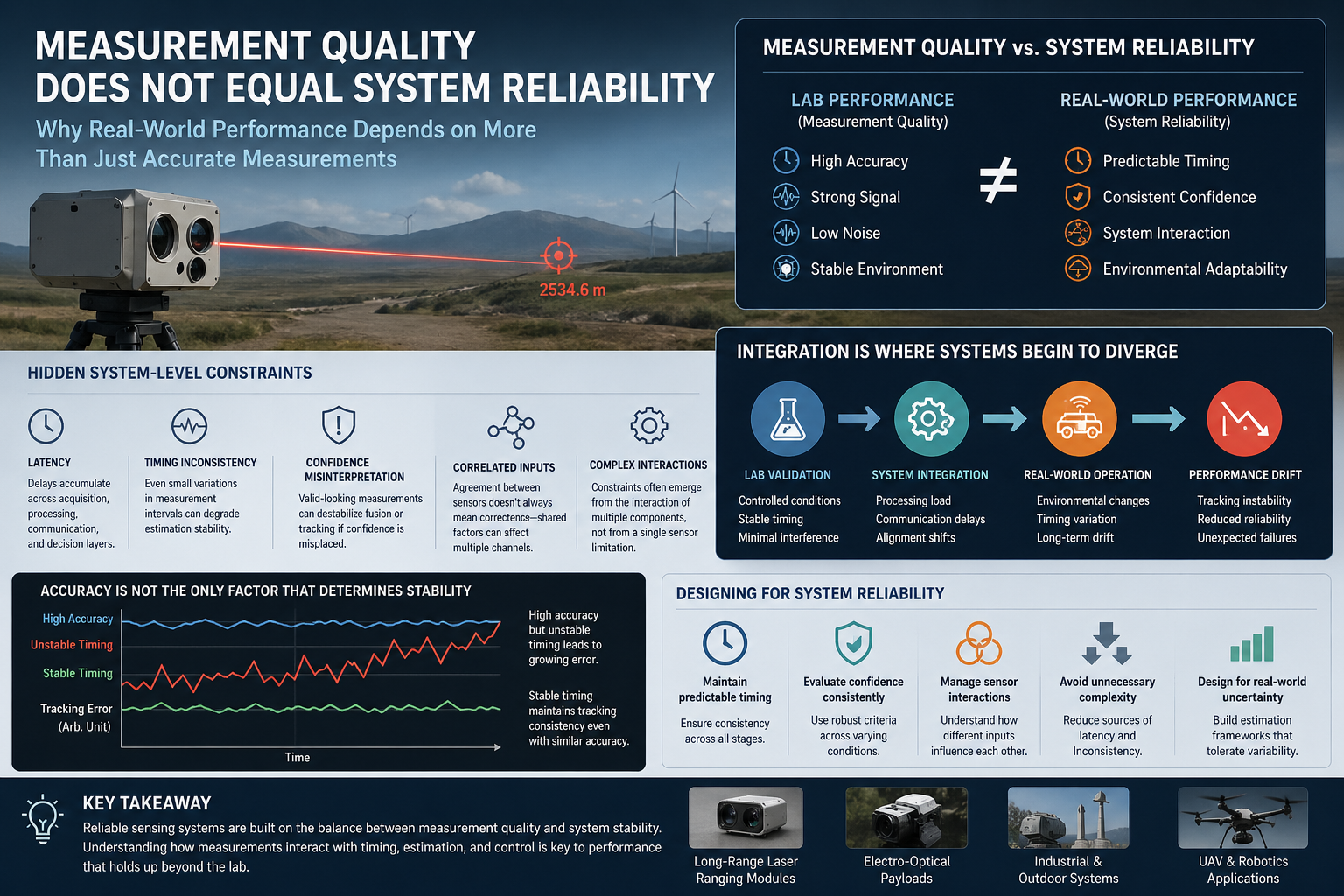
In sensing system design, improving measurement quality is often viewed as the most straightforward path to better performance. Higher accuracy, stronger signal returns, and more advanced processing—these are the metrics teams typically prioritize, expecting them to deliver more reliable outcomes.
Yet real-world results often tell a different story. Systems with high-quality measurements don’t always perform reliably in practice. In many real-time architectures, failures stem not from inaccurate readings, but from how those measurements interact with timing, control logic, and underlying system constraints. This gap between measurement quality and actual system behavior usually only becomes clear post-deployment. This issue is closely related to how measurement confidence is interpreted in real-time systems.Measurement Quality Does Not Equal System Reliability
Measurement performance is nearly always tested in isolation. Accuracy, repeatability, and detection range are validated under controlled lab conditions—stable targets, predictable environments, and minimal external interference. System reliability, by contrast, hinges on how measurements are applied over time, in dynamic scenarios.
Consider a highly accurate distance measurement: it can still trigger unstable tracking if it arrives too late, conflicts with other sensor inputs, or is assigned misplaced confidence within the system. In real-time sensing architectures, reliability is a product of interaction—not just the quality of individual measurements. This becomes especially evident when accuracy and update timing are not aligned. Sometimes the interaction itself is difficult to characterize.
Hidden System-Level Constraints
Many system limitations fly under the radar at the sensor level. Latency is a prime example. Even when individual components meet their timing specs, cumulative delays across acquisition, processing, communication, and decision layers can erode system responsiveness.
Timing inconsistency adds another layer of complexity. Even small variations in measurement intervals can influence system stability over time. Small variations in measurement intervals may not hurt accuracy directly, but they can disrupt estimation frameworks that rely on stable temporal structure. Confidence handling also matters: measurements that seem valid can still introduce instability if their reliability is misinterpreted in fusion or tracking logic.
In multi-sensor systems, correlated inputs further complicate things. This is particularly relevant when sensor diversity is limited and inputs share similar failure modes. Agreement between sensors doesn’t always signal correctness—especially when shared environmental factors (like temperature shifts or ambient light) influence multiple channels at once. These constraints are subtle, often eluding detection during early development.
Integration Is Where Systems Begin to Diverge
Most sensing systems perform as expected during laboratory validation. Controlled environments offer stable conditions, predictable timing, and little interference between subsystems. But once integrated into operational platforms—whether industrial machinery, outdoor equipment, or mobile units—additional variables come into play. These changes are usually gradual rather than immediate.Processing loads fluctuate. Communication delays grow inconsistent. Sensor alignment shifts due to motion or mechanical wear. Environmental conditions introduce further uncertainty. It’s in this real-world context that system behavior drifts from initial expectations.
From our observations across multiple integration projects, teams often see diminishing returns from improving individual sensor performance once system-level interactions become the dominant factor.
Why Problems Often Appear After Deployment
System-level issues rarely surface during short-duration testing. Early validation phases use limited scenarios and controlled inputs—timing variation, environmental dynamics, and long-term drift aren’t fully tested. Post-deployment, extended operation uncovers interactions that were previously hidden.
Small timing inconsistencies, for instance, can accumulate over time, disrupting synchronization between sensing modules. Confidence thresholds that work well in stable lab settings may behave erratically in dynamic real-world environments. These issues don’t always cause immediate failures; instead, they lead to gradual degradation in stability, tracking consistency, or decision reliability.
Practical Observation in EO Ranging Integration
In compact electro-optical (EO) ranging architectures—common in outdoor industrial applications—teams often grapple with trade-offs between adding sensing inputs and maintaining system stability. A typical scenario involves integrating a long-range laser ranging module with visual tracking and platform control systems.
Initial lab testing usually shows strong ranging accuracy and stable signal performance. But during extended field operation, timing alignment between ranging updates and tracking loops becomes far more critical than peak measurement precision. In some cases, maintaining consistent update intervals and predictable latency does more for stable tracking than increasing sensor complexity.
Systems that prioritize a stable measurement cadence often deliver more consistent performance—even when nominal accuracy stays the same.
Designing for System Reliability
Improving system reliability requires shifting focus from how measurements are produced to how they’re used. Key design considerations include:
-
Maintaining predictable timing across all sensing and processing stages
-
Ensuring consistency in how measurement confidence is evaluated
-
Managing interactions between different sensing modalities (e.g., laser ranging + visual tracking)
-
Limiting unnecessary system complexity that could introduce latency or inconsistency
-
Designing estimation frameworks that tolerate real-world uncertainty
These factors are typically addressed at the architectural level—not through sensor optimization alone. In practice, reliability comes from balancing measurement quality with system stability. Many of these effects are not visible when evaluating sensors in isolation.
Conclusion
High-quality measurements are essential, but they’re not enough to guarantee reliable system behavior. In real-time sensing architectures, performance depends on how measurements interact with timing, estimation, and control mechanisms. Many failures arise not from incorrect data, but from mismatches between measurement characteristics and system expectations.
These issues often only become visible post-deployment, when real-world conditions expose hidden constraints. Understanding this gap between measurement performance and system reliability is key to designing sensing systems that remain stable beyond the lab—whether for industrial, outdoor, or mobile applications.