
Introduction
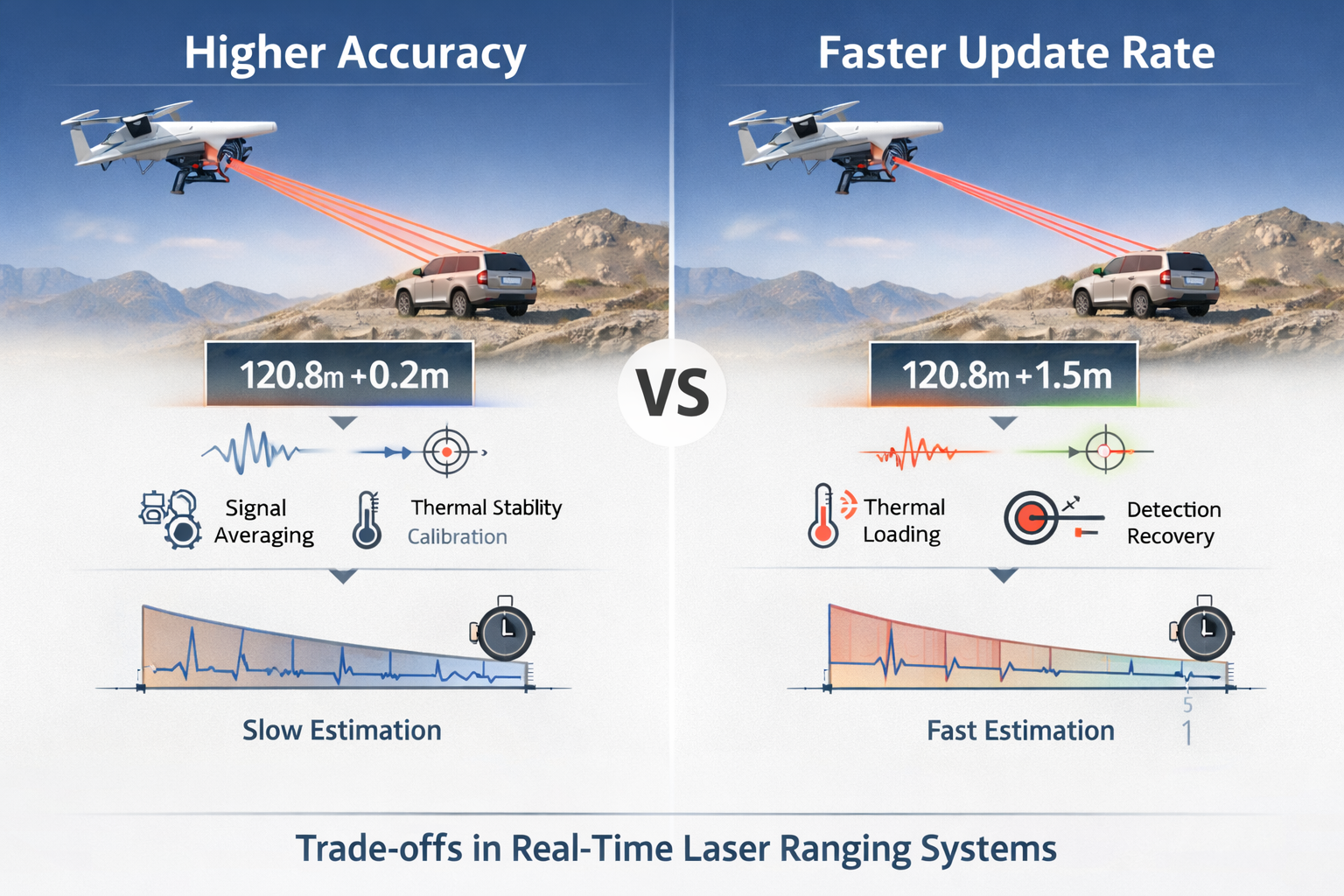
In laser ranging system design, performance is typically characterized by two core parameters: measurement accuracy and update rate. Both influence how effectively a sensing system responds to dynamic environments such as UAV navigation, electro-optical tracking, robotic perception, and industrial automation. At first glance, maximizing both accuracy and measurement frequency appears desirable. In practice, however, engineering constraints often require a balance between spatial precision and temporal resolution. Increasing update rate can introduce challenges related to signal stability and processing bandwidth, while optimizing for maximum accuracy may reduce responsiveness to rapid target motion.
In real-world sensing architectures, system reliability rarely depends on a single specification. Stable interaction between measurement precision and predictable timing behaviour often contributes more to overall performance than peak parameter values alone.
Measurement Accuracy Depends on Signal Stability
Range accuracy is closely related to signal-to-noise ratio, pulse energy consistency, detector sensitivity, and atmospheric transmission conditions. Achieving higher precision typically requires stable signal return characteristics combined with selective signal processing strategies. In many laser rangefinder designs, improving measurement resolution involves longer integration time, stricter signal validation thresholds, or additional filtering techniques. While these approaches may improve distance precision under controlled conditions, they can also increase sensitivity to motion disturbance, vibration, or air turbulence in outdoor environments.
For mobile platforms such as UAVs or stabilized electro-optical systems, maintaining consistent signal quality over extended operating periods is often more challenging than achieving high single-shot accuracy in laboratory testing.
Environmental influences such as target reflectivity variation, beam pointing jitter, and atmospheric scattering may affect effective ranging accuracy more than theoretical resolution limits specified in datasheets.
Increasing Update Rate Introduces Timing Constraints
Higher update frequency allows distance measurements to follow rapid changes in target position. This becomes particularly relevant when relative motion introduces continuous variation in range, such as obstacle avoidance, terrain following, or dynamic target tracking. However, increasing pulse repetition frequency introduces additional system-level considerations. Detector recovery time, thermal behaviour of laser emitters, and signal processing bandwidth all influence achievable measurement cadence. Shorter sampling intervals may also reduce the available time for signal averaging, potentially affecting measurement consistency under low signal conditions.
In many UAV integration projects, update rate requirements are often determined by flight control loop bandwidth rather than theoretical sensor limits. For example, moderate update rates in the range of 5–20 Hz may already provide sufficient temporal resolution for stable distance estimation when platform motion remains relatively predictable.
Extremely high measurement frequency does not always translate into improved system performance if signal quality becomes less stable at shorter sampling intervals.
Accuracy and Update Rate Influence Estimation Behaviour Differently
Measurement accuracy primarily contributes to spatial confidence, while update rate influences temporal continuity in state estimation algorithms.
High-precision measurements obtained at moderate frequency can still support stable tracking when target motion follows predictable trajectories. Conversely, higher measurement frequency combined with moderate uncertainty may improve estimation robustness when motion behaviour becomes less predictable or when environmental disturbances introduce intermittent signal fluctuation. Many sensor fusion frameworks balance prediction stability with periodic measurement correction. In such systems, consistent measurement timing often contributes as much to estimation stability as absolute ranging precision.
As a result, performance optimization frequently occurs at the system level rather than through isolated improvement of a single sensor parameter.
Practical Observations in Dynamic Environments
Field deployment often reveals differences between theoretical performance and operational behaviour.
Atmospheric turbulence, scattering conditions, and variations in target surface reflectivity can introduce fluctuations in received signal amplitude. Under such conditions, slightly higher update frequency may increase the probability of obtaining stable measurements across multiple sampling cycles. In other scenarios, measurement stability may benefit more from stronger signal return characteristics than from faster repetition rate. For example, long-range ranging tasks often rely more heavily on pulse energy stability than on high measurement frequency.
These trade-offs are not always fully visible during controlled laboratory testing and typically become more apparent after extended outdoor operation.
Stability Often Contributes More Than Peak Specification
Datasheets commonly highlight maximum achievable accuracy or highest supported update frequency. During system integration, however, engineers often prioritize consistent behaviour across varying environmental conditions.
Stable measurement cadence, predictable latency, and manageable processing load frequently contribute more to overall system reliability than peak specification values alone. When ranging performance remains consistent despite environmental variation, downstream estimation algorithms can operate more efficiently and with fewer correction artifacts.
Careful balancing of measurement precision and update frequency often emerges gradually during integration testing and application-specific optimization.
Conclusion
Measurement accuracy and update rate represent complementary dimensions of laser ranging performance. Each parameter influences estimation stability in different ways depending on motion characteristics, environmental variability, and system architecture.
Rather than maximizing individual specifications, system designers typically evaluate how spatial precision and temporal resolution interact within the broader sensing framework. Balanced parameter selection often supports more stable real-time operation than peak specification values alone, particularly in applications requiring predictable performance over extended operating periods.
In practical laser ranging applications, consistent and repeatable measurement behaviour frequently provides greater system value than isolated improvements in a single performance metric.
Related articles: