
Introduction
In many sensing systems, measurement accuracy is often treated as the primary indicator of performance. In practice, however, accuracy alone does not determine whether a measurement can be trusted.
Real-time ranging systems operate in environments where signal quality, environmental conditions, and system dynamics continuously change. Under these conditions, the reliability of a measurement depends not only on its numerical value, but also on the confidence associated with it.
In many integration projects, engineers spend more time evaluating whether to trust a measurement than improving its theoretical precision.
In practice, this distinction is often not obvious during early system validation.
Measurement Accuracy and Measurement Confidence Are Not the Same
Accuracy describes how close a measurement is to the true value. Confidence describes how reliable that measurement is under current conditions.
A measurement can appear accurate but still carry low confidence if environmental conditions are unstable or if signal characteristics are inconsistent.
This situation is not uncommon in outdoor testing environments.
Conversely, a measurement with moderate precision but high confidence may be more useful for maintaining stable system behaviour.
This distinction becomes particularly important in real-time systems, where decisions must be made continuously rather than retrospectively.
Where Measurement Uncertainty Comes From
Measurement uncertainty is rarely caused by a single factor.
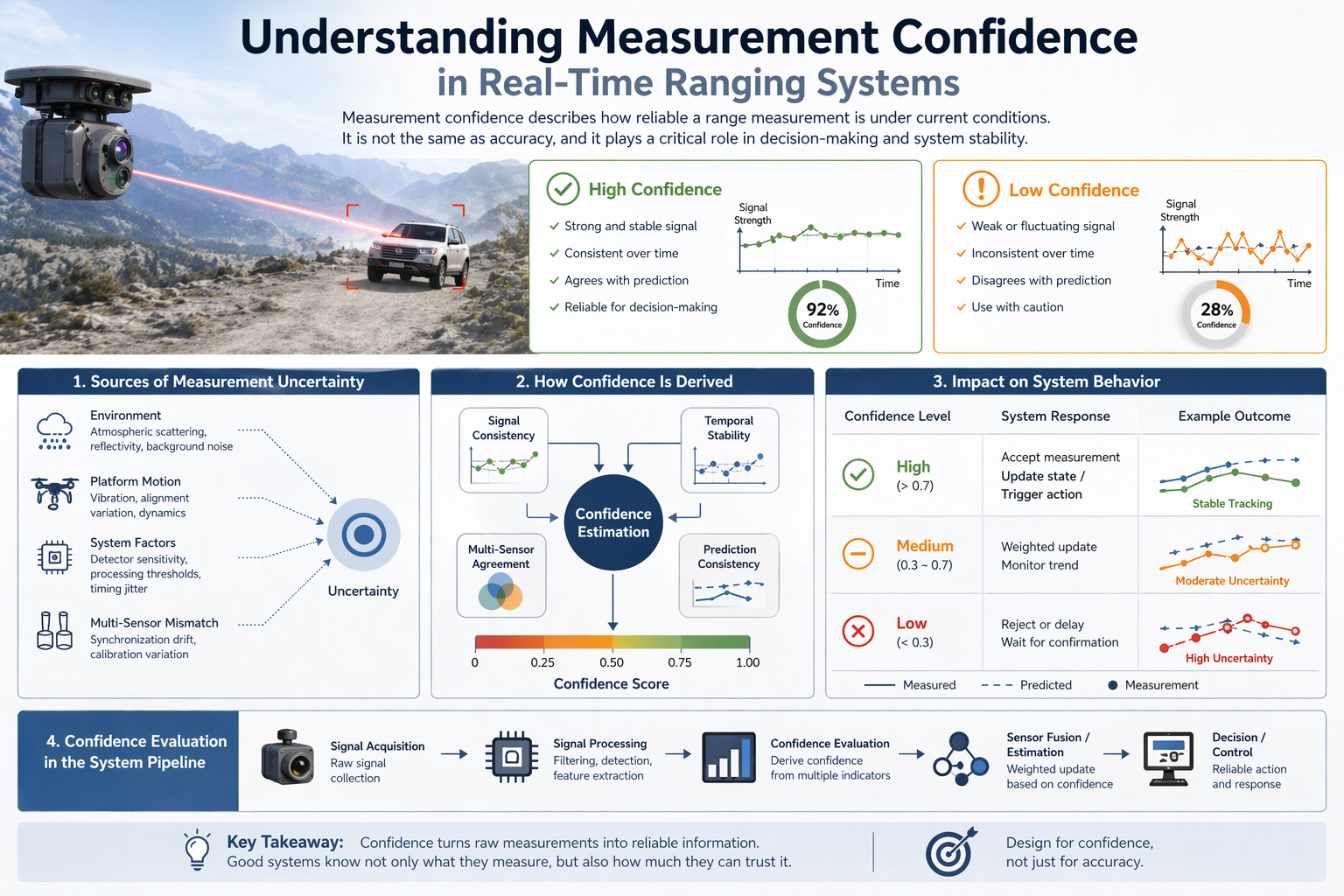
Environmental effects such as atmospheric scattering, reflectivity variation, and background noise can influence signal quality. Platform motion may introduce alignment variation or signal fluctuation. Internal system factors, including detector sensitivity and processing thresholds, may also contribute to uncertainty.
These sources of variation do not always behave independently, and in some cases their interaction is difficult to isolate.
In many UAV-based systems, these effects evolve gradually rather than appearing as obvious measurement failures.
Confidence is rarely a fixed property.
Confidence Is Often Derived, Not Measured
Unlike distance or signal amplitude, confidence is not directly measured.
It is typically inferred from signal characteristics and system behaviour.
Examples include:
-
Signal strength consistency across multiple samples
-
Consistency with predicted system state
In some UAV tracking systems, confidence thresholds are adjusted based on motion stability rather than signal strength alone.
These factors are often combined into confidence metrics used by estimation or decision frameworks.
In practice, confidence evaluation depends strongly on system architecture and application context.
Impact on Decision-Making and System Behaviour
Confidence directly influences how systems respond to measurement data.
High-confidence measurements may trigger immediate tracking updates or control actions. Low-confidence measurements may be filtered, delayed, or ignored.
In some architectures, confidence weighting determines how much influence each measurement has on state estimation.
When confidence estimation is poorly designed, systems may react strongly to unreliable data or ignore useful information.
Over time, this can lead to unstable behaviour, particularly in dynamic environments.
Practical Observations in Integrated Systems
In electro-optical and UAV-based systems, confidence-related issues often become visible only after integration.
During controlled testing, signal conditions are relatively stable, and confidence metrics may appear consistent. Once deployed, environmental variability introduces fluctuations that expose weaknesses in confidence evaluation.
In some integration stages, these issues are only noticed after extended operation rather than during initial testing.
In several projects, adjusting confidence thresholds or introducing multi-frame validation improved stability more effectively than modifying sensor hardware.
Designing for Reliable Confidence Evaluation
Improving confidence evaluation typically involves system-level design considerations.
Common approaches include:
-
Combining temporal consistency checks with signal-based metrics
-
Using prediction models to validate measurement plausibility
-
Adjusting confidence thresholds based on environmental conditions
-
Avoiding reliance on a single confidence indicator
These strategies aim to ensure that confidence reflects actual measurement reliability rather than static assumptions. In practice, confidence evaluation often evolves during system integration rather than being fully defined at the outset.
Conclusion
Measurement confidence plays a central role in determining how real-time ranging systems behave under uncertainty.
While accuracy defines potential precision, confidence determines practical usability.
In dynamic environments, system stability often depends on how measurement reliability is interpreted rather than how precisely distance is measured.
In practice, this distinction often becomes clear only after systems begin operating under real conditions.