
Introduction
In sensing and detection systems, performance is often framed as a balance between detection probability and coverage range. Missed detections are typically treated as the primary failure mode, while false alarms are considered a secondary inconvenience—something that can be filtered, tolerated, or corrected later.
In integrated autonomous and security systems, this assumption no longer holds.
As sensing architectures evolve toward tightly coupled perception–decision–action loops, false alarms introduce costs that propagate far beyond the sensor layer. In many real deployments, false alarms degrade system effectiveness more severely than occasional missed detections. This article examines why false alarms should be treated as a system‑level cost rather than a sensor‑level imperfection.
1. Why False Alarms Can Be More Damaging Than Missed Detections
A missed detection represents a lack of information. A false alarm represents incorrect information.
In autonomous systems, incorrect information is often more dangerous than incomplete information. When a system believes a non‑existent target is real, it initiates downstream actions: tracking, classification, threat evaluation, and sometimes physical response. Each step consumes computational resources, operator attention, and system confidence.
Repeated false alarms erode trust in the sensing stack. Operators begin to ignore alerts. Autonomous systems raise thresholds or introduce conservative logic, reducing responsiveness when real threats emerge. Over time, the system adapts not to reality, but to its own noise.
2. False Alarm Propagation in Autonomous Decision Loops
False alarms rarely remain localized.
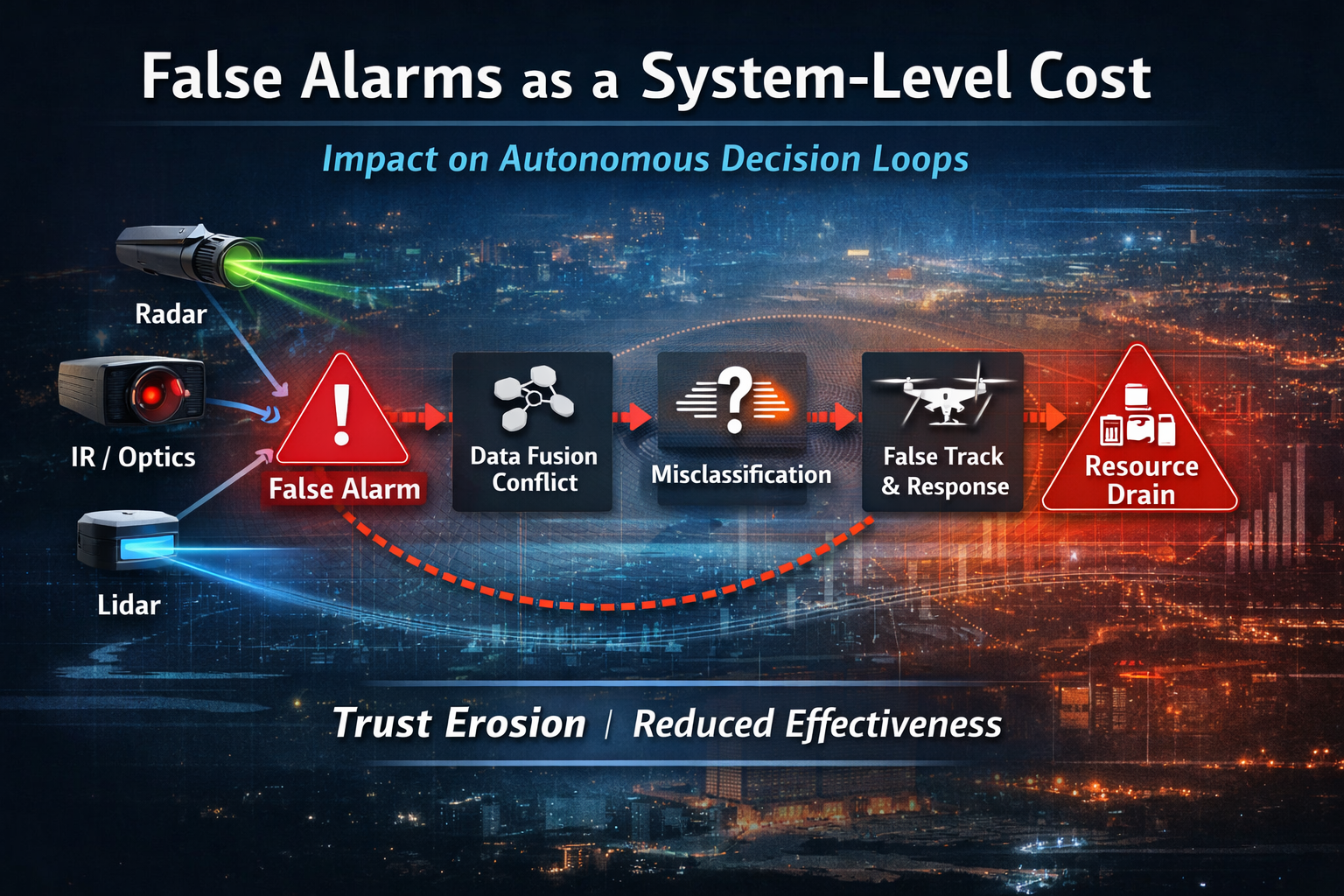
Once a spurious detection enters an autonomous loop, it can trigger a cascade:
- Sensor cueing and gimbal movement
- Additional sensor activation for confirmation
- Data fusion conflicts between modalities
- Classification ambiguity and confidence dilution
- Premature or unnecessary action commands
Each stage amplifies the original error. What began as a marginal signal fluctuation becomes a system‑wide event. Unlike latency, which introduces temporal misalignment, false alarms introduce logical distortion—forcing the system to reason about something that does not exist.
3. Operational Cost in Border and Counter‑UAS Systems
In border surveillance and counter‑UAS deployments, false alarms carry tangible operational costs.
In border monitoring, repeated false alerts increase patrol workload, inflate response cycles, and reduce attention to genuine anomalies. Environmental clutter—vegetation, terrain reflections, weather effects—often generates ambiguous signals that must be resolved quickly and reliably.
In counter‑UAS systems, false alarms are even more disruptive. Each alert may trigger escalation procedures, sensor handoffs, or engagement readiness. When false alarms dominate, systems either exhaust resources or suppress alerts entirely—both outcomes reducing real intercept effectiveness.
In these environments, stability and predictability often outweigh raw sensitivity.
4. The Role of Laser Ranging in Reducing Misclassification
Laser ranging does not inherently eliminate false alarms, but it can constrain them.
Precise distance data provides a physical consistency check within multi‑sensor fusion architectures. Range stability over time helps distinguish real targets from transient artifacts. Temporal coherence in ranging data supports motion validation and trajectory estimation, reducing the likelihood that noise is promoted to a confirmed track.
However, this benefit depends on integration quality. Ranging data that is accurate but temporally misaligned can increase ambiguity rather than reduce it. As discussed in Week 1, timing integrity determines whether ranging information suppresses or amplifies false alarms.
5. Design Tradeoffs: Conservative vs. Aggressive Architectures
System designers face an unavoidable tradeoff.
Aggressive detection architectures prioritize sensitivity and early warning, accepting higher false alarm rates. Conservative architectures prioritize stability, reducing false positives at the cost of delayed or missed detections.
In autonomous systems, this tradeoff is not purely technical—it is architectural. Designers must decide whether the system optimizes for maximum theoretical coverage or for consistent decision quality under uncertainty.
Increasingly, mature systems favor controlled sensitivity paired with robust validation mechanisms. The goal is not to detect everything, but to act correctly on what is detected.
Conclusion
False alarms are not a nuisance; they are a system‑level cost.
As sensing systems transition from passive observation tools to active decision‑making components, the impact of incorrect detections becomes multiplicative. Managing false alarms requires more than sensor tuning—it demands architectural discipline, temporal alignment, and clear prioritization of decision quality over headline performance metrics.
In the next article, we will examine how confidence scoring and uncertainty handling shape system behavior—and why reliable decisions often depend more on what a system chooses not to act on than on what it detects.
This article discusses system-level engineering principles and does not describe operational or tactical procedures.
Explore other system issues:
Distance Accuracy vs. System Latency Why Precision Alone Is Not Enough
False Alarms in Autonomous Sensing Systems: Confidence Over Detection
Feedback Loops in Autonomous Sensing Systems: A Systems Perspective
Correlated Failure in Multi-Sensor Redundancy: More Sensors ≠ Higher Reliability