
Introduction
Accuracy is often treated as the primary benchmark when evaluating sensing technologies. Higher resolution, improved signal processing, and advanced filtering are commonly expected to improve system performance.
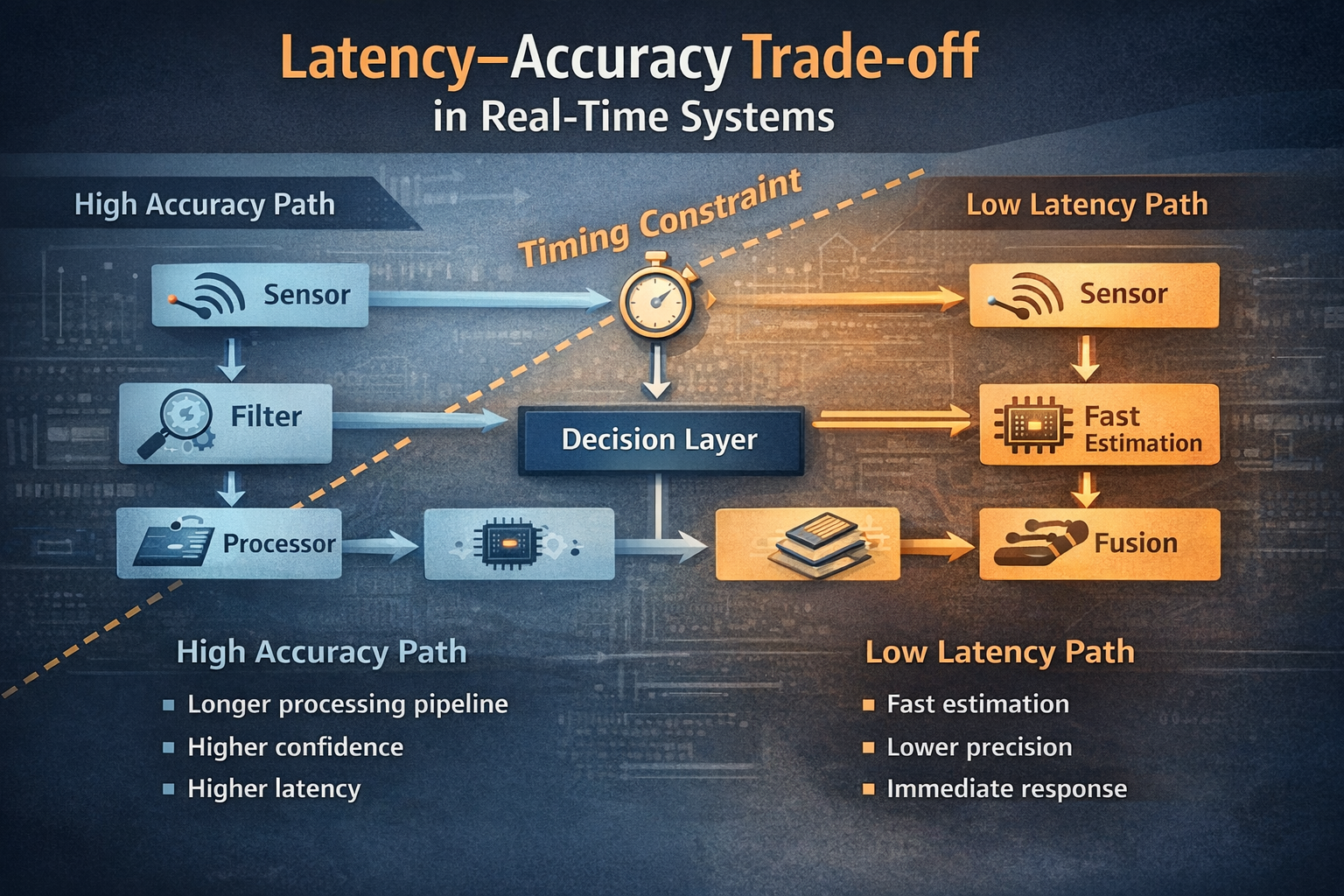
In many electro-optical tracking and UAV perception pipelines, however, accuracy alone does not determine effectiveness. Data must not only be precise — it must also arrive within a time window that allows the system to react. When processing delays increase, even highly accurate measurements may lose practical value.
For systems operating under continuous feedback or fast-changing environmental conditions, the balance between latency and accuracy becomes a defining design constraint rather than a secondary consideration. Take the ERDI rangefinder module as an example, the accuracy rate is above 98%.
1. When Higher Accuracy Does Not Improve Outcomes
In offline analysis, improved accuracy typically leads to better results. Real-time systems behave differently.
Perception outputs must be delivered within deadlines defined by control loops, tracking logic, or operator interaction timing. If updated information arrives too late, the system may respond to conditions that no longer exist.
For moving targets, even small timing offsets can produce noticeable positional deviation. In field deployments, integration teams often observe that increasing processing depth produces smaller performance gains than expected once timing constraints are considered.
Beyond a certain point, additional precision contributes less to system effectiveness than maintaining stable and predictable update intervals. These effects often become visible only after extended operation under dynamic conditions.
2. Where Latency Accumulates in Practice
Latency rarely originates from a single stage. Instead, it emerges gradually across the sensing pipeline.
Signal acquisition time is one contributor. Increasing integration or exposure duration may improve signal quality, but also delays the availability of measurement results. Preprocessing steps such as denoising, confidence estimation, or temporal smoothing introduce additional computational layers that may extend processing time.
Communication interfaces also contribute to delay, particularly when multiple subsystems exchange synchronized data across embedded networks. Fusion layers must often reconcile different sampling frequencies or timestamp references, especially in multi-sensor architectures combining electro-optical and ranging subsystems.
Individually, each delay source appears manageable. Combined, however, they can extend response time beyond limits assumed during early architectural design.
In mobile sensing platforms, these accumulative delays are often more visible when systems operate under tight power or compute constraints.
3. Processing Depth and Diminishing Returns
Additional processing is often introduced to stabilize outputs or reduce uncertainty. While these measures may improve signal clarity, they can also suppress short-duration features that are operationally relevant.
Longer temporal smoothing windows may increase confidence metrics while masking rapid target motion. Similarly, complex validation logic may improve robustness in static scenarios but reduce responsiveness in dynamic environments.
These trade-offs are not always apparent during controlled evaluation phases, particularly when datasets emphasize signal quality rather than timing sensitivity.
During real-world deployment, timing-related degradation frequently becomes noticeable only when systems encounter fast-changing motion patterns or intermittent signal conditions.
4. Latency Sensitivity Depends on System Context
The impact of latency depends on how sensing architecture interacts with control and decision layers.
Target speed and control loop frequency jointly influence how quickly measurements lose relevance. Systems operating at higher update frequencies typically require tighter alignment between perception outputs and actuation timing.
Sensor update rate also affects how prediction models compensate for temporal gaps. State estimation methods, including Kalman filtering approaches, are commonly used to maintain stable tracking when measurement updates are not perfectly synchronized.
Human-supervised systems may tolerate moderate delays, while fully autonomous platforms operating without intervention often require more consistent temporal behavior.
As a result, acceptable latency thresholds emerge from system-level timing relationships rather than individual sensor specifications.
5. Practical Approaches to Managing the Trade-off
Balancing latency and accuracy often requires architectural adjustments rather than isolated parameter tuning.
In some real-time ranging and electro-optical tracking systems, coarse but fast estimation paths are used to maintain responsiveness, while slower refinement stages improve confidence when timing margins allow. Parallel processing structures may separate time-critical estimation from computationally intensive validation routines.
Predictive filtering methods can partially compensate for sensing delays when motion dynamics remain reasonably constrained. In practice, engineers often adapt processing depth depending on environmental stability, allowing reduced filtering when signal conditions remain consistent. These strategies reflect a broader principle: improving signal quality should not compromise temporal stability.
6. Example: Latency Considerations in Long-Range Laser Ranging Integration
Latency considerations are particularly visible in long-range laser ranging modules integrated into electro-optical tracking systems.
For example, the LDR80K1 is designed for extended-distance measurement scenarios where detection confidence and response timing must remain balanced. Increasing signal averaging can improve ranging stability under weak return conditions, but may also introduce additional delay between measurement cycles.
In mobile tracking platforms, engineers often evaluate whether slightly reduced averaging allows more frequent distance updates, improving overall tracking continuity even if individual measurements exhibit marginally higher variance.
This type of adjustment illustrates a common integration decision: system-level responsiveness may benefit more from stable update timing than from maximizing single-measurement precision.
Such trade-offs become particularly relevant when ranging data feeds into higher-level fusion or motion prediction modules.
Conclusion
Accuracy remains an important performance dimension, but its operational value depends on timing context.
Measurements that arrive outside useful decision windows may not improve system effectiveness, regardless of their precision. In real-time sensing architectures, system stability often depends on maintaining predictable update timing alongside acceptable measurement uncertainty.
Rather than optimizing accuracy in isolation, engineering teams frequently evaluate how sensing delays interact with control loops, fusion logic, and decision timing requirements.
In operational environments, performance is shaped not only by measurement quality, but by whether that information arrives early enough to influence system behavior.
Designing effective sensing systems therefore requires balancing precision with temporal availability — ensuring that improved signal quality does not come at the cost of actionable timing.
Written by ERDI Technical Team
Specializing in laser ranging, electro-optical sensing, and system integration technologies.
Related Articles:
Why Sensor Fusion Alone Cannot Guarantee Robust Multi-Sensor Systems