
Introduction
Redundancy is often assumed to increase reliability.
In autonomous sensing systems, adding multiple sensors is frequently presented as a straightforward method to reduce risk and improve detection confidence.
However, redundancy does not automatically guarantee resilience.
When failure modes are correlated, additional sensors may reinforce the same blind spots rather than mitigate them.
Understanding correlated failure in multi-sensor redundancy is therefore essential for designing systems that remain stable under real-world uncertainty. In extended deployments, correlated weaknesses often remain invisible until environmental stress conditions expose shared vulnerabilities.
1. Redundancy vs. Independence
True redundancy requires statistical independence.
If two sensors:
- Share the same environmental vulnerabilities
- Operate under identical geometry
- Depend on common timing references
- Use similar signal processing pipelines
then their errors are likely to be correlated.
In such cases, adding more sensors increases system complexity without proportionally increasing reliability.
In field deployments, correlated degradation often becomes visible only under specific environmental conditions — heavy rain, dense clutter, thermal gradients, or electromagnetic interference.
2. Sources of Correlated Failure
Correlated failure can emerge from multiple layers of system architecture.
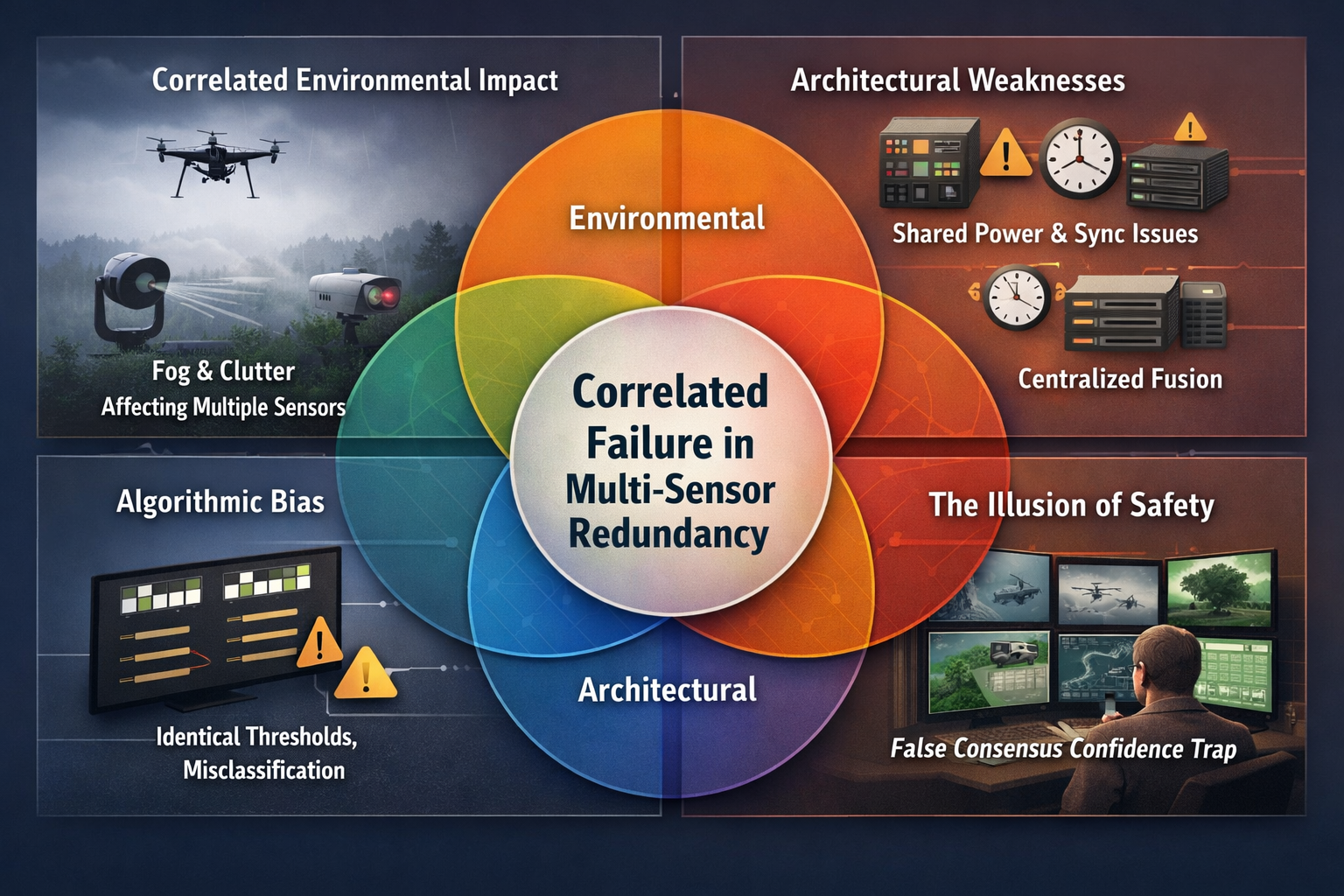
Environmental correlation may occur when fog reduces both optical and infrared contrast, when background clutter simultaneously affects radar and lidar performance, or when sun angle influences multiple electro-optical channels at once.
Architectural Correlation
- Shared power supply instability
- Common clock synchronization errors
- Centralized fusion algorithms with identical thresholds
Algorithmic Correlation
If different sensors feed into a fusion engine that applies the same confidence weighting logic, misclassification bias may propagate uniformly.
In such scenarios, redundancy exists physically — but not statistically. For example, a radar–lidar pair may appear complementary during daytime evaluation. Yet under heavy precipitation, multipath reflections and scattering may degrade both channels in subtly correlated ways.
3. The Illusion of Safety
Redundant systems can create a false perception of robustness.
When multiple sensors agree, operators often interpret consensus as confirmation.
Yet consensus may simply reflect shared bias.
In practice, correlated failure tends to surface during rare events — precisely when reliability matters most.
This is particularly relevant in:
- Counter-UAS interception
- Border monitoring under adverse weather
- Autonomous perimeter security
Rare environmental conditions often align sensor weaknesses. Operators may not immediately recognize correlated bias, especially when agreement appears statistically strong during routine operation. In practice, fully eliminating correlation is rarely feasible; the objective is to reduce its impact below operational risk thresholds rather than remove it entirely.
4. Designing for True Resilience
Mitigating correlated failure requires more than sensor diversity in name.
Independence must span sensing physics, spectral behavior, geometry, processing logic, and even power distribution.
In practice, achieving independence often requires architectural trade-offs. Different sensing paths may need separate preprocessing stages, independent timing references, or even distinct power domains to avoid shared failure triggers.
This may include:
- Decentralized preprocessing
- Cross-validation across asynchronous time bases
- Adaptive fusion thresholds under environmental uncertainty
The goal is not simply agreement, but disagreement awareness.
Systems must be able to detect when sensor outputs are suspiciously aligned.
5. Independence as a Design Parameter
In many legacy systems, redundancy was introduced incrementally — often to meet procurement requirements rather than architectural principles.
As a result, correlation was rarely modeled explicitly.
Modern autonomous systems increasingly treat statistical independence as a measurable parameter, not an assumption.
Reliability modeling must therefore consider not only individual sensor accuracy, but cross-sensor covariance under stress conditions. In practice, correlated failure is rarely obvious during system qualification. It often emerges only after long-term exposure to environmental variability. By the time it becomes visible, it is no longer a theoretical concern — it becomes an operational liability.
Conclusion
Redundancy improves reliability only when failure sources remain sufficiently independent under stress conditions. In real deployments, independence degrades long before sensors actually fail.
When errors share common causes, additional sensors may reinforce instability instead of preventing it.
Understanding correlated failure in multi-sensor redundancy shifts system design from counting sensors to engineering independence.
In complex operational environments, resilience depends less on the number of sensors deployed and more on how independently they fail under stress.
Explore other system issues:
Distance Accuracy vs. System Latency Why Precision Alone Is Not Enough
False Alarms as a System-Level Cost: Why Reducing Noise Often Matters More Than Extending Range
False Alarms in Autonomous Sensing Systems: Confidence Over Detection
Feedback Loops in Autonomous Sensing Systems: A Systems Perspective