
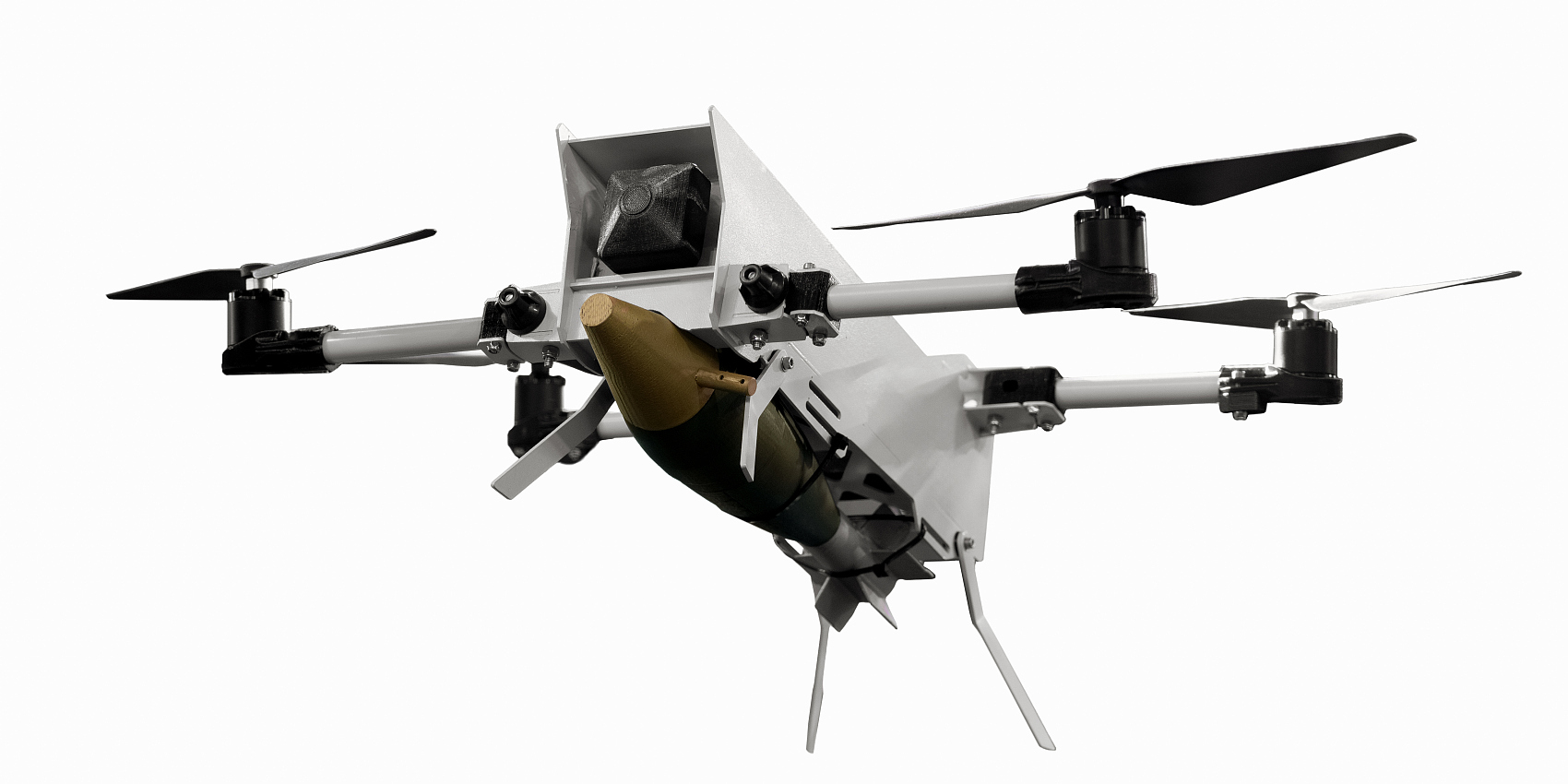
When Russian “Lily-3” drones precisely hit the engine compartments of Ukrainian armored vehicles on the Donbas battlefield, and when Ukrainian “Sea Eagle-10” drones locked onto artillery positions 3 kilometers away at night, these tactical marvels were made possible by compact laser rangefinders, which are emerging as the invisible protagonists rewriting the rules of war. Since the outbreak of the Russia-Ukraine conflict, this civilian technology originally used for surveying and industrial inspection has, driven by battlefield demands, undergone military modifications and technological innovations to become a core force in decisive battles.
I. The Nervous Center of Precision Strikes: Laser Rangefinders Redefine Drone Combat Logic
The miniaturization breakthrough of laser rangefinding modules has transformed drones from “aerial reconnaissance units” into “precision killers.” The Russian V2U drone, a suicide drone, integrates artificial intelligence, GPS modules, servo motors, solid-state drives, and rangefinders, exhibiting high autonomy, swarm capabilities, and vertical attack capabilities. In the 2024 Kharkiv campaign, the “Geranium-2” drones equipped with this module achieved a hit rate of 78% against Ukrainian air defense radars, a threefold increase compared to unmodified models.
Multispectral fusion technology plays a crucial role. Laser ranging data provides precise target distances, while infrared imaging identifies vulnerable target areas. On the Zaporizhzhia front, homemade drones equipped with this system converted RPG rockets into precision-guided weapons, achieving a 61% hit rate on the side armor of Russian T-72 tanks, while traditional manual aiming achieved only a 12% hit rate. This combination of “civilian technology + military creativity” enables low-cost weapons to achieve “sniper rifle”-like precision strikes.
Dynamic ranging frequency has become a tactical advantage. The Russian “Orion” drone is equipped with an 800Hz high-frequency laser rangefinder, capable of real-time tracking of moving targets traveling at 120 km/h. During the battle for Odessa Port, it successfully guided ship-based artillery to intercept 17 Ukrainian suicide drones. It is evident that drones equipped with “dynamic sniper” capabilities have become a key standard for ensuring the precision of guidance systems.
II. The Technological Core of Offensive-Defensive Warfare: Laser Rangefinders Shape New Forms of Confrontation
In anti-drone operations, the application of laser ranging technology has led to an intense “offense versus defense” confrontation. The Russian military's “Provocateur” laser defense vehicle is equipped with a 15-kilowatt laser, whose targeting system relies on a high-precision laser rangefinder to achieve positioning accuracy of ±0.1 meters, capable of destroying the optical sensors of a drone 2 kilometers away within 3 seconds. This system set a record of intercepting 23 drones in a single day during actual combat in the Kherson region, and its core ranging module actually originated from the diode-pumped technology of medical laser equipment.
The Ukrainian military has developed an innovative “laser-countering-laser” tactic. In the Kyiv air defense campaign, Ukrainian forces combined civilian laser rangefinders with French “Sidewinder” radars: the radar provides the approximate direction of the target, while the laser rangefinder precisely locates the drone's avionics system, guiding a 10-kilowatt laser to perform directed interference. This combination extended the effective range for disabling drone electro-optical systems from the traditional 800 meters to 1.5 kilometers, reducing the misfire rate by 62% and successfully defending against Russian “swarm” attacks.
The technological competition between deception and countermeasures has become increasingly sophisticated. Ukrainian engineers deployed a “false target matrix” using special coatings to mimic the laser reflection characteristics of armored vehicles, causing Russian drones' laser rangefinders to produce ±5-meter errors, increasing the misfire rate to 37%. Meanwhile, Russian forces have developed “laser decoys”—ground-based transmitters that mimic the laser reflection signals of drones, tricking enemy air defense systems into firing. In the Donetsk region, this increased the false alarm rate of Ukrainian air defense missiles by 210%.
III. Industrial Chain Transformation and Rule Reconstruction: The War Spillover Effects of Laser Ranging Technology
The rapid conversion of military-civilian technology is disrupting traditional arms control systems. Russian military drones purchased through Turkish intermediaries, equipped with industrial-grade laser ranging modules, have been deployed on the battlefield; Ukrainian military drones obtained from the United States, whose core ranging components originate from Shenzhen's electronics market in China. A report by the United Nations Institute for Disarmament Research shows that in 2024, 120,000 civilian laser ranging modules flowed into conflict zones globally, a 480% increase from 2022. These devices, originally intended for architectural surveying, can be transformed into battlefield weapons with simple programming.
This has led to structural changes in the international military trade market. Germany's Rheinmetall has introduced the “Drone Hunter” system, which combines military-grade laser rangefinders with AI recognition algorithms to simultaneously track 20 aerial targets. This system, originally designed for airport security, saw a fivefold increase in orders in 2025 compared to the previous year, with 70% of sales going to countries neighboring Russia and Ukraine. France's Thales Group has developed a more targeted “Battlefield Laser Kit”—a modular component system comprising ranging modules, targeting systems, and jamming devices—that can rapidly retrofit various civilian drones. This system has already been deployed in 300 units along the Poland-Ukraine border.
Technical standards have become a new strategic battleground. The EU's 2025 export controls on laser equipment, particularly targeting civilian modules with ranging accuracy ≤1 meter and weight ≤500 grams, aim to curb their military applications. However, the Russian military continues to procure compliant equipment through third countries like Vietnam and Kazakhstan—this “technological guerrilla warfare” highlights that the spread of laser ranging technology is now unstoppable.
Want to learn about the latest laser rangefinder technologies and solutions? Please contact our sales team: yeva@erditechs.com