
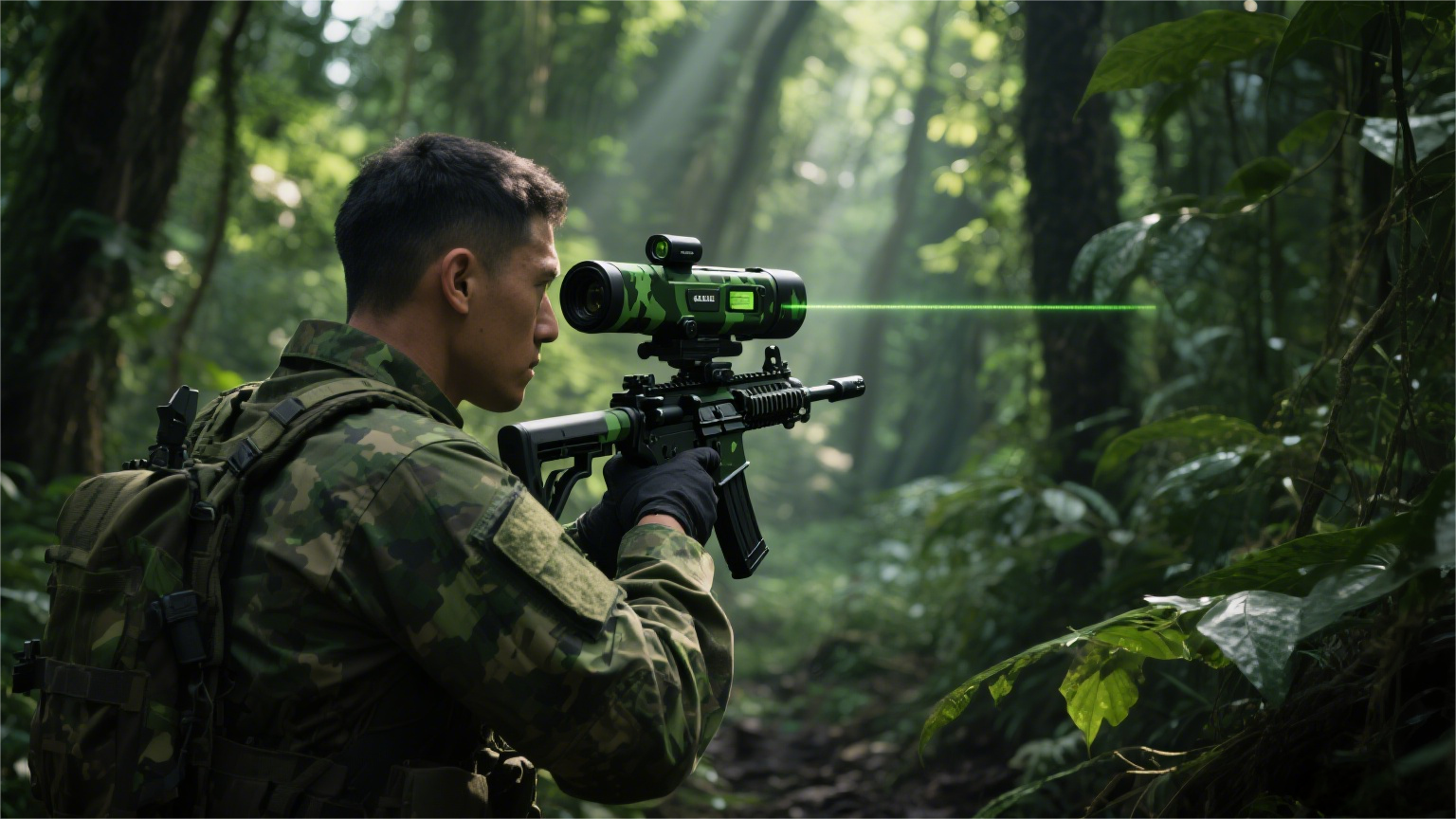
In the era of rapid technological advancement, military equipment is evolving toward greater intelligence and precision. Among these innovations, the eye-safe laser rangefinder integrated into handheld target positioning systems stands out as a groundbreaking “black technology.” With its increasing adoption in the military field, it demonstrates tremendous potential for modern combat and operational efficiency. This article analyzes the critical role of eye-safe laser rangefinders in military handheld target positioning systems.
1. Handheld Target Positioning Systems: Industry Applications and Development Trends
As modern society progresses, the demand for portable and efficient measurement tools has surged across various sectors—such as urban planning, wildfire response, and engineering exploration. In this context, handheld target positioning systems have gained attention for their features of miniaturization, intelligence, and integration.
In mobile operations, emergency scenarios, and military deployments, professional handheld target positioning systems have become indispensable tools. Notably, as early as 2017, the U.S. military officially deployed handheld target positioning systems, marking a major step in portable battlefield intelligence.
2. Eye-Safe Laser Rangefinders: Adaptability in Handheld Systems
Laser rangefinders work by emitting a laser beam toward a target and calculating the distance based on the time it takes for the beam to reflect back. However, traditional laser rangefinders often have drawbacks such as high beam energy, suboptimal wavelength selection, and excessive energy concentration. These issues not only pose significant risks to the human eye but also limit advancements in safety standards across industries.
To overcome these limitations, eye-safe laser rangefinders have emerged. These devices offer precise distance measurement while significantly reducing eye hazards, making them far more suitable for integration into handheld systems. In military applications in particular, they enhance real-time situational awareness, improving both safety and operational effectiveness for combat personnel.
3. Advantages of Integrating Eye-Safe Laser Rangefinders into Military Handheld Target Positioning Systems
Unique Wavelength Design and Controlled Energy Output
Eye-safe laser rangefinders typically operate in the mid-to-long infrared range (above 1.4 µm). For instance, Ertech’s laser rangefinder uses a 1535 nm erbium-doped laser, which avoids wavelengths most harmful to the human retina. It delivers output pulses ranging from 5 µJ to 10 mJ, with a distance accuracy of ±1 meter and an effective range of 3 km to 18 km.
Furthermore, the system can automatically identify measurement echoes based on different target materials, allowing it to adapt seamlessly to a wide variety of field environments—from dense forests to rugged battlefield terrain.
Seamless Integration and Intelligent Coordination with Targeting Systems
Thanks to their compact, enclosure-free designs, eye-safe laser rangefinders can be deeply integrated with handheld target positioning systems. A prime example is the U.S. Marine Corps’ Common Laser Rangefinder Integration Capability (CLRF-IC). In this system, the laser rangefinder collects target distance data and transmits it in real time to other subsystems. These modules work together to relay precise target location data to platforms such as the Advanced Field Artillery Tactical Data System (AFATDS).
This effectively installs an “intelligent navigation system” for rear artillery units, enabling them to conduct accurate, coordinated strikes with dramatically improved speed and precision.
4. Conclusion
The eye-safe laser rangefinder, as a core component of handheld target positioning systems, has become a hallmark of modern military equipment thanks to its advanced technology, excellent safety profile, and strong adaptability. With ongoing innovation in the field of laser ranging, the performance of eye-safe systems will continue to evolve—cementing their place as essential “black technology” across an even wider range of military and civilian systems.
Want to learn more about laser technology? Visit our website: erditechs.com