
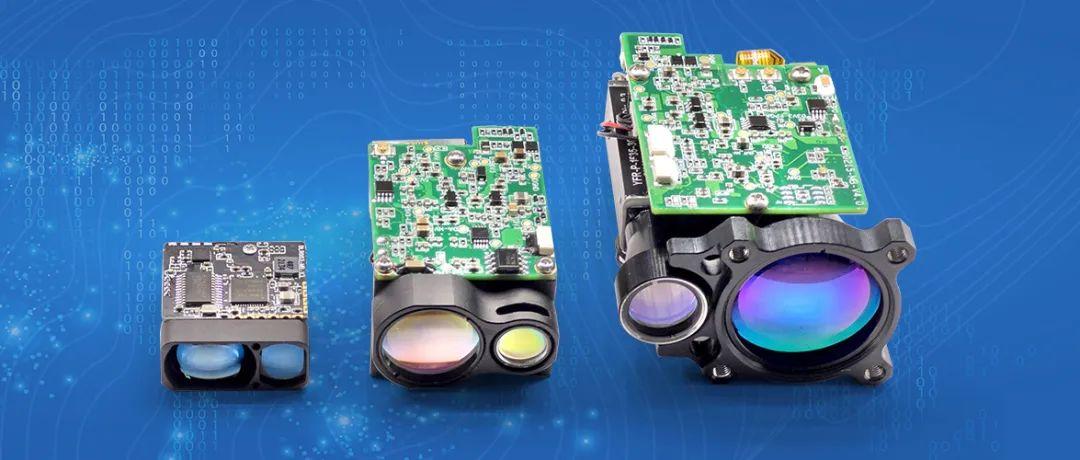
In recent years, handheld laser devices have become a "must-have tool" in military reconnaissance, industrial mapping and other fields due to their convenient and flexible characteristics. The laser rangefinder module, as one of the core components for external perception of these devices, directly affects parameters such as distance, accuracy and environmental adaptability. Whether it is the need for rapid positioning and indication in battlefield environments, or the need for precise ranging in industrial scenarios, the role of the laser rangefinder module is indispensable. This article will focus on the two main application areas of handheld laser devices and analyze the importance of the laser rangefinder module in detail.
I. Compatibility of the Laser Rangefinder Module with Handheld Laser Devices
Unlike fixed equipment (unmanned aircraft pods, vehicle-mounted radars), handheld laser devices have the characteristics of convenient storage, simple operation and "single-person portable operation", so there are specific requirements for the volume, power consumption and environmental adaptability of the laser rangefinder module. In terms of volume, the overall weight of handheld laser devices is generally no more than 1.5 kg, so the laser rangefinder module needs to be "lightweight integrated"; for power consumption, it generally needs to support more than eight hours of continuous industrial operations and four hours of high-intensity military scenarios; for environmental adaptability, military scenarios have higher requirements for temperature, weather and electromagnetic interference, while industrial scenarios are lower, but still face strong light, vibration and dust threats. In terms of accuracy and range, military handheld devices emphasize medium-long-range rapid ranging (range 50m - 10km, accuracy needs to reach ±1m), while industrial equipment requires "medium-short-range high-precision measurement", requiring a ranging accuracy of ±0.1mm - ±1cm within a range of 500m.
As for the mainstream laser rangefinder modules on the market at present, they are mainly divided into three types: time-of-flight (ToF), phase method and triangulation measurement. They have high precision, fast response, strong anti-interference ability, strong environmental adaptability and compact design. With the improvement of power consumption, they can basically meet the requirements of handheld laser devices.
II. Application of the Laser Rangefinder Module in Military Handheld Laser Devices
The core functions of military handheld laser devices are reconnaissance, aiming and fire control calibration. For this, the laser rangefinder module, as an important sensing unit in single-person combat, needs to achieve rapid, anti-interference and covert ranging in complex and variable battlefield environments.
Target detection and positioning in the battlefield: In military reconnaissance and deployment, soldiers need to quickly determine the distance of the target, which serves as the basis for subsequent precise strikes and timely evasions. Taking the US soldier's handheld ranging instrument (AN/PED-1 "Light Sword") as an example, it is equipped with a 1550nm eye-safe laser rangefinder module with a range of 10km and a ranging accuracy of ±1m. Whether facing harsh environments during border patrols or complex and variable urban street battles, through this device, soldiers can quickly and accurately measure the position of the target or obstacles.
Sniper aiming assistance: The handheld laser ranging aiming instrument can be paired with a sniper rifle. Through the measurement of the target distance and the linkage with the ballistic calculation chip, it can improve shooting accuracy and reduce shooting errors. In addition, the divergence angle of the laser rangefinder module is low, which can avoid the exposure of the sniper position and is more suitable for battlefield environments. Taking the domestic CS/LR4 sniper system supporting equipment as an example, it can measure distances of 50 - 2km, with an accuracy of ±0.5m, and a divergence angle of ≤ 0.2mrad. Combined with the ballistic chip, the shooting error is only 1MOA.
III. Application of the Laser Rangefinder Module in Industrial Handheld Laser Devices
Industrial handheld laser devices mainly focus on mapping, inspection, processing verification. The laser rangefinder module needs to achieve "high precision, high efficiency, easy operation and automation".
Fast size verification: In the construction and mapping industries, handheld laser rangefinders can achieve millimeter-level measurement accuracy by carrying a phase difference laser rangefinder module, accurately measuring target parameters. Additionally, the module supports data synchronization, allowing for direct data import and the generation of drawings, thereby avoiding human errors.
Safety inspection: In the power and energy industries, handheld laser rangefinders equipped with a laser rangefinder module resistant to strong electromagnetic interference, and with an IP67 waterproof and dustproof design, can achieve remote measurement parameters in dusty and rainy environments, avoiding human damage.
Summary
The laser rangefinder module, as the core component of handheld laser devices, is gaining prominence due to its high precision, efficiency, portability, and intelligence level, becoming the performance cornerstone in military and industrial ranging fields. Whether in harsh battlefield environments or busy industrial frontlines, handheld laser devices have significantly enhanced measurement safety and production efficiency with their speed, accuracy, and ease of use. In the future, with continuous technological upgrades, the laser rangefinder module will have broader application prospects.
For more information about the laser rangefinder module or customized solutions, please contact our sales team at: yeva@erditechs.com