
-0.png?w=1872&h=924)
In various modern technological fields—especially in national defense—precise distance measurement is a critical task and serves as a fundamental guarantee for the smooth execution of operations. Among the many distance measurement technologies, the laser rangefinder stands out for its high precision and rapid measurement capabilities, making it a widely used tool. These devices determine distance by emitting a laser beam toward a target and measuring the time it takes for the beam to travel to the target and return.
This article focuses on the impact of avalanche photodiodes (APDs) on the performance of laser rangefinders.
A laser rangefinder typically comprises several key components, including the laser emitter, optical system, detector (usually an avalanche photodiode, or APD), timing circuit, and signal processing unit (Figure 1).
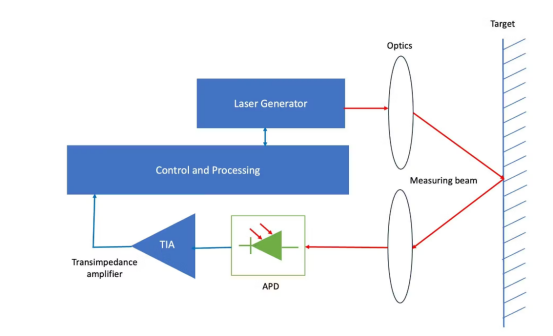
The APD serves as the core component in the receiving system of a laser rangefinder and plays an indispensable role. In this system, the APD is responsible for detecting the weak laser signals reflected by the target. Due to atmospheric interference, these signals are often extremely faint. Therefore, the APD’s sensitivity is crucial, as it allows for the effective detection and amplification of these weak signals, producing usable data for processing.
The sensitivity of an APD is influenced by several factors, including temperature and noise, which can significantly affect its performance. Recently, InGaAs APD technology for 1550nm lasers has been improved through the incorporation of antimony alloy into the APD structure. This advancement has led to devices with significantly lower excess noise, resulting in higher signal-to-noise ratio efficiency compared to previous designs, and substantially enhancing APD sensitivity.
Higher sensitivity also enables the use of smaller receiving lenses, reducing the overall weight and size of laser rangefinders. This makes it easier to integrate these devices into portable machinery and equipment.
As the core component of the receiving system, continuous advancements in APD technology have consistently improved the performance of laser rangefinders, broadening their application scope. It is expected that in the future, APDs will continue to drive laser rangefinders toward even more precise and versatile distance measurement solutions.