
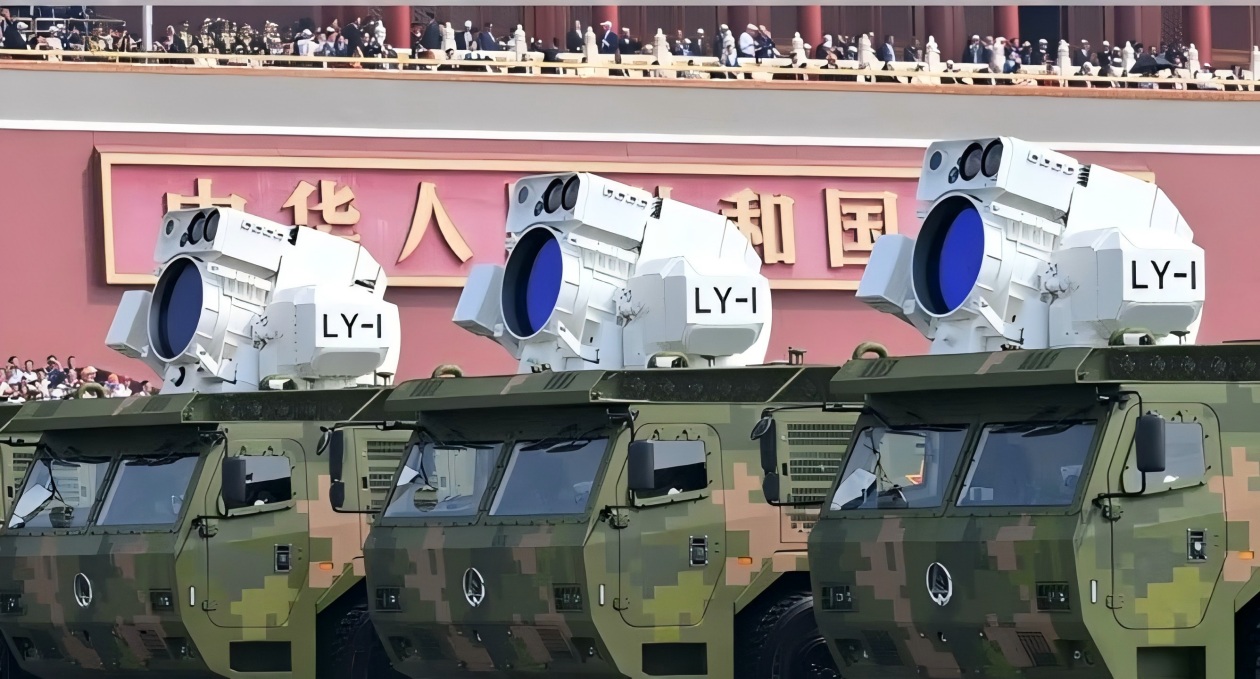
On September 3rd, 2025, it was the 80th anniversary of the victory of the Chinese People's War of Resistance against Japanese Aggression and the World Anti-Fascist War. China held a grand military parade at Tiananmen Square, during which laser weapons, as important equipment, made their first public appearance. In the naval anti-aircraft weapon formation and anti-UAV formation, Chinese laser weapons, as important equipment, were inspected. Their usage cost was much lower than other weapons, and they could achieve precise strikes on UAV systems within a short period of time. They are a powerful "trio" for countering UAV warfare and also a "guardian blade" for safeguarding national security.
I: The Threat of Unmanned Aerial Vehicle Warfare Has Increased, and Laser Weapons Emerged
In recent years' regional conflicts, unmanned aerial vehicles have been widely deployed on the battlefield, playing multiple roles such as reconnaissance, target indication, attack, rapid passage, and decoy consumption. They are one of the main weapons in modern warfare. Take the Russia-Ukraine conflict as an example. As of July this year, both sides suffered over a hundred unmanned aerial vehicle losses per day, frequently using unmanned aerial vehicles to attack each other's air defense systems and equipment bases. Among them, suicide drones were the most common. Russia's "Lyovet" had a high speed, high altitude, and was difficult to intercept, causing great pressure on Ukraine's air defense system. Ukraine, on the other hand, used a large number of low-cost unmanned aerial vehicles for interception. Both sides expended a great deal of effort in improving their attack and counterattack capabilities.
In this context, traditional anti-UAV methods gradually exposed shortcomings such as slow response, insufficient battlefield adaptability, high cost, and significant resource loss. In response to this, seeking new anti-UAV systems is urgent. Chinese laser weapons thus emerged.
II: Overview of Laser Weapons
Laser weapons are directed energy weapons that use high-energy laser beams to damage or destroy targets at a long distance. Their core principle relies on electrical energy or chemical reactions to generate high-power, directional beams that act on the target surface in a short period of time, causing the target material to vaporize or the structure to be damaged. Their main advantages include: precise strikes, capable of achieving dense positioning, precise action on the key parts of UAVs, with minimal collateral damage; rapid response, unlimited strikes: laser weapons do not require ammunition replenishment, the ammunition is nearly unlimited, and they can quickly switch to target strikes, having strong continuous combat capabilities; the usage cost is much lower than conventional missiles and other anti-aircraft weapons, and a single use can achieve multiple target strikes, which is very suitable for dealing with UAV swarms on the battlefield. Combined with other weapon systems, they are a powerful weapon for anti-UAV systems.
III. Typical Application Scenarios of Laser Weapons in Anti-UAV Systems
The "Tianqiu" system, achieving 100% interception of unmanned aerial vehicles
In the air-defense operation near Jidda Port in Saudi Arabia, the Houthi forces launched a large-scale suicide drone attack, using a cluster tactic, targeting the core defense base of Saudi Arabia. The traditional radar system found it difficult to deal with its numerical superiority at this time. At this moment, the "Tianqiu" system, relying on its radar detection, electro-optical tracking, electronic detection, and laser attack capabilities, achieved precise strikes on 21 unmanned aerial vehicles, with an interception rate of 100%. In the past year, the "Tianqiu" system has cumulatively intercepted over 110 unmanned aerial vehicles in Saudi Arabia, maintaining a 100% success rate, and is a solid shield for safeguarding the security of key areas in Saudi Arabia.
The "Silent Hunter" in the Balochistan War defends the airspace
In South Asia, to counter India's multi-batch, multi-directional, day-and-night continuous raids, Pakistan adopted the "Silent Hunter" developed by China. At night, using a "silent killing" method, laser flashes were used to precisely shoot down the approaching unmanned aerial vehicles, defending the country's airspace security, and also demonstrating the strong strength of Chinese laser weapons in anti-UAV systems.
IV. Conclusion
China's laser weapons represent a major breakthrough in dealing with the threat from unmanned aerial vehicles. This not only signifies the enhancement of China's military strength but also reflects the country's emphasis on its security system. Moreover, it indicates that China's laser weapons have become a key force in countering unmanned aerial vehicle warfare worldwide. It is believed that in the future, with the continuous upgrading and innovation of laser weapons, China's laser weapons will play a significant role in safeguarding national security, strengthening the solidarity of the community with a shared future, continuously defending national airspace security, and promoting world peace and development.
Contact ERDI TECH
If you need technical information, specification sheets, prototype tests or customized solutions for the 1064nm laser target designator, please contact the ERDI TECH engineering team.
📧 yeva@erdimail.com (responses within 24 hours)
We will provide the most suitable laser technology solutions for your platform.