Introduction - Hot Trends in Defense Technology in 2026
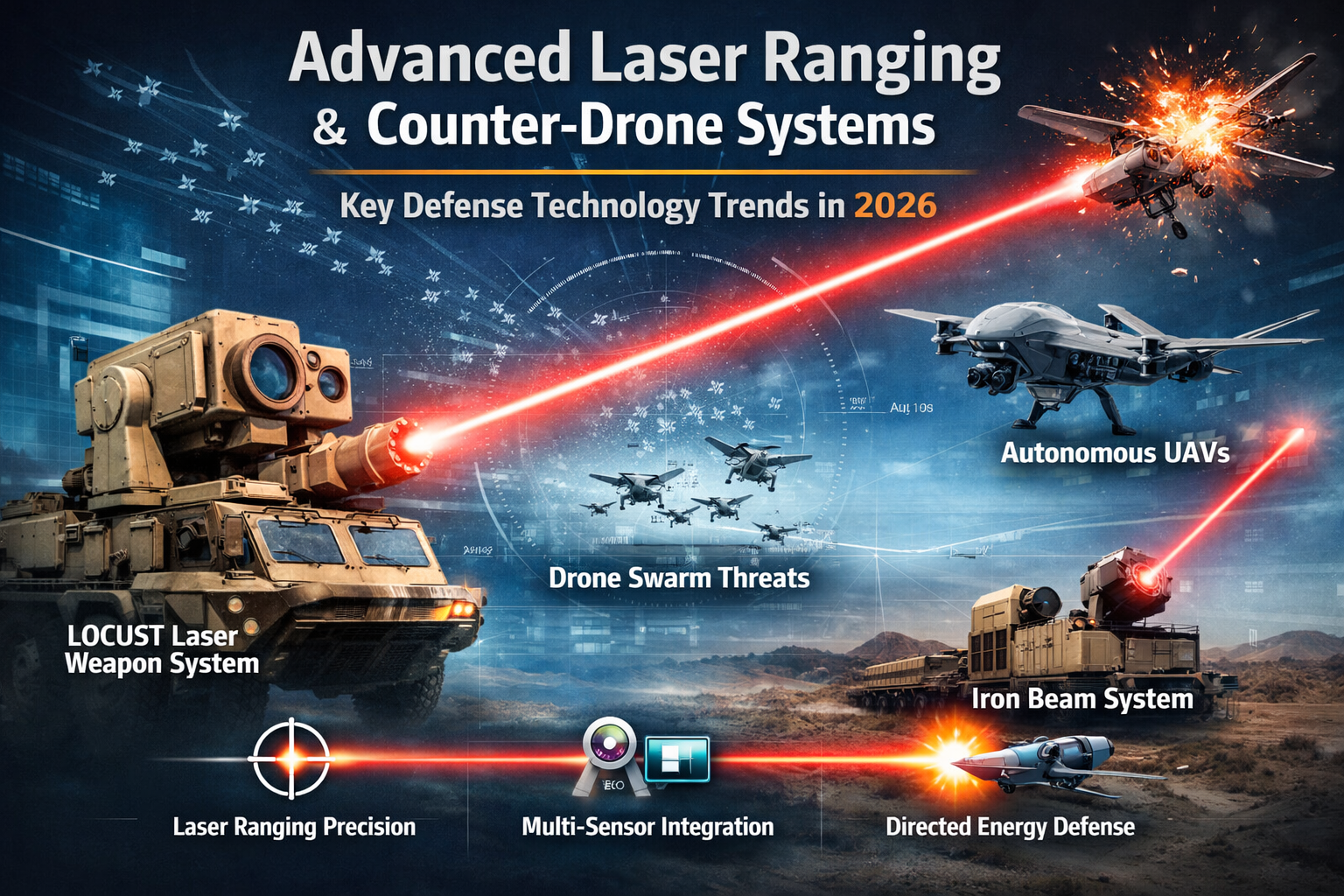
On January 4, 2026, Tom Hardware published an article about the US Army's advancement in the research and development of the second-generation "Locust" (LOCUST) laser weapon system. The article stated that Locust is a mobile high-power laser device that can be rapidly deployed to the required location, specifically designed to counter drone swarms and protect soldiers and critical infrastructure. Additionally, the US military leadership also emphasized that a multi-level, interoperable anti-drone solution should be adopted to address drone threats in various tasks and environments. Not long ago, Israel also deployed the "Iron Beam" high-power laser interception system to counter drones and mortars. These actions all indicate that by 2026, global defense technology increasingly focuses on defense strategic systems based on laser weapons and autonomous sensing technologies, marking a shift toward laser ranging integration for counter-drone and directed energy systems.
Defense of Unmanned Aircraft and Anti-UAV Requirements Drive the Evolution of Precise Sensing
Demand for Directed Energy Defense Weapons
Precision laser ranging data is critical for directed energy weapons to achieve "lock and destroy" and "efficient and error-free" strikes on targets. The core requirement is to concentrate high-energy laser energy on the key parts of the target (such as the engine of a drone), destroying the target through thermal ablation. To achieve this requirement, precise detection data is needed, clearly indicating the real-time distance between the target and the weapon system, so as to accurately guide the strike position of the laser-directed energy weapon. Thus, precise laser ranging for directed energy weapons is the core prerequisite for ensuring the precise strike of the directed energy weapon system, directly affecting the success rate of interception, energy utilization efficiency, and battlefield strike capability.
Demand for Expanded Counter-drone Strategies
To counter drone threats worldwide, global defense forces gradually shift their focus to drone defense measures. However, the US anti-drone forces stated that through long-term assessment of the country's anti-drone weapon arsenal, there is no magic cure-all, and there is no standalone system weapon that can single-handedly stop this threat, especially small unmanned flight systems (UAS). Colonel Matt Ross of the detachment called it "the decisive threat of our era." Counter-drone systems require the combination of multiple means, and multiple instruments such as radar, radio frequency detection, and electro-optical/infrared need to be deployed in layers to have the opportunity to deal with drone threats. In this demand, there are certain requirements for the integration capabilities of various sensors in the anti-drone framework.
Combat Requirements for Autonomous Unmanned Aircraft
Autonomous unmanned aircraft are the main component of modern combat systems, serving as the main tool for "without human real-time control, independently completing tasks." Laser ranging for autonomous drones is a core prerequisite for achieving this goal, being the "eyepiece" and "early warning system" of the unmanned aircraft, capable of accurately addressing key issues such as "invisibility, unclear identification, inability to avoid, and incorrect operation" during autonomous flight. Traditional sensors have certain limitations in complex environments. In contrast, advanced laser ranging modules can well solve this problem and better adapt to the requirements of unmanned aircraft combat.
Modern Defense Weapon Types Integrating Advanced Laser Ranging
In current defense modernization projects, laser ranging integration is increasingly supporting autonomous combat and anti-drone combat through the following methods:
- Enhancing target positioning of directed energy systems
- Safety distance measurement in multi-sensor fusion stacks
- High-resolution ranging feedback for autonomous drone navigation
- Supporting layered anti-drone system architectures
Advanced anti-drone studies show that, combined with optical tracking and event-based detection, energy-efficient systems can extend the precise detection range and target identification to hundreds of meters, with high accuracy, even in complex conditions.
ERDI TECH's Laser Ranging Solutions for the Evolving Defense Systems
With the development of defense applications and counter-drone systems, ERDI TECH, as a professional manufacturer of laser ranging modules, has meticulously designed and launched 905nm, 1535nm, and 1064nm wavelength solutions that can meet high precision, rugged durability, and easy integration requirements:
ERDI LASER® 1535nm Erbium Glass Laser: An eye-safe laser with erbium glass as the gain medium, using semiconductor pumping and passive Q-switching technology, with an output wavelength of 1535nm. It can be classified into:
- High-frequency laser (500Hz–5kHz)
- Low pulse energy laser (100μJ–900μJ)
- High pulse energy laser (2mJ–10mJ)
It is worth noting that ERDI recently released a MINI-100 laser, which outputs 100μJ pulse energy and weighs only 2.5 g.
ERDI LASER® 1535nm Eye-Safe Laser Ranging Module: A ranging module based on the Erbium Glass laser, with a compact structure, flexible interfaces, and high beam quality. According to the ranging range, it can be classified as:
- Short-range laser ranging instrument: 3–10 km (NATO targets)
- Long-range laser ranging instrument: The measurement distance for a 4-meter × 6-meter vehicle target is 12–18 km.
Among them, the 3 km laser ranging module based on MINI-100 has an overall weight of only 14±1 grams and can precisely measure the 3-kilometer distance of NATO targets, and offers a 3 Hz/10 Hz model option.
ERDI LASER® 905nm Diode Laser Ranging Module: Using a 905nm laser diode as its core light source, it has high stability, high measurement accuracy, compact design, and low power consumption. According to the ranging frequency, it can be classified as:
- Compact laser module: 1,000 m – 2 km
- High-frequency laser module: 20 m – 1,500 m
ERDI LASER® Laser Ranging and Target Designator System: Using a 1064nm pulsed laser (Nd:YAG), integrating ranging and target indication functions into a compact module, according to the size of the pulse energy, there are 20 to 160 mJ model options available.
These solutions can help integrators build next-generation perception systems to support complex defense roles - from autonomous drone coordination to anti-drone fusion frameworks.
Conclusion - Strategic Laser Ranging in Modern Defense
As defense forces of various countries adopt multi-level, adaptive combat frameworks, the importance of laser ranging technology is increasingly prominent. Whether providing precise target positioning for directed energy systems, enhancing anti-drone defense capabilities with reliable distance data, or empowering autonomous perception systems for drones, advanced laser ranging technology is an indispensable part of modern defense innovation.
Disclaimer: This article references publicly available defense technology development and research materials, and combines ERDI TECH's actual integration experience to provide accurate and industry-relevant viewpoints.
Contact ERDI TECH
For technical inquiries, sample requests, or partnership opportunities, please contact:
📧 yeva@erdimail.com (responses within 24 hours)
Related Articles:
How Global Border Security Upgrades Drive Demand for Long-Range Laser Rangefinders
Why Long-Range Laser Rangefinder Is Becoming Essential in Border Surveillance
Global Trends in Defense and Autonomous UAVs 2026: Why Laser Ranging Matters
Why Precise Laser Ranging Data Is Critical for Modern Anti-UAV Systems