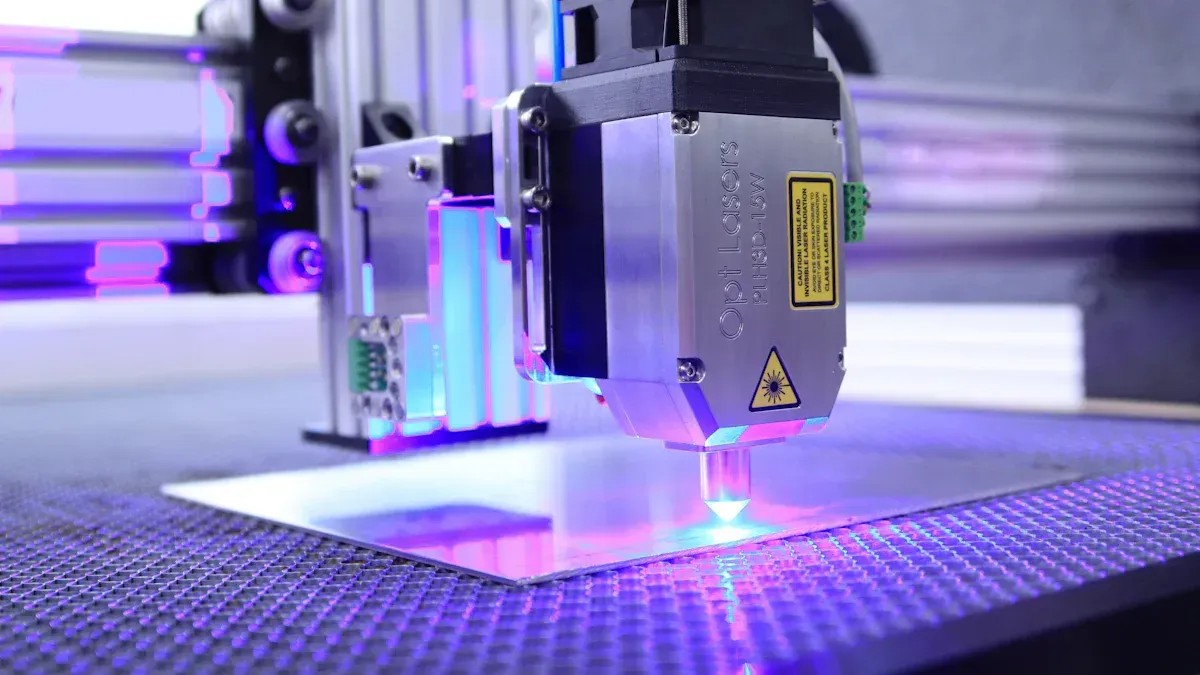
Choosing between diode vs CO2 laser depends on factors like power, materials, size, and budget. Diode lasers are ideal for those who want a small, lightweight tool. They perform well for simple engraving or photo-engraving and are best suited for metals when used with marking sprays. On the other hand, CO2 lasers offer higher power and are better for cutting or engraving non-metal materials. The table below highlights the main differences:
| Aspect | Diode Laser Cutter | CO2 Laser Cutter |
|---|---|---|
| Power Output | 8-10 W | 40-60 W |
| Size & Weight | Small, ~200 grams | Large, bulky tubes |
| Cost | Least expensive | More expensive |
| Material Compatibility | Good for metals (with marking sprays), photo-engraving | Best for non-metals |
When deciding between diode vs CO2 laser, buyers should consider their workspace, budget, and the types of materials they plan to work with.
Key Takeaways
- Diode lasers are small and not expensive. They work well for light engraving. You can mark metals with sprays using them. CO2 lasers are stronger and best for cutting or engraving things like wood and acrylic.
- CO2 lasers cut faster and go deeper. They are good for big projects and for factories. But they cost more money and need more care than diode lasers.
- Diode lasers use less power. They are simple to use. They are good for beginners or people who do hobbies. They work well for small and detailed designs.
- Picking the right laser depends on what you use it for. Think about your materials, project size, money, and workspace. Use diode lasers for small and easy jobs. Use CO2 lasers for thick or quick cutting work.
- Both lasers need safety gear and good airflow. This keeps users safe from bad fumes and bright light.
Key Differences
Diode vs CO2 Laser
When you look at diode vs CO2 laser, you see many differences. Each laser type has its own good and bad points. The table below shows how they are different in power, cost, and how well they work:
| Feature | Diode Laser Cutter | CO2 Laser Cutter |
|---|---|---|
| Power Output | 8-10 W | 40-60 W |
| Beam Type | Rectangular, multimode (808/940 nm) | Circular, TEM01* mode (10.6 μm) |
| Size & Weight | Small, lightweight (~200 grams) | Large, heavy tubes |
| Initial Cost | Lower | Higher |
| Ongoing Cost | Disposable tips needed (adds up yearly) | No disposable tips (lower long-term cost) |
| Cutting Efficiency | Higher penetration per pass (1.6 mm) | Lower penetration per pass (1.3 mm) |
| Number of Passes (120 mm) | 74 passes | 94 passes |
| Traverse Speed | 2 mm/s | 2 mm/s (similar conditions) |
| Material Compatibility | Metals (with marking spray), plastics, wood | Best for non-metals: wood, acrylic, leather |
| Typical Applications | Engraving, photo-engraving, light cutting | Deep cutting, engraving, ablation |
Note: Diode laser cutter can cut deeper with each pass. They need fewer passes to cut through some things, like concrete. This happens because of their beam shape and how well they focus energy. But CO2 lasers cutter have more power. They are better for fast cutting and removing material, especially with non-metals.
Studies show that CO2 lasers can make medical and dental work faster. For example, a CO2 laser can cut tissue in about 20 seconds. A diode laser might take up to a minute. CO2 lasers also cause less pain and bleeding for people.
Typical Uses
Picking between diode vs CO2 laser depends on what you need to do. Here are the most common uses for each one:
-
Diode Laser:
- Engraving photos or designs on wood, plastic, or coated metals
- Marking metals with a marking spray
- Small craft projects or hobby work
- Dental work that needs good blood control but not fast cutting
-
CO2 Laser:
- Cutting and engraving non-metal things like wood, acrylic, leather, and glass
- Industrial and professional jobs that need deep or fast cutting
- Medical and dental work where speed and less pain matter
- Projects that need high power and bigger work areas
💡 Tip: If you need to cut deep or work with thick non-metals, use a CO2 laser. If you want something light and easy to move for engraving or marking, pick a diode laser.
How They Work
Diode Laser
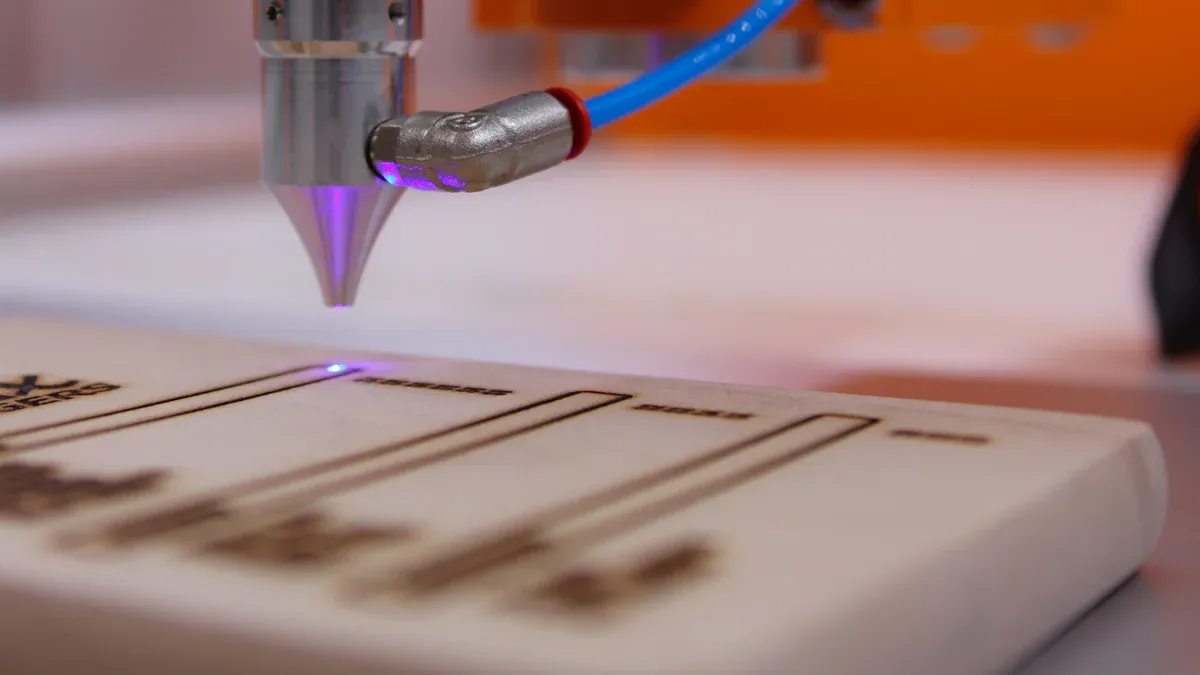
A diode laser has a small chip that makes a strong light beam. This beam goes after dark colors, like melanin or black coatings on metal. The light turns into heat and melts or marks the top layer. Diode lasers are great for engraving because they make thin, sharp lines. The beam can go as deep as 4 millimeters in some things. This helps when you need to remove just certain parts, especially on dark surfaces. Diode lasers are small and use little power, so many hobbyists and small shops like them.
CO2 Laser
A CO2 laser uses a tube filled with gas to make a strong infrared light. This light looks for water in the material. When it hits, the water heats up and boils, making the material turn to vapor. CO2 lasers cut and engrave by burning away the top layer. This makes a wider cut than a diode laser. The beam only goes about 20 micrometers deep, so it works best on things like wood, acrylic, and leather. CO2 lasers cut fast and can handle thick stuff, so they are used in big jobs and factories.
Wavelength Impact
The wavelength of a laser changes how it works with different things.
- Diode lasers use near-infrared light (700–1200 nm). Their light goes deeper and does not soak up water.
- CO2 lasers use far-infrared light (>1200 nm). Their light is taken in by water, so it burns the surface fast.
| Aspect | Diode Laser | CO2 Laser |
|---|---|---|
| Cutting Mechanism | Uses heat to melt material, making a thin cut | Uses heat to burn away material, making a wide cut |
| Material Compatibility | Works best on metals (with marking spray) and some plastics | Works on many non-metal things (wood, plastics, cloth) |
| Advantages | Uses little power, easy to care for, small size | Cuts fast, works on thick and hard-to-heat things |
| Limitations | Not very strong or fast, has trouble with thick or shiny things | Big, harder to use, costs more to run, not good on shiny metals |
| Typical Use | Good for careful cutting and engraving, easy for beginners | Used for big jobs, business use, works on many materials |
Note: The type of light explains why diode lasers are best for marking dark things, but CO2 lasers are better for cutting and engraving non-metals.
Performance
Cutting
How well a laser cuts depends on how deep and clean it can go. CO2 lasers cut faster and deeper, especially in things like wood or acrylic. Diode lasers can cut too, but they work best on thin or soft stuff. Scientists use different ways to check how good a laser is at cutting:
- The efficiency factor, called γz, tells how well a laser cuts. It compares how deep the cut is to the whole area the laser touches, including any heat damage.
- If a cut has a γz of 1, it is perfect. This means the laser makes a clean cut with no extra damage, like a scalpel.
- Researchers look at the cut and the heat-damaged area under a microscope. They use special masks to see how deep and wide the cut is.
- Most experts say a γz of 0.6 or more is good for medical jobs, like oral surgery.
CO2 lasers often reach this level more easily. Their wavelength matches water in soft tissues. Diode lasers may need more passes to cut as deep, especially in thick things.
Engraving
Engraving uses less power than cutting. Diode lasers are great for engraving small details on wood, plastic, or coated metals. Their small beam helps make sharp lines and clear pictures. CO2 lasers also engrave well, especially on non-metals. They can cover big areas fast, so people use them for signs and crafts. Both lasers can engrave, but diode lasers give more control for tiny, detailed work.
Precision
Precision means how closely the laser follows the design. Diode lasers are very precise because their beam is narrow. They can engrave tiny letters or detailed pictures. CO2 lasers are also good, but their wider beam can make edges less sharp. Scientists use microscopes to check how wide and deep each cut or engraving is. They also use averages and error numbers to compare results. Both lasers can do precise work, but diode lasers are best for the finest details.
Applications
Materials
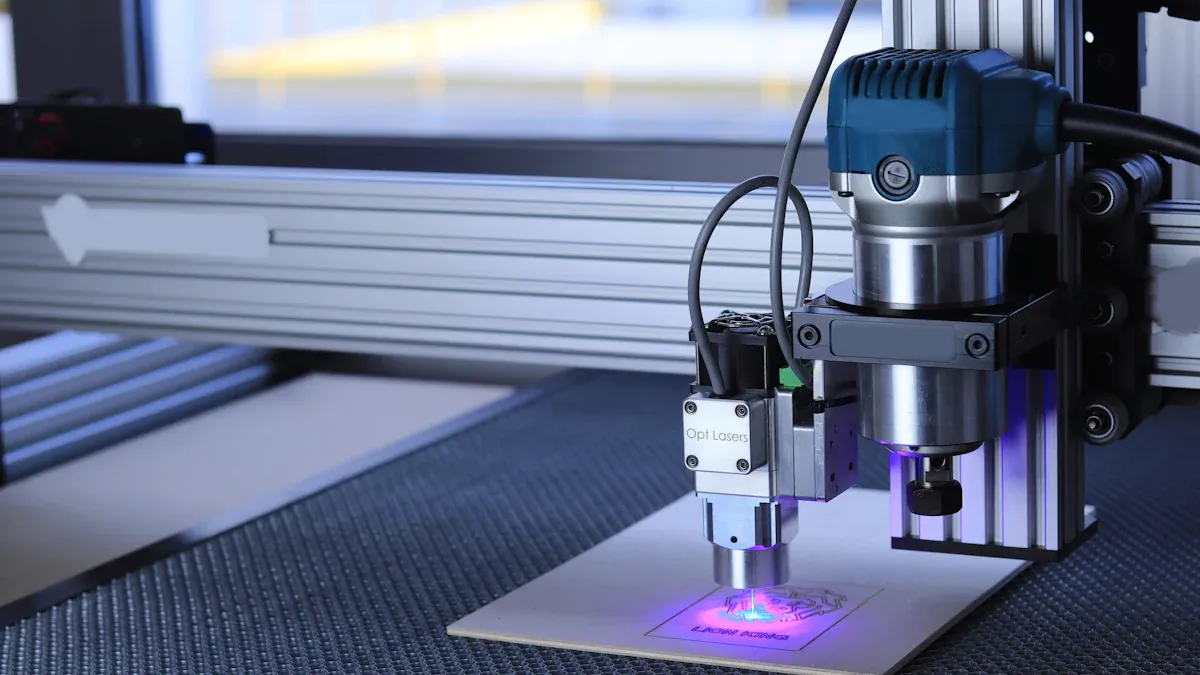
Different lasers work better with certain things. Diode lasers can work on many materials. They are best for engraving and marking. People use diode lasers for wood, plastic, and coated metals. Diode lasers can mark metals if you use a marking spray. But they do not work well on thick or shiny metals.
CO2 lasers are great for non-metal things. Their beam works well with things that come from plants or animals. This makes them good for cutting and engraving wood, acrylic, leather, glass, rubber, fabric, and paper. The cuts look smooth and the edges stay neat. CO2 lasers do not work well on metals. The beam bounces off shiny metal surfaces.
Fiber lasers use a different kind of light. They are made for metals. Fiber lasers can mark and engrave stainless steel, aluminum, copper, brass, titanium, and coated metals. They make sharp marks and do not cause much heat damage. Fiber lasers use less power and last longer than CO2 lasers.
Tip: Use a CO2 laser for wood, acrylic, or fabric. Pick a diode laser for light engraving on plastic or coated metals. Choose a fiber laser for marking or engraving metals.
Common material applications:
- Wood signs and crafts (CO2)
- Acrylic displays (CO2)
- Leather goods (CO2)
- Metal tags and tools (Fiber, Diode with marking spray)
- Glass etching (CO2)
- Rubber stamps (CO2)
- Electronics and jewelry (Fiber)
User Types
Many people use laser machines. Each type is good for a different group.
- Hobbyists and Makers: They like diode lasers. These machines are small, easy to use, and not expensive. Hobbyists engrave wood, plastic, or coated things at home or in small shops.
- Small Businesses: Many small shops use CO2 lasers. These machines work on many non-metals. Shops make signs, gifts, or packages with CO2 lasers.
- Industrial Users: Big factories use fiber lasers for metal marking. Car, plane, and electronics companies use fiber lasers for fast, exact marks on metal parts.
- Medical and Dental Professionals: CO2 lasers help cut and shape soft body parts. Dentists and doctors use them for quick, clean work with less pain.
- Artists and Designers: Both diode and CO2 lasers are good for creative people. Artists engrave detailed designs on wood, leather, or glass.
🛠️ Note: The best laser depends on what you want to make and how big your project is. Each group gets the most from the laser that fits their needs.
Cost & Maintenance
Initial Cost
The price of a laser machine is important for buyers. Diode lasers cost much less than CO2 lasers. Most diode lasers start at $300 and can go up to $2,500. This makes diode lasers good for hobbyists and small shops. CO2 lasers have a bigger price range. Some CO2 lasers start at $1,000. The most powerful CO2 lasers can cost over $50,000. Buyers should look at their budget and what features they want before picking a laser.
| Cost Category | Diode Lasers | CO2 Lasers |
|---|---|---|
| Initial Purchase | $300 to $2,500 | $1,000 to $50,000+ |
💡 Tip: Diode lasers are a cheap way to start engraving or cutting. CO2 lasers cost more but give you more power and options.
Operating Cost
Operating costs mean the money spent to use the laser every day. Diode lasers use less energy and need fewer supplies. This keeps their costs low. CO2 lasers use more electricity, especially the stronger ones. For example, a 3 kW CO2 laser can cost about $0.36 each hour if power is $0.12 per kWh. CO2 lasers also need special gases. These gases can cost thousands of dollars each month for big jobs. Cooling systems for CO2 lasers also add to the cost.
| Cost Category | Diode Lasers | CO2 Lasers |
|---|---|---|
| Operating Costs | Low energy, minimal consumables | High energy, assist gases, cooling needed |
Upkeep
Maintenance keeps a laser working well. Diode lasers need very little care. Owners just clean the lens and check for dust. CO2 lasers need more work. Owners must change laser tubes every 1,000 to 5,000 hours. This can cost $200 to $4,000 each time. They also need to change lenses, nozzles, and filters. Cooling systems for CO2 lasers need yearly care, costing $100 to $500. Machines that cost more at first may need fewer repairs later.
🛠️ Note: Taking care of your laser helps it last longer and work better. Buyers should remember these costs when picking a machine.
Pros & Cons
Diode Laser
Diode lasers are good for people who want something simple and cheap. They use less energy and do not cost much to buy or fix. Many people think diode lasers are easy to learn and use. The FDA says diode lasers are safe for sulcular debridement. This means they work well and are safe. Diode lasers are great for small jobs and soft things. They help wounds heal faster and make patients feel better after treatment. Studies say diode lasers help gums attach better and stop gum loss more than CO2 lasers. People feel less pain and get better faster with diode lasers.
But diode lasers have some problems. They do not cut as fast or as deep as CO2 lasers. They are not strong enough for thick or hard things. Diode lasers are not as exact, so they are not best for tiny designs. They cannot cut glass or metals well. For big or pro jobs, diode lasers may not do enough.
🟢 Tip: Diode lasers are great for beginners, hobby fans, and people who want easy use and quick healing.
CO2 Laser
CO2 lasers are known for being strong and very exact. They can cut and engrave many things, like thick wood, acrylic, and some metals with help. CO2 lasers make clean, sharp cuts and work fast. In medicine and dental work, CO2 lasers remove germs and clean roots with little harm if used right. Using CO2 lasers with other treatments can help teeth and gums. These lasers also stop bleeding well, which helps some patients.
But CO2 lasers cost more to buy and use. They need more training and safety steps because they are stronger. The machines are bigger and need more care. Some people feel more pain after CO2 laser work, maybe because it goes deeper. It is harder to learn, so new users need more practice.
| Aspect | CO2 Laser Advantages | CO2 Laser Disadvantages | Diode Laser Advantages | Diode Laser Disadvantages |
|---|---|---|---|---|
| Precision | Superior precision, cleaner cuts | More expensive, more upkeep | Affordable, energy-efficient | Lower precision, less detail |
| Power & Speed | High power, fast cutting | Needs more expertise | Low power use | Limited speed and power |
| Material Compatibility | Cuts/engraves many materials | Limited metal cutting | Good for small, soft projects | Cannot cut glass or metals well |
| Cost | Higher initial and running costs | More expensive to operate | Low cost to buy and use | Less versatile for big jobs |
| Safety | Needs strict safety steps | More complex safety | Safer due to lower power | Still needs safety care |
⚠️ Note: When picking between diode vs CO2 laser, think about what you need and what each laser can do.
Decision Guide
User Scenarios
Choosing the right laser depends on what the user wants to do. The following guide helps readers decide between a diode laser and a CO2 laser. Each step asks a simple question. The answers lead to the best choice.
Quick Guide: Which Laser Should You Choose?
-
What materials will you work with most?
- Wood, acrylic, leather, glass, or fabric → Go to Step 2.
- Metal (with marking spray), plastic, coated items → Go to Step 3.
-
Do you need to cut thick materials or work on large projects?
- Yes → CO2 laser is the better choice.
- No → Diode laser can work, but CO2 laser is still preferred for deep cuts.
-
Is your main goal engraving or marking small items?
- Yes → Diode laser fits these needs.
- No → For larger or faster jobs, CO2 laser may be better.
-
What is your budget?
- Under $1,000 → Diode laser is more affordable.
- Over $1,000 → Both options are open.
-
How much space do you have?
- Small workspace or need for portability → Diode laser is compact.
- Large dedicated area → CO2 laser fits well.
📝 Tip: Think about your main project type, budget, and space before making a choice.
Picking the best laser depends on what you want to make. You also need to think about your budget and how much space you have. Diode lasers are good for small projects and light engraving. CO2 lasers can cut thicker things and do bigger jobs. Look at the decision guide and table before you buy. If you are still not sure, ask an expert or read more about lasers.
FAQ
What safety gear does someone need when using a laser cutter?
People should wear safety glasses made for their laser. The room should have good airflow. Experts say to use gloves and keep a fire extinguisher close. These steps help stop burns and protect your eyes.
Can a diode laser cut metal?
A diode laser cannot cut metal by itself. It can mark metal if you use a marking spray first. To cut metal, you need a fiber laser or a strong CO2 laser.
How long does a CO2 laser tube last?
Most CO2 laser tubes work for 1,000 to 5,000 hours. The tube lasts longer if you use the machine less and take care of it. Cleaning and cooling the tube helps it last longer.
Which laser is easier for beginners to use?
A diode laser is easier for new users. It is simple to set up and has less power. There are fewer safety problems. Many hobbyists pick diode lasers because they are small and cheap.
Do both lasers need special ventilation?
Yes, both diode and CO2 lasers need good airflow. Cutting or engraving makes smoke and fumes. A fan or exhaust keeps the air safe and clean.
1 yorum