
.jpg?w=823&h=823&q=80)
.jpg?w=823&h=823&q=80)
.jpg?w=823&h=823&q=80)
.jpg?w=823&h=823&q=80)
.jpg?w=823&h=823&q=80)
.jpg?w=823&h=823&q=80)
1064nm Laser Rangefinder & Target Designator - 160mJ
MOQ
After-Sales Support
Choose ERDI modules with confidence.
OEM/ODM Capabilities
Support Global Delivery
30-day TrialTake
_1445x.jpg?w=823&h=823&q=80)
_1445x.jpg?w=823&h=823&q=80)
_1445x.jpg?w=823&h=823&q=80)
_1445x.jpg?w=823&h=823&q=80)
_1445x.jpg?w=823&h=823&q=80)
_1445x.jpg?w=823&h=823&q=80)
_1800x.jpg?w=823&h=823&q=80)
_1800x.jpg?w=823&h=823&q=80)
_1800x.jpg?w=823&h=823&q=80)
_1800x.jpg?w=823&h=823&q=80)
_1800x.jpg?w=823&h=823&q=80)
_1800x.jpg?w=823&h=823&q=80)
PRODUCT DESCRIPTON
The ERDI LASER LR160 is a compact 1064 nm laser target designator and rangefinder delivering high-energy output for long-range precision engagement. With switchable pulse energy and accurate multi-target ranging, it is designed for integration into UAV gimbals, airborne pods, vehicle turrets, and border or coastal surveillance systems operating in harsh environments.
Key Advantage
-
High-Energy Long-Range Capability
Switchable 85 mJ / 160 mJ output enables reliable ranging up to 30 km and effective coded laser illumination for extended-range missions. -
Fast Multi-Target Ranging
10 Hz ranging with selectable first, second, and last target improves detection efficiency in complex or cluttered scenes. -
Precision Coding and Synchronization
Supports accurate frequency and time-code laser designation with microsecond-level timing control and internal/external synchronization. -
Compact and Integration-Friendly
Optimized size, weight, and RS-422 digital interface simplify integration into airborne and ground-based electro-optical platforms. -
Designed for Harsh Environments
Stable operation across a wide temperature range ensures dependable performance under demanding operational conditions.
TECHNICAL PARAMETERS
|
Laser Wavelength |
1064nm±1nm |
|
Laser Energy |
85 mJ and 160 mJ (switchable) |
|
Optical Delay |
304 μs±1μs |
|
Beam Divergence |
≤0.2mrad |
|
Laser Designation Frequency |
8~21Hz |
|
Ranging Frequency |
10Hz |
|
Laser Pulse Width |
l0ns ~l5ns |
|
Power Stability |
≤8% |
|
Ranging Range |
0.2 m – 30 km |
|
Ranging Error |
≤5m |
|
Target Selection |
First Target / Second Target / Last Target |
|
Valid Measurement Rate |
98% |
|
Trigger Mode |
Internal Sync Illumination, External Sync Illumination |
|
Dimensions |
≤306×145×94mm |
|
Weight |
≤3.3kg |
|
Laser Designation Performance |
Laser Designation Center Frequency: 20 Hz Low/Normal Temperature, 85 mJ Output Low/Normal Temperature, 160 mJ Output High Temperature, 85 mJ Output High Temperature, 160 mJ Output |
|
Ranging Performance |
Minimum Measuring Distance: ≤ 300 m Maximum Measuring Distance: ≥ 30 km Ranging Frequency: 10 Hz (up to 3 targets) Continuous Operating Cycles: l Low/Normal Temperature: l High Temperature, 85 mJ Output: l High Temperature, 160 mJ Output: |
|
|
RS422 |
|
External Synchronization Interface |
+5 V differential line-driver chip, RS-422 interface (laser emission delay from external sync signal: 304.0 μs ± 0.1 μs) |
|
Coding Mode |
Precise frequency coding and time coding |
|
Period Accuracy |
<±1us |
|
Power Supply |
DC 24V±4V |
|
Startup Time |
< 1 minute (at room temperature) |
|
Low Temperature |
Operating temperature: −40 °C |
|
High Temperature |
Operating temperature: +60 °C |
DIMENSION(mm)
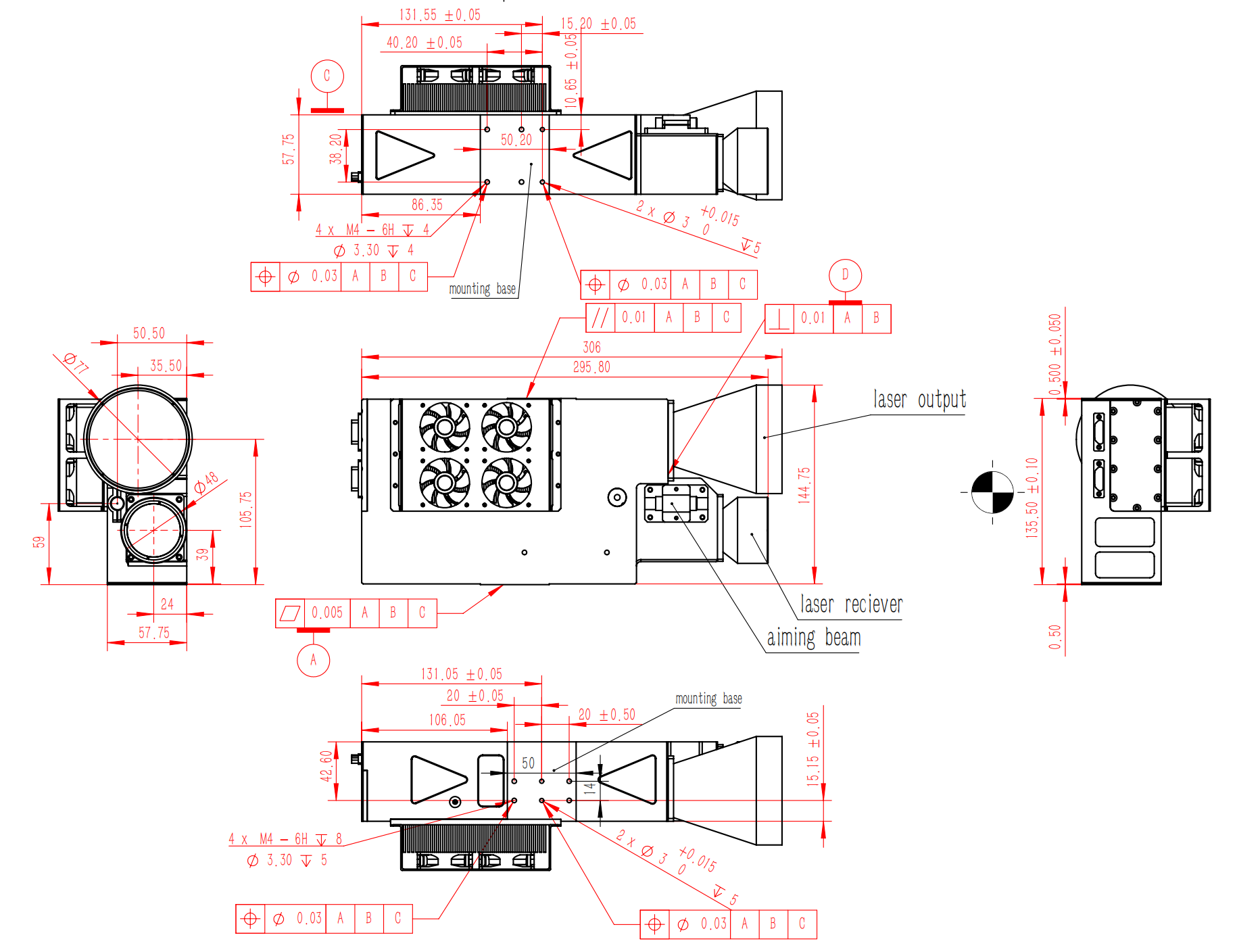
INTERFACE
The interface definitions are as follows:
Table 1 — J30J-21ZKP Interface Definition
|
J30J-21ZKP |
||||
|
Pin |
Function |
Description |
Direction |
Remarks |
|
1 |
TX+ |
RS-422 TX+ |
Output |
RS-422 Communication Interface |
|
2 |
TX- |
RS-422 TX− |
Output |
|
|
3 |
RX+ |
RS-422 RX+ |
Input |
|
|
4 |
RX- |
RS-422 RX− |
Input |
|
|
5 |
GND |
RS-422 GND |
GND |
|
|
6 |
EN+ |
Power Enable |
|
24 V Power Enable Switch |
|
7 |
EN- |
Power Enable |
|
|
|
8-13 |
|
Not Connected / NC |
|
|
|
14 |
A |
External Sync Differential + (A) |
Input |
A and B are the A/B differential outputs of the RS-422 driver chip |
|
15 |
B |
External Sync Differential − (B) |
Input |
|
|
16 |
LED+ |
DC5V |
Input |
Laser Designation Power Supply |
|
17 |
LED- |
GND |
Input |
|
|
18-21 |
|
|
|
|
Table 2 — J30J-04ZK Interface Definition
|
J30J-04ZK |
||||
|
Pin |
Function |
Description |
Direction |
Remarks |
|
A、B |
24V |
Power Supply |
Input |
Red |
|
C、D |
GND |
Power GND |
Input |
Black |
3. External Trigger:RS-422 differential signal
- Cooling Method:Cooling fan located at the front of the device
Information Download
-
PRODUCT DESCRIPTON
-
TECHNICAL PARAMETERS
-
DIMENSION(mm)
-
INTERFACE
-
Information Download
The ERDI LASER LR160 is a compact 1064 nm laser target designator and rangefinder delivering high-energy output for long-range precision engagement. With switchable pulse energy and accurate multi-target ranging, it is designed for integration into UAV gimbals, airborne pods, vehicle turrets, and border or coastal surveillance systems operating in harsh environments.
Key Advantage
-
High-Energy Long-Range Capability
Switchable 85 mJ / 160 mJ output enables reliable ranging up to 30 km and effective coded laser illumination for extended-range missions. -
Fast Multi-Target Ranging
10 Hz ranging with selectable first, second, and last target improves detection efficiency in complex or cluttered scenes. -
Precision Coding and Synchronization
Supports accurate frequency and time-code laser designation with microsecond-level timing control and internal/external synchronization. -
Compact and Integration-Friendly
Optimized size, weight, and RS-422 digital interface simplify integration into airborne and ground-based electro-optical platforms. -
Designed for Harsh Environments
Stable operation across a wide temperature range ensures dependable performance under demanding operational conditions.
|
Laser Wavelength |
1064nm±1nm |
|
Laser Energy |
85 mJ and 160 mJ (switchable) |
|
Optical Delay |
304 μs±1μs |
|
Beam Divergence |
≤0.2mrad |
|
Laser Designation Frequency |
8~21Hz |
|
Ranging Frequency |
10Hz |
|
Laser Pulse Width |
l0ns ~l5ns |
|
Power Stability |
≤8% |
|
Ranging Range |
0.2 m – 30 km |
|
Ranging Error |
≤5m |
|
Target Selection |
First Target / Second Target / Last Target |
|
Valid Measurement Rate |
98% |
|
Trigger Mode |
Internal Sync Illumination, External Sync Illumination |
|
Dimensions |
≤306×145×94mm |
|
Weight |
≤3.3kg |
|
Laser Designation Performance |
Laser Designation Center Frequency: 20 Hz Low/Normal Temperature, 85 mJ Output Low/Normal Temperature, 160 mJ Output High Temperature, 85 mJ Output High Temperature, 160 mJ Output |
|
Ranging Performance |
Minimum Measuring Distance: ≤ 300 m Maximum Measuring Distance: ≥ 30 km Ranging Frequency: 10 Hz (up to 3 targets) Continuous Operating Cycles: l Low/Normal Temperature: l High Temperature, 85 mJ Output: l High Temperature, 160 mJ Output: |
|
|
RS422 |
|
External Synchronization Interface |
+5 V differential line-driver chip, RS-422 interface (laser emission delay from external sync signal: 304.0 μs ± 0.1 μs) |
|
Coding Mode |
Precise frequency coding and time coding |
|
Period Accuracy |
<±1us |
|
Power Supply |
DC 24V±4V |
|
Startup Time |
< 1 minute (at room temperature) |
|
Low Temperature |
Operating temperature: −40 °C |
|
High Temperature |
Operating temperature: +60 °C |
The interface definitions are as follows:
Table 1 — J30J-21ZKP Interface Definition
|
J30J-21ZKP |
||||
|
Pin |
Function |
Description |
Direction |
Remarks |
|
1 |
TX+ |
RS-422 TX+ |
Output |
RS-422 Communication Interface |
|
2 |
TX- |
RS-422 TX− |
Output |
|
|
3 |
RX+ |
RS-422 RX+ |
Input |
|
|
4 |
RX- |
RS-422 RX− |
Input |
|
|
5 |
GND |
RS-422 GND |
GND |
|
|
6 |
EN+ |
Power Enable |
|
24 V Power Enable Switch |
|
7 |
EN- |
Power Enable |
|
|
|
8-13 |
|
Not Connected / NC |
|
|
|
14 |
A |
External Sync Differential + (A) |
Input |
A and B are the A/B differential outputs of the RS-422 driver chip |
|
15 |
B |
External Sync Differential − (B) |
Input |
|
|
16 |
LED+ |
DC5V |
Input |
Laser Designation Power Supply |
|
17 |
LED- |
GND |
Input |
|
|
18-21 |
|
|
|
|
Table 2 — J30J-04ZK Interface Definition
|
J30J-04ZK |
||||
|
Pin |
Function |
Description |
Direction |
Remarks |
|
A、B |
24V |
Power Supply |
Input |
Red |
|
C、D |
GND |
Power GND |
Input |
Black |
3. External Trigger:RS-422 differential signal
- Cooling Method:Cooling fan located at the front of the device