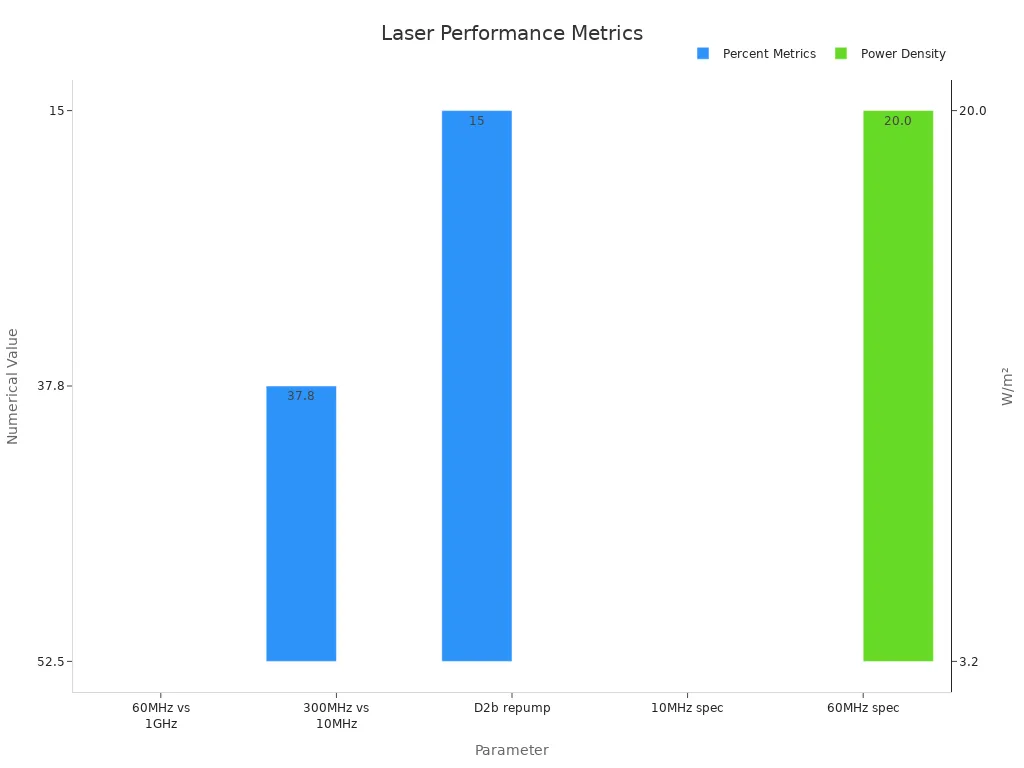
A high-frequency laser sends out quick pulses or waves over 20 kHz. This allows it to deliver energy with more control and accuracy. Laser frequency refers to how fast the light pulses happen. A laser is called "high-frequency" when it goes above 20 kHz. Tests show that materials only start to etch at frequencies higher than this. So, picking the right frequency is very important. The chart below shows that changing frequency and linewidth affects how well the laser works. It also changes how much power the laser needs.
Understanding these facts helps you choose the best high-frequency laser for your work.
Key Takeaways
-
High-frequency lasers flash over 20,000 times every second. This allows for great control and accuracy. These lasers excite atoms to produce steady, focused light. The light can be adjusted for many uses. Changing the laser’s frequency and modulation helps with cutting, marking, and medical tasks. High-frequency lasers create less heat damage. This keeps materials stronger and the work cleaner. Always test the laser settings on your material first. This helps you achieve the best results and stay safe.
High-frequency Laser Basics
What Is Laser Frequency
Laser frequency shows how often light waves repeat each second. We measure this in hertz (Hz). When you see a laser beam, it has a specific frequency. This frequency determines the laser’s color and the energy of each photon. For example, a red laser has a lower frequency than a blue or ultraviolet laser.
Scientists use special tools to check laser frequency. One tool is a frequency comb, which acts like a ruler for light waves. Sometimes, scientists use another laser and special crystals to double the frequency. They compare signals between lasers to find the exact frequency. This method gives very accurate results, even for ultraviolet lasers. The frequency comb stays steady by locking it to a GPS-controlled oscillator. This makes the measurements reliable.
You can also check laser frequency with interference patterns. When two light beams meet, they make a pattern that changes with their frequencies. By looking at these patterns, you can see how steady and exact a laser is. Scientists have used these ways to measure tiny differences, as small as 0.625 kHz.
Tip: Laser frequency is not the same as electrical frequency. Laser frequency is about the light. Electrical frequency is about how fast electric current changes direction.
What Makes a Laser High-Frequency
A laser is called high-frequency when it pulses or cycles faster than 20 kHz. This means the light turns on and off, or changes phase, over 20,000 times each second. High-frequency lasers can also use light with higher photon energy, like ultraviolet or blue light.
High-frequency lasers give better control and accuracy. In science, researchers use fast photodiodes and special electronics to record signals from lasers pulsing very fast. They use tools like Fourier transforms to study details in the laser’s spectrum. This helps them see how steady and sharp the laser beam is.
|
Study / Author |
Laser Type & Pulse Duration |
Repetition Frequency Threshold |
Key Findings on Incubation Effect and Ablation Threshold |
|---|---|---|---|
|
Di Niso et al. |
Pulsed laser, 650 fs & 10 ps |
Incubation effects weaker below 600 kHz; stronger heat accumulation and more pronounced incubation effects above 600 kHz for both fs and ps lasers |
|
|
Chen et al. |
Femtosecond laser |
N/A |
Ablation threshold of carbon fiber is more than twice that of resin; optimal laser fluence is 50–60 times the ablation threshold for minimal heat-affected zone |
|
Xiao et al. |
Femtosecond laser |
N/A |
Incubation coefficient ~0.82, independent of film thickness under single and multi-pulse irradiation |
|
Mannion et al. |
Various metals |
N/A |
Identified two ablation stages (gentle and strong) and differences in incubation coefficients among metals |
This table shows that using a high-frequency laser changes how materials act. For example, above 600 kHz, there is more heat and stronger effects on the material. This matters if you want to cut, engrave, or treat things with high accuracy.
Sometimes, people talk about "high-frequency" in skincare. That usually means a high-frequency electrical current, not a laser. Those devices use electricity to make heat or help the skin. A high-frequency laser uses light to give energy. These are not the same, so do not mix them up.
Note: Always check if you are using a high-frequency laser or a high-frequency electrical device, especially in medical or beauty settings.
How It Works
Laser Operation Principle
A laser has three main parts: the pump, the gain medium, and the resonant cavity. The pump gives energy to atoms in the gain medium. This energy makes more atoms excited than calm. Scientists call this "population inversion." Without it, a laser will not work. When an excited atom meets a photon with the right energy, it lets out another photon. This is called stimulated emission. Both photons match in phase and frequency. More photons make even more photons as they move through the gain medium. This is called optical amplification. The photons bounce between two mirrors in the resonant cavity. Each time, the light gets stronger. When the gain is bigger than the losses, the laser starts working. This is called the lasing threshold. The resonant cavity keeps the light waves in step. It also makes the laser beam narrow and focused. The beam is bright, steady, and one color. This helps lasers cut, measure, and send signals. Tests show these ideas work well. For example, lasers can measure things very accurately. Double-line structured light works better than single lasers. These systems need the steady, focused light that lasers give.
Frequency Modulation
You can control a high-frequency laser by changing how fast it pulses. This is called frequency modulation. There are different ways to modulate a laser:
|
Description |
Applications |
|
|---|---|---|
|
Amplitude Modulation |
Changes the strength of the laser beam |
Data transmission, light shows |
|
Phase Modulation |
Changes the phase of the light wave |
High-speed communications |
|
Frequency Modulation |
Changes how fast the light cycles |
LIDAR, spectroscopy |
|
Polarization Modulation |
Changes the direction of the light wave |
Quantum computing, advanced optics |
You can use direct modulation by changing the current in the laser diode. This changes the number of electrons and the light made. You can also use external modulators for more control. Each way has its own speed and accuracy limits. Rise time and fall time show how fast the laser turns on and off. If you try to modulate too fast, you may get distortion or lose signal quality. In high-frequency laser systems, frequency modulation is important for energy delivery. For example, in LIDAR, changing the modulation frequency between 2 MHz and 10 MHz does not change average power much. But the bias current can make the laser brighter. The best results come from picking the right mix of bias current, frequency, and amplitude. This gives a stable and accurate laser output. When using a high-frequency laser for drilling or cutting, the modulation frequency affects the material. At some frequencies, you get cleaner holes or cuts. The laser energy can push material out in bursts. This makes the process better. If the frequency is too high, the energy spreads out and does not remove material as well.
Tip: Always try different modulation settings for your high-frequency laser. The right settings can help accuracy, lower heat, and save energy.
High-frequency Laser Applications
Marking and Engraving
A high-frequency laser can make very exact marks on metal and plastic. Many factories use this to put marks on products. These marks do not rub off or get changed easily. You see these marks in cars, planes, electronics, and medical tools. Fiber lasers work well at high frequencies. They help you pick how deep or rough the mark is. If you change the frequency, you change how the engraving looks. For example, a 30 W fiber laser on tungsten carbide showed something interesting. When the frequency goes up, the surface gets rougher but the engraving is not as deep. To get the best marks, you must balance power, speed, and frequency.
Special tools can help you check your marks. Picosecond lasers and special microscopes let you see the size and quality of each mark. You might clean the material first. Then you set the laser settings. After that, you check the marks with machines and your eyes. These steps help you get good results every time.
Tip: High-frequency operation gives you more control. You can make marks that last longer and can handle tough use. The material also stays safe from too much heat.
|
Parameter / Aspect |
Continuous Wave (CW) Laser |
High-Frequency Pulsed Wave (PW) Laser |
|---|---|---|
|
Lower |
Much higher |
|
|
Heat Input |
Higher |
Lower |
|
Precision |
Lower |
Higher |
|
Application Suitability |
Thick materials |
Delicate, precise work |
Therapy and Ultrasonics
High-frequency lasers are also used in medicine. Doctors use them to help people with pain or muscle injuries. In one study, people with neck pain got high-frequency laser therapy. After 15 sessions, they felt less pain and could move better. Their lives got better, just like with other therapy. High-frequency laser therapy sends energy deep into your body. This energy helps you heal, lowers swelling, and helps blood flow.
Ultrasonic therapy uses sound waves. Sometimes doctors use it with laser treatments for better results. The laser’s light helps your body heal faster and with less heat. You get deeper treatment and can target the problem area better.
Note: Always talk to a doctor before starting laser therapy. The right settings and tools are important for safety and good results.
Benefits and Considerations
Quality and Efficiency
High-frequency lasers help you make better marks and work faster. These lasers let you cut things more neatly and make smoother surfaces. For example, fiber lasers with high-frequency settings can cut aluminum alloys with less roughness. The area that gets hot is also smaller. You get less dross, so there is less waste and the edges are cleaner.
-
The surface can be as smooth as 3 micrometers.
-
The hot area can be only a few micrometers wide.
-
Using the right gas pressure makes your cuts even better.
High-frequency pulsed lasers save energy and keep your materials strong. You can do more work with less power.
A study found that using high repetition rates makes laser quenching faster. It also makes the final material stronger. This means you finish jobs quicker and get better results.
Heat Management
It is very important to control heat when using a high-frequency laser. Too much heat can hurt your materials. Advanced computer models help you see how heat moves during laser work. These tools let you try different settings without wasting time or materials.
|
Heat Management Strategy |
Benefit |
|---|---|
|
Heat-spreading materials |
Lower temperature spikes |
|
Passive cooling methods |
No need for complex cooling systems |
|
Phase-change cooling |
Protects sensitive parts from quick changes |
You can use special materials like technical ceramics and Inconel alloys. These help your laser stay stable when it gets hot. They also help your laser last longer and work better in hard jobs.
Material Suitability
Not all materials act the same with a high-frequency laser. You need to pick the right settings for each job. For example, aluminum alloys and advanced composites work better with high-frequency lasers. You can get clean cuts and strong surfaces. Some lasers use wide-bandgap semiconductors and special coatings. These help them handle high heat and tough places.
Always test your laser settings on a small spot first. This helps you find the best frequency, power, and pulse time for your material.
You should also think about where you use your laser. Some lasers have strong cases and cooling systems. This lets you use them in factories, labs, or even space missions.
You now know these lasers send quick pulses for accurate energy. People use them to mark, cut, and help in medicine. Research shows they lower pain and help people heal faster. Many patients get better with these lasers.
|
Aspect |
Evidence Summary |
|---|---|
|
Less pain, better tissue repair, improved life quality |
|
|
Conditions Studied |
Back pain, arthritis, bone loss, joint problems |
|
Practical Impact |
Safe, non-invasive, and effective for many uses |
|
This is why learning about these lasers is helpful. It lets you pick the right tool for your job. |
|
FAQ
What is the main benefit of using a high-frequency laser?
You can control the laser better. High-frequency lasers help you make neat cuts and marks. Your materials do not get as much heat damage.
Can you use a high-frequency laser on any material?
You should check if your material works with high-frequency lasers. Some metals and plastics work better than others. Always test a small spot first.
How do you adjust the frequency of a laser?
You can change the frequency with the laser’s controls or software. Some lasers let you pick the frequency right away. Others need special electronics to change it.
Is a high-frequency laser safe to use?
You must follow safety rules every time. Always wear safety glasses. Never look at the laser beam. Keep the laser in a safe place.
What is the difference between a high-frequency laser and a high-frequency electrical device?
A high-frequency laser uses light to give energy. A high-frequency electrical device uses electric current instead. Do not mix them up. Always check what kind of device you have.