In today's era of vigorous development of the low-altitude economy and intelligent driving, LiDAR has become the "eyes" for high-precision environmental perception. As a leading manufacturer of laser ranging solutions, ERDI TECH is guided by the "military-civilian integration" strategy, deeply engages in the field of lidar integration, and has built an independent R&D system covering the industrial chain from erbium glass lasers to pulsed laser rangefinder modules, providing underlying technical support for drones and vehicle-mounted scenarios.
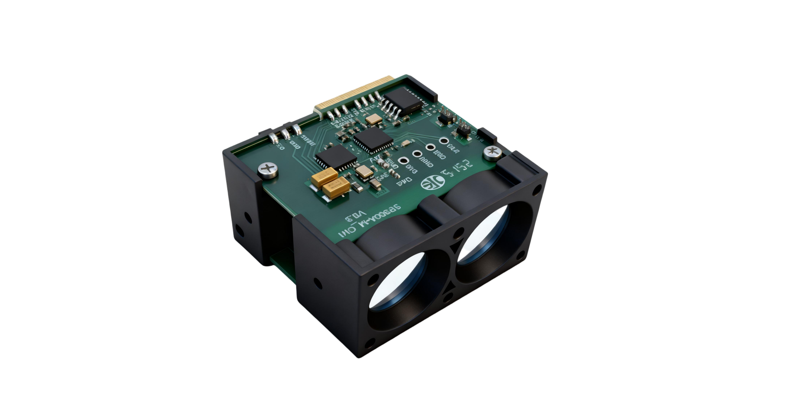
This article will elaborate on the LRF 1500 H as a high-performance laser rangefinder module. Its various parameters accurately match the core needs of drones operations for "full-range coverage, high stability, and strong environmental adaptability". From ranging capability, response efficiency to environmental adaptability, it provides key technical support for drones scenarios. The specific parameter advantages and corresponding application values are as follows:
-
Range (0.05m~1500m at 90% reflectivity; 0.05m~300m at 10% reflectivity)
-
Short-range advantage: The short-range lower limit of 0.05m (5 cm) is extremely small, completely eliminating the "near-field blind spot" problem of UAVs. Whether it is the distance control of crop canopies during UAV close-to-ground plant protection, the detection of 5-10cm short-distance cracks on building exteriors, or the accurate distance judgment from the ground during take-off and landing phases, it can avoid the safety hazard of "unable to measure at short range" and ensure the accuracy of short-distance operations.
-
Long-range advantage: The maximum ranging distance of 1500m at 90% high reflectivity far exceeds that of mainstream industrial modules (usually 800-1200m), which can greatly expand the long-distance operation radius of UAVs. For example, during power inspection, UAVs can lock onto high-reflectivity metal components such as high-voltage line insulators and vibration dampers from 1000m away, without the need to approach at a short distance, thus avoiding the risk of electric shock; in forest fire prevention scenarios, it can detect high-reflectivity fire markers within 1500m, buying time for early fire disposal.
-
Low-reflectivity adaptation advantage: The ranging capability of 300m at 10% low reflectivity is better than the industry average (most modules only reach 150-250m). When facing low-reflectivity targets such as forest mapping with dense vegetation and road inspection on dark asphalt roads, it can still maintain a long detection distance, avoid "target missing", and adapt to operations in complex environments. It is a module that "has no shortcomings in short range, makes breakthroughs in long range, and does not hold back in low-reflectivity scenarios". It can not only meet the needs of short-distance precision operations, but also support long-distance large-scale operations, and cope with complex target scenarios such as low reflectivity, thus adapting to the "full-range coverage" application needs of UAVs.
-
Frequency (1KHz or 50Hz, automatically switchable)
-
High-frequency adaptation to dynamic scenarios: The high-frequency mode of 1KHz can meet the high-speed operation needs of UAVs. For example, during the inspection of high-speed railway lines with a speed of 150km/h, high-frequency sampling can fully capture the spatial positions of catenary wires and track fasteners, avoiding target missing caused by excessively long sampling intervals.
-
Anti-ambient light interference (100klux)The anti-light interference capability of 100 kilolux can resist interference in environments with direct strong light. When UAVs operate in strong light scenarios such as summer noon plant protection and plateau mapping, there is no need to worry about ranging data distortion caused by ambient light, ensuring all-weather operation stability.
-
Central wavelength (905 nanometers) + Class I photobiological safety
The 905nm wavelength is a mature solution for laser ranging, with strong technical compatibility, which can work in coordination with the existing optical systems of UAVs (such as cameras and obstacle avoidance sensors); it complies with Class I photobiological safety standards, which can minimize the harm to personnel when UAVs fly at low altitudes.
-
Dimensions (33×34×18mm) + Weight (20±2 grams)
It adopts a lightweight design, perfectly adapting to the installation needs of UAVs for "small space and low load": it can be embedded in the UAV fuselage, pod or wing without damaging the aerodynamic performance; the weight of 20g is only 1/20 of the weight of a UAV battery, which has a negligible impact on the UAV's endurance, and is especially suitable for consumer-grade small UAVs or industrial-grade UAVs integrated with multiple sensors.
-
Operating temperature (-20℃~+60℃)
The operating temperature range of -20℃~+60℃ can cover most UAV operation environments. Whether it is power inspection in low-temperature winters in northern China or farmland plant protection in high-temperature summers in southern China, the module can maintain stable performance, avoid laser power attenuation and data drift caused by high and low temperatures, and ensure the continuity of operations.
-
Power supply voltage (9~36VDC) + Average power consumption (1.2 watts)
The wide voltage adaptation range of 9-36VDC can be directly compatible with the 12V and 24V lithium battery power supply systems commonly used in UAVs, without the need for additional voltage converters, reducing integration complexity; the low average power consumption of 1.2 watts consumes only a small amount of electricity during the continuous operation of UAVs, has little impact on endurance, and does not require additional battery load for the module.
-
Communication interfaces (UART/IIC)
UART and IIC are common interfaces for UAV flight control systems and processors. No complex protocol conversion is required, and the communication connection between the module and the UAV control system can be quickly realized, thereby shortening the integration cycle.
The parameter design of the LRF 1500 H rangefinder module, which is anchored by DTOF laser core technology, basically centers on the UAV operation needs of "full-scenario, high reliability, and low burden". It can meet civil safety specifications and multi-environment operation needs, and is a high-performance laser rangefinder module tailor-made for UAV scenarios.
Contact ERDI TECH
If you need technical information, specification sheets, prototype tests or customized solutions for the 1064nm laser target designator, please contact the ERDI TECH engineering team.
📧 yeva@erdimail.com (responses within 24 hours)
📞+86 18123396539
We will provide the most suitable laser technology solutions for your platform.
For datasheets and downloads, visit:
🔗 LRF1500H Product PDF
ERDI TECH — Advancing Drone Perception through Precision Laser Ranging.