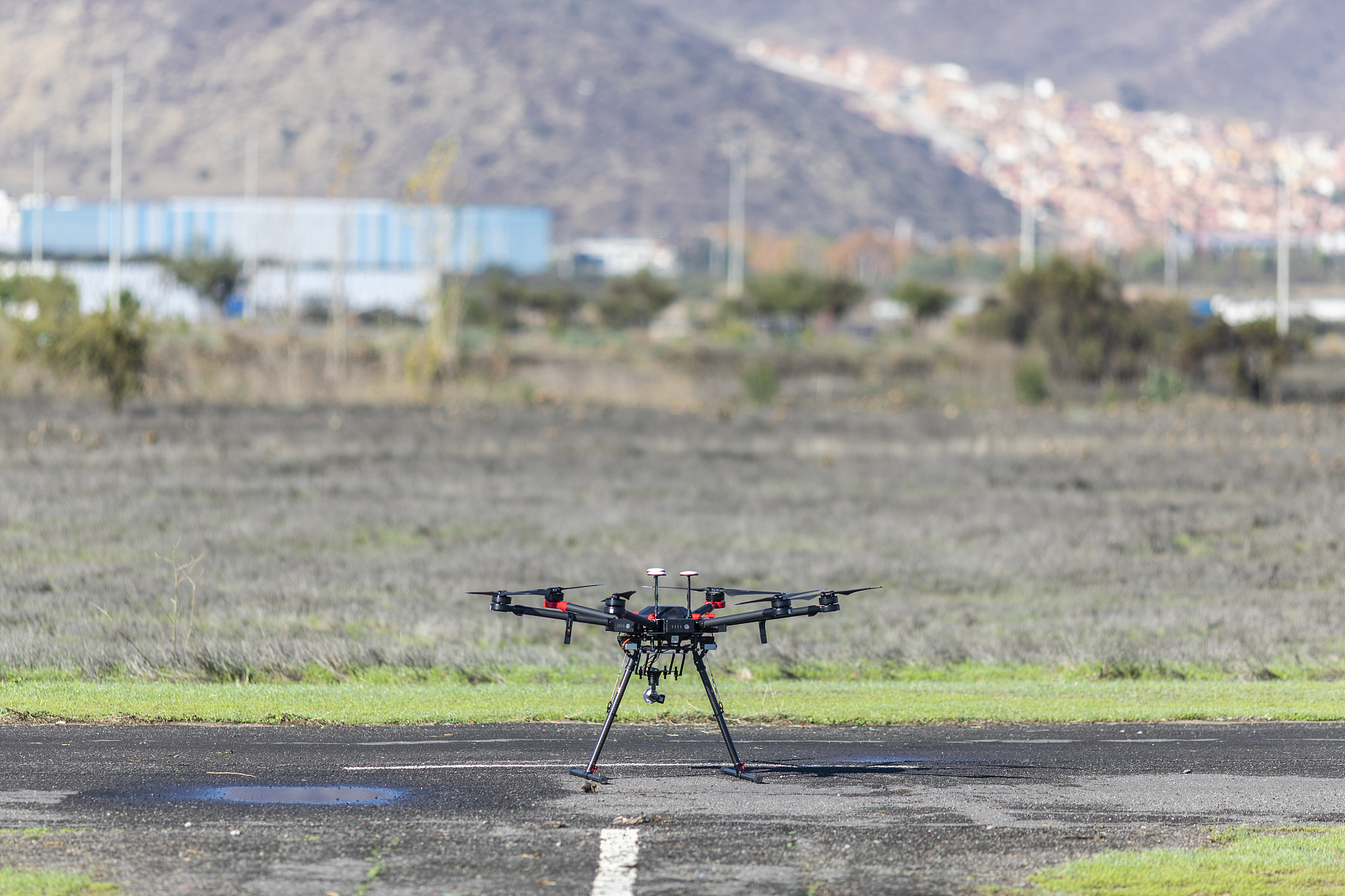
In the autonomous operation of robot aircraft (such as unmanned drones, unmanned helicopters, etc.), obstacle avoidance technology is the core link to ensure their safe and efficient operation. Whether it is complex terrain mapping, urban low-altitude delivery, military reconnaissance, or industrial inspection, it is necessary to have precise and reliable environmental perception capabilities to identify obstacles in real time and make avoidance responses. Among various sensing technologies, lidar has become the mainstream choice due to its high measurement accuracy and fast response speed. The 1535nm laser, as one of the core light sources in lidar, is gradually becoming the preferred solution for obstacle avoidance technology in robotic aircraft thanks to its unique physical properties and engineering compatibility.
I. Outstanding atmospheric transmission capability, adapting to complex environmental challenges
The operation scenarios of robot aircraft often involve uncertainties - fog, rain, dust, smoke, etc., which can seriously affect the transmission efficiency of light signals and lead to the "blindness" of the obstacle avoidance system. The 1535nm laser, with its wavelength in the near-infrared band in the atmospheric low attenuation window, exhibits significant advantages in harsh environments.
Compared to the common 905 nm laser, the 1535nm laser has less scattering and absorption of atmospheric particles. Experimental data shows that in an environment with 60% humidity, the 905 nm laser decays by approximately 3 dB after 1 kilometer of transmission, while the 1535 nm laser has a significantly lower attenuation; in sandstorm conditions, its penetration ability can even increase by 2-3 times. This means that even in battlefield smoke, urban haze, or wild sand environments, aircraft equipped with 1535 nm laser radar can maintain stable detection performance and provide reliable data for obstacle avoidance decisions.
In addition, the beam quality of 1535 nm laser is excellent (M² factor close to 1.2), with high energy concentration, and is less likely to diverge during long-distance transmission, further ensuring the detection accuracy in complex environments. This strong environmental adaptability enables it to cover various operation scenarios from urban low-altitude to wild deserts.
II. Balance between human eye safety and high power output, considering safety and performance
When robot aircraft operate at low altitudes, they inevitably intersect with human activity areas, so the "human eye safety" of the obstacle avoidance system becomes a key indicator. The 1535 nm laser performs exceptionally well in this dimension: according to the IEC 60825-1 international standard, its safety level reaches Class 1, meaning that it can ensure human (especially eyes) safety without additional protective measures.
This characteristic stems from the energy absorption mechanism of 1535 nm laser - its wavelength's light is mainly absorbed by the cornea and lens of the human eye, rarely reaching the retina (the retina is the core of visual perception and is the most susceptible to laser damage). In contrast, the safety threshold of 1064 nm laser is only 1/400000 of that of 1535 nm, and the potential risk to the human eye under the same power is significantly higher.
More importantly, the high safety threshold of 1535 nm laser allows it to operate at a higher power. For instance, the 1535nm laser module independently developed by ERDI TECH LTD can output high-repetition-frequency pulses with a frequency as high as 5 kHz. The single pulse energy is stable and controllable. The direct advantage brought by high power is the extension of detection distance and the enhancement of echo signals, which is crucial for aircraft to avoid obstacles over long distances in open areas (such as mountains and oceans).
III. Collaboration with advanced detection technologies to enhance obstacle avoidance accuracy
The performance of laser radar not only depends on the light source, but also on the matching degree of the detector. The synergy between 1535 nm laser and InGaAs (indium gallium arsenide) detectors precisely forms a "1+1>2" technological advantage.
The InGaAs detector has an extremely high quantum efficiency in the near-infrared band (especially 1500-1600nm), which is much higher than that of silicon-based detectors (which experience a sharp decline in efficiency above 900nm). For instance, the 1550nm linear scanning laser radar developed by the Chinese Academy of Sciences, when using InGaAs single-photon detectors, achieves a detection efficiency of over 3%, combined with active quenching technology, can achieve remote detection distances of over 3km, and the depth resolution reaches centimeter level.
In recent years, the application of superconducting nanowire detectors (SNSPD) has further unleashed the potential of 1535 nm laser. These detectors have a time jitter of only 12.6ps (picoseconds) in the 1535nm band, and the equivalent depth resolution can reach 2mm. They can precisely identify small obstacles (such as wires and branches) - these obstacles are common "invisible killers" in low-altitude unmanned aircraft flights, and traditional obstacle avoidance systems often have difficulty detecting them.
V. Comprehensive Value in Practical Applications, Adapted to Aircraft Requirements
The requirements for obstacle avoidance systems for unmanned aerial vehicles are "light, small, stable, and energy-efficient" - light weight, small size, stable performance, and low energy consumption. The advantages of 1535 nm laser radar in system integration enable it to perfectly meet these requirements.
From the perspective of hardware design, the optical path system of 1535 nm laser can adopt fiber coupling technology, significantly reducing the volume. For example, ERDI TECH's 1535nm miniaturized laser has a weight of only 2.5 grams and a size smaller than that of a coin. However, it can withstand the impact of meeting MIL-STD-810G test standards (1500 G, 0.5 ms). In terms of energy consumption, the slope efficiency of the 1535nm laser radar with pumping technology (such as 1535nm pumped erbium-ytterbium co-doped fiber amplifier) can reach 58.4%, much higher than conventional pumping methods, effectively extending the flight time of the aircraft.
In terms of anti-interference ability, 1535 nm laser has extremely low sensitivity to environmental light. The energy in the 1535nm band in natural light (such as sunlight) accounts for less than 0.1%, so even under direct sunlight, the laser radar can maintain a high signal-to-noise ratio. The experiment conducted by Heriot-Watt University in the UK shows that the superconducting nanowire radar based on 1535 nm laser can still achieve millimeter-level three-dimensional imaging at a distance of 1km under midday sunlight conditions, and the background noise suppression capability is more than 10 times that of the 905nm system.
Conclusion
The 1535 nm laser has become the ideal choice for obstacle avoidance technology in robotic aircraft due to its comprehensive advantages in environmental adaptability, eye-safety, detection accuracy, and system integration. It not only solves the problem of signal attenuation under complex weather conditions, but also balances the contradiction between high power output and safety. Moreover, through collaboration with advanced detectors, it achieves the dual requirements of "long-distance detection + precise identification".
As robotic aircraft continue to develop towards intelligence, miniaturization, and multi-scenario applications, the 1535 nm laser technology will further enhance the performance of the obstacle avoidance system, providing more reliable safety guarantees for low-altitude economy, military reconnaissance, industrial inspection and other fields, and becoming an important support for future autonomous flight technology.