What Is Beam Divergence?
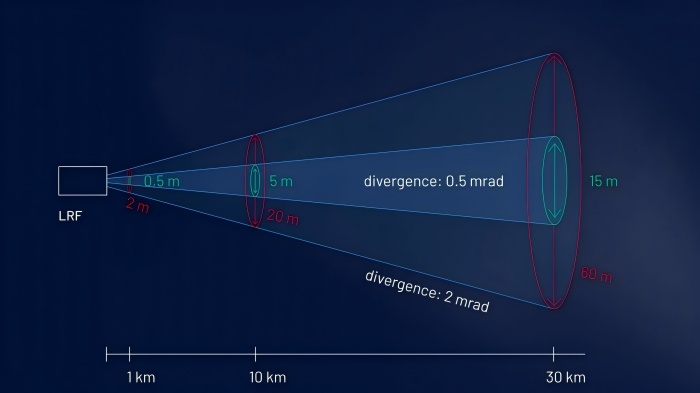
In laser rangefinding, beam divergence describes how much a laser beam spreads as it travels over distance. Measured in milliradians (mrad), it directly affects the spot size, target coverage, and ultimately the measurement accuracy of the laser system.
For instance, a divergence of 0.3 mrad results in a spot size of 30 cm at 1000 m. The tighter the divergence, the more focused and accurate the beam remains at long distances.
Small Beam Divergence: Why It Matters
A small divergence angle, such as ≤0.3 mrad, results in a tightly focused beam that maintains a smaller spot size over long distances. This is crucial in laser rangefinding for several reasons:
1. Higher Targeting Accuracy
Smaller divergence reduces the spot size at distance, which minimizes the risk of hitting unintended surfaces. This is especially important for:
- Small, precise targets
- Long-distance measurements
- Cluttered or complex environments
2. Better Environmental Performance
In real-world conditions such as fog, rain, dust, or heat shimmer, a narrow beam is less affected by atmospheric scattering, resulting in more stable signal returns.
3. Long-Distance Capability
For example, in a 1535nm erbium glass laser rangefinder designed to detect targets up to 12 km, beam divergence is a critical limiting factor. A wider beam may spread beyond the target, diluting energy density and reducing measurement success rate. A divergence angle of 0.3 mrad or less ensures that the laser spot remains tight enough for precise returns, even at extreme ranges.
Many of ERDI TECH’s rangefinders, such as the LRF1221C-03, are built with this principle in mind, achieving ≥12 km ranging under 30% reflectivity conditions while maintaining a ≤0.3 mrad divergence for excellent long-range performance.
Large Beam Divergence: Pros and Cons
While larger divergence angles (e.g., >1 mrad) may reduce long-range accuracy, they do offer benefits in short- to medium-range applications where a larger spot size increases hit probability on moving, wide, or low-reflectivity targets.
This trade-off is discussed in detail in this peer-reviewed study from MDPI Photonics Journal, which highlights how beam divergence influences range accuracy, energy distribution, and target detectability across diverse scenarios.
Beam Divergence and Spot Size: The Relationship
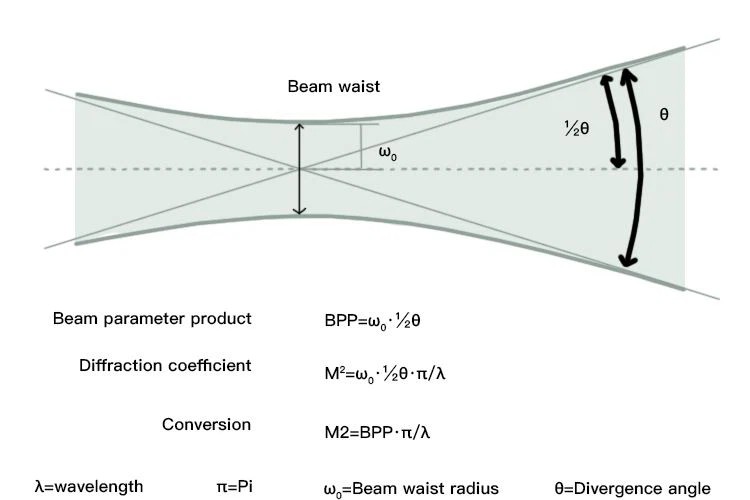
Source: Safran Vectronix
The laser spot size at a given distance can be approximated by:
Spot Diameter ≈ Beam Divergence (in radians) × Distance
| Divergence | Distance | Spot Size |
|---|---|---|
| 0.3 mrad | 1000 m | 30 cm |
| 1.0 mrad | 500 m | 50 cm |
| 2.0 mrad | 100 m | 20 cm |
The LRF200A-03 905nm diode laser rangefinder module uses a larger beam spot (approx. 20×10cm at 100m), offering key advantages in industrial and vehicle environments:
- Increased measurement reliability on uneven or moving targets
- Wider field overlap, improving detection success on diffuse or non-cooperative surfaces
- Reduces missed readings in vibration-prone systems such as AGVs or construction equipment
This design choice prioritizes practical stability over extreme pinpoint precision, making it ideal for outdoor automation, vehicle positioning, and collision avoidance.
Tips for Optimizing Laser Rangefinder Performance
- Match divergence to your range & target size
- Minimize ambient interference by choosing appropriate wavelengths (e.g., 1535nm for eye-safety and fog resistance)
- Use precision optics to control divergence and focus
- Ensure proper alignment in your system integration
- Select modules with signal confidence output, such as return intensity or working status feedback
Final Thoughts
Beam divergence may seem like a small technical detail, but it has a big impact on laser rangefinder performance. Whether you're building a military-grade long-range targeting system or a vehicle-mounted safety sensor, understanding and selecting the right beam divergence will ensure:
- Higher measurement accuracy
- Better reliability in real-world environments
- Improved system integration
Ready to choose the right laser rangefinder for your application? Explore ERDI TECH’s laser modules for solutions designed to balance divergence, power, and precision—tailored for your performance needs.