
I. Introductio
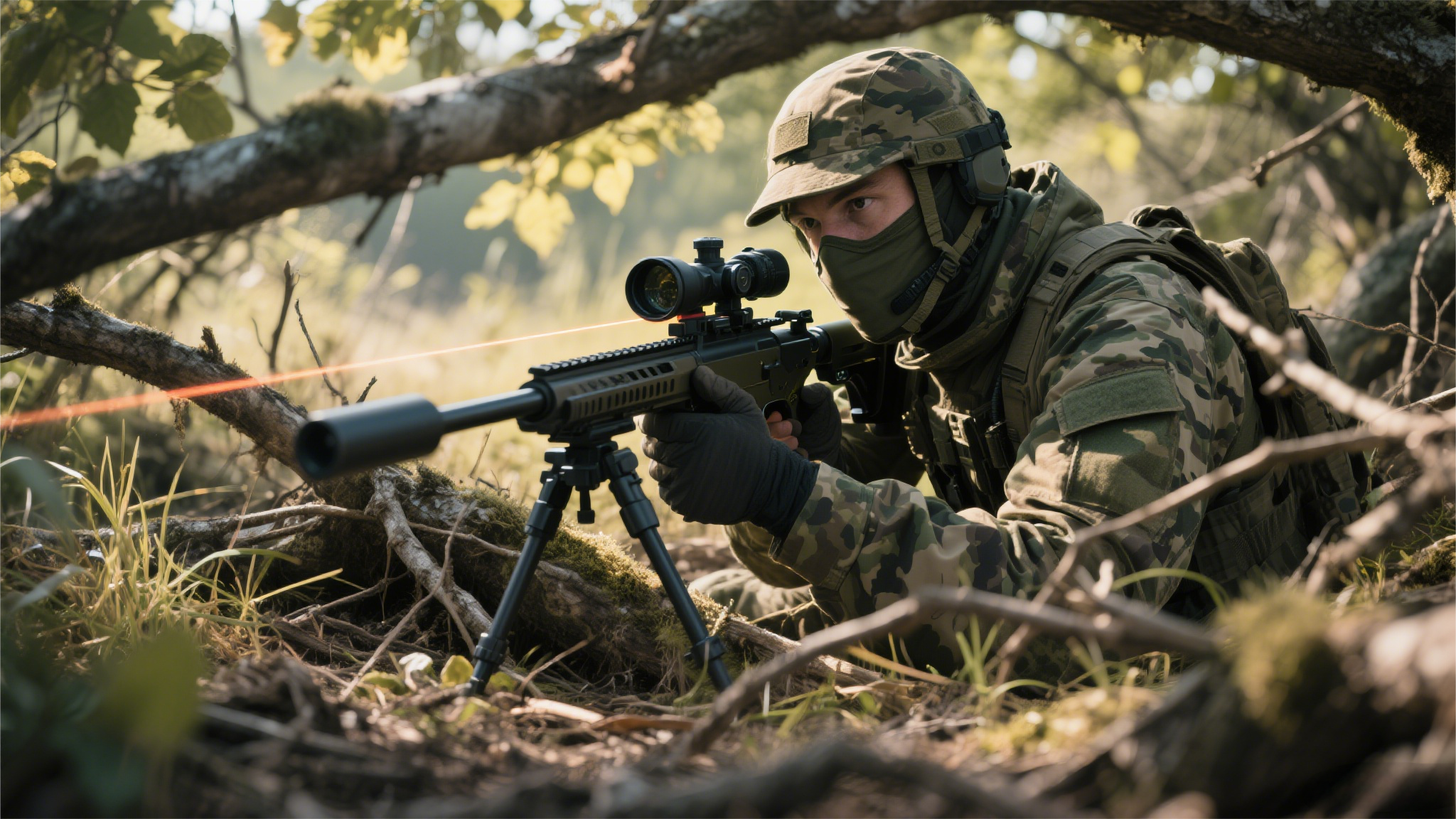
In today’s complex battlefield environment, snipers—highly skilled combatants with tactical functions such as precision strikes, reconnaissance, and strategic deterrence—are an indispensable part of modern military systems. Their actions can directly influence the outcome of engagements. Therefore, the ability to execute precise strikes is at the core of a sniper’s mission. The development and deployment of laser rangefinders have become critical in supporting this goal. This article explores how laser rangefinders enhance the combat effectiveness of snipers.
II. Working Principle of Laser Rangefinders
A laser rangefinder is a sophisticated optoelectronic device based on the speed-of-light principle. It determines distance by emitting a laser beam toward a target and measuring the time it takes for the light to return. The two main working principles are the pulse method and the phase method. Erdi laser rangefinders primarily use the pulse method, which offers advantages such as long-range measurement, fast response, and a straightforward operating principle—making it particularly suitable for sniper operations.
III. Empowering Precise Strikes
1) Data Support
Pulse-method laser rangefinders emit extremely narrow and energy-concentrated laser pulses that can travel long distances through the atmosphere. They provide accurate distance measurements for targets several kilometers away, supplying essential data for precision shooting.
2) High Measurement Accuracy
Pulse-method laser rangefinders offer high measurement accuracy, helping reduce deviation in ballistic calculations. In sniper missions, precise distance measurements are foundational to calculating bullet trajectories. Snipers must consider target distance, wind direction, wind speed, and the ballistic properties of their firearms to adjust their aim. For long-range shots, even small ranging errors can result in trajectory deviations of tens of centimeters. Erdi’s laser rangefinders achieve an accuracy of ±1m, effectively controlling trajectory deviation within 4cm.
3) Easy System Integration
Our laser devices feature a shell-less design and compact size, making them easy to integrate into various systems. In sniper platforms, they work with preloaded parameters and complex algorithms to calculate precise aim point adjustments, significantly improving hit rates in dynamic battlefield environments.
IV. Improving Snipers’ Battlefield Awareness
1) Increasing Hit Rates on Moving Targets
In modern warfare, snipers often face moving targets in complex environments. Pulse-method laser rangefinders emit and receive laser pulses rapidly, using internal timers to record time differences—usually within a second. This quick response enables snipers to obtain real-time distance data, adjust their sniping parameters, and effectively engage moving targets.
2) Building a Collaborative Combat Network
Laser rangefinders can integrate with various combat systems to form a collaborative battlefield network, boosting operational efficiency. For example, UAVs (unmanned aerial vehicles) offer high mobility and aerial reconnaissance capabilities. They can relay panoramic imagery to ground snipers, expanding their battlefield awareness. Additionally, UAVs can guide precision strikes using the range data, enhancing coordination and intelligence sharing among friendly forces.
V. Enhancing Combat Flexibility and Safety
1) Stable Ranging in Diverse Environments
Laser beams are less affected by environmental conditions compared to traditional optical devices. Thanks to their focused energy and strong directionality, laser rangefinders can consistently emit and receive signals in varying weather and terrain. Their fast response and portability allow snipers to track targets and adapt quickly, improving flexibility and reaction speed in complex terrains.
2) Improving Survivability
Concealment is critical for snipers; exposure can lead to mission failure or worse. Most of Erdi’s laser rangefinders operate in the near-infrared band, making them less detectable to enemy forces. This reduces the risk of revealing sniper positions during distance measurement, significantly improving survivability and mission success rates.
VI. Case Studies in Modern Battlefields
1) Mountain Warfare in Afghanistan
During operations in the mountainous regions of Afghanistan, U.S. snipers encountered Taliban militants familiar with the local terrain. After an ambush led to a stalemate, U.S. forces used advanced laser rangefinders to detect enemy strongholds hidden in valleys from a distance. This intelligence enabled successful precision strikes and paved the way for further military actions.
2) Russia–Ukraine War
In the Russia–Ukraine conflict, snipers operated in challenging environments such as urban combat zones and open terrain. Russian snipers employed the 1PN108-3 laser rangefinder sight, which combines laser ranging and aiming capabilities. These devices allowed them to quickly locate Ukrainian forces hiding in rubble, facilitating coordinated attacks. Ukrainian snipers also used similar systems, resulting in fierce sniper duels in complex terrains. These scenarios highlight the growing role of laser rangefinders in modern sniper operations.
VII. Conclusion
With precise distance measurement and strong environmental adaptability, laser rangefinders have significantly enhanced snipers’ combat effectiveness. They play a vital role in improving shooting accuracy, battlefield awareness, operational flexibility, and survivability. As technology continues to advance, laser rangefinders are expected to become even more capable—providing robust support for sniper missions in increasingly complex battlefield conditions.
Frequently Asked Questions
Q1: What battlefield environments are suitable for laser rangefinders?
Laser rangefinders are suitable for a variety of environments—particularly those requiring high-precision ranging, including both open and complex terrains.
Q2: What basic skills are required to operate a laser rangefinder?
Basic training is needed to operate a laser rangefinder, while some advanced functions require specialized instruction or certification.
References and Recommended Readings
-
Applications of Laser Technology in Military Affairs
-
Modern Combat Strategies for Snipers
We hope this article provides readers with a comprehensive understanding of laser rangefinders' technical features and battlefield impact—and promotes innovation in the application of tactical technologies.
Want to learn more about lasers? Visit our website: erditechs.com