
Introduction
Autonomous sensing systems are often described in linear terms: detect, decide, act. In practice, however, operational stability is rarely determined by linear performance metrics alone. What distinguishes resilient systems from fragile ones is not just detection accuracy, but the integrity of feedback loops in autonomous sensing systems — the mechanisms through which decisions influence future sensing behavior.
When feedback loops are poorly designed, minor perception errors can amplify over time. When they are properly structured, systems adapt, stabilize, and recover from uncertainty. This distinction becomes critical in border surveillance, counter-UAS environments, and multi-sensor security platforms where environmental variability is constant.
1. From Linear Pipelines to Closed-Loop Architectures
Early sensing architectures were largely feedforward:
Sensor → Processing → Decision → Output
Modern autonomous systems operate differently:
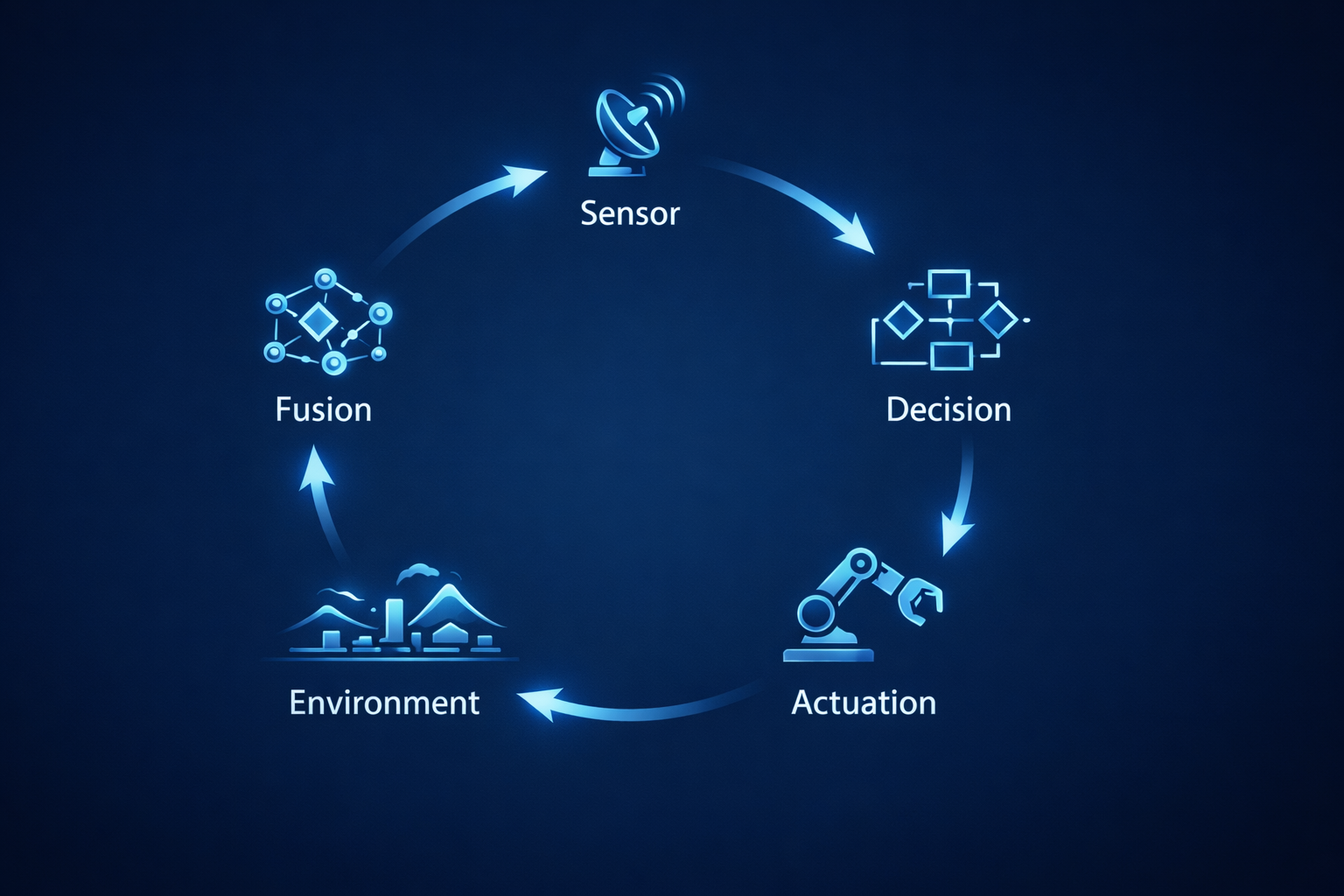
Sensor → Fusion → Decision → Action → Environmental Change → Sensor Update
The system is no longer observing a static world.
It is interacting with it.
A tracking decision may alter sensor pointing.
A threat classification may trigger illumination or ranging.
A maneuver decision may change sensor geometry.
Each action modifies the next sensing condition. Without stable feedback loops, systems can drift into oscillation, over-correction, or degraded situational awareness.
In practice, instability rarely appears immediately. It often emerges gradually after hours of operation, when minor perception inconsistencies accumulate and begin influencing control behavior.
2. Error Amplification and Error Damping in Practice
Feedback loops can either amplify errors or damp them.
Error Amplification Scenario
- A false detection triggers a tracking lock
- Tracking modifies sensor orientation
- Modified orientation increases noise or clutter
- Increased noise generates additional false detections
The loop reinforces instability.
Error Damping Scenario
- Detection confidence is evaluated over time
- Multi-frame consistency is required before actuation
- Sensor repositioning includes uncertainty compensation
The loop absorbs uncertainty instead of magnifying it. The distinction is fundamentally architectural rather than purely algorithmic. In many legacy systems, feedback mechanisms were introduced only after initial deployment, which makes long-term stability significantly harder to manage.
3. Temporal Consistency and Control Stability
Closed-loop sensing depends heavily on timing integrity. If decision latency exceeds environmental dynamics, corrective actions may arrive too late. If synchronization across sensors is inconsistent, fusion confidence may fluctuate.
In high-dynamic environments — such as drone interception or mobile surveillance — feedback stability becomes a control systems problem rather than a detection problem. This is why parameters such as sensor update rates, trigger synchronization accuracy, measurement repeatability, and ranging latency are often treated as independent specifications, yet in closed-loop systems they directly influence stability margins.
4. Coupling Between Actuation and Perception
In many deployed systems, actuation is treated as downstream of perception.
In reality, actuation changes perception conditions.
Examples include:
- Laser ranging altering reflectivity response
- Platform motion changing field of view overlap
- Target illumination affecting sensor exposure
If the architecture does not account for this coupling, system models become inaccurate after deployment.
Engineers often discover these interactions only during field testing, when performance deviates from laboratory expectations. Closed-loop modeling must therefore consider perception and actuation as mutually dependent subsystems.
These coupling effects are frequently underestimated during laboratory validation, where environmental variability is limited and feedback dynamics remain partially untested.
5. Designing for Operational Stability
In practice, this means introducing confidence-aware thresholds, validating decisions across multiple frames, compensating for latency through predictive models, limiting actuation authority, and explicitly modeling sensor–actuator coupling.
These principles are easier to describe than to implement, particularly in legacy systems where synchronization and control logic were never designed for tight loop integration.
However, without such considerations, increasing sensor precision alone does not guarantee operational reliability.
Conclusion
Fielded autonomous sensing systems rarely fail because of a single detection error. More often, instability emerges from how small errors propagate through feedback structures over time. Failures often occur when feedback structures magnify uncertainty rather than contain it. Closed-loop architecture determines whether a system stabilizes under environmental variability or progressively drifts toward degraded performance. Understanding feedback loops in autonomous sensing systems shifts engineering focus from isolated sensor specifications to system-level stability — where operational effectiveness is ultimately decided.
Explore other system issues:
Distance Accuracy vs. System Latency Why Precision Alone Is Not Enough
False Alarms as a System-Level Cost: Why Reducing Noise Often Matters More Than Extending Range
False Alarms in Autonomous Sensing Systems: Confidence Over Detection
Correlated Failure in Multi-Sensor Redundancy: More Sensors ≠ Higher Reliability