
Estimated reading time: 6 minutes
Introduction
Among various system integrations, multi-sensor fusion is generally regarded as equivalent to higher system reliability. Undeniably, additional measurements can obtain more data information, thereby reducing the uncertainty of the system. In fact, the correlation effect rarely appears immediately. In many actual photonic and unmanned aerial vehicle sensing architectures, increasing the number of sensing inputs also increases the difficulty of maintaining time synchronization, ensuring consistency in calibration, and maintaining stable confidence weights among measurement sources. Taking the engineering team responsible for developing multi-sensor tracking systems as an example, during the development process, they usually find that the problem is not the lack of data, but how to ensure the compatibility of the obtained data among different sensing methods. When the independence of the sensing channels is insufficient, increasing the input signals may increase the system complexity, but it will not significantly improve the stability of the estimation.
In this regard, understanding the difference between sensor fusion and sensor diversity will help explain why increasing the number of sensors does not necessarily lead to better results.
Sensor Fusion Does Not Guarantee Independent Information
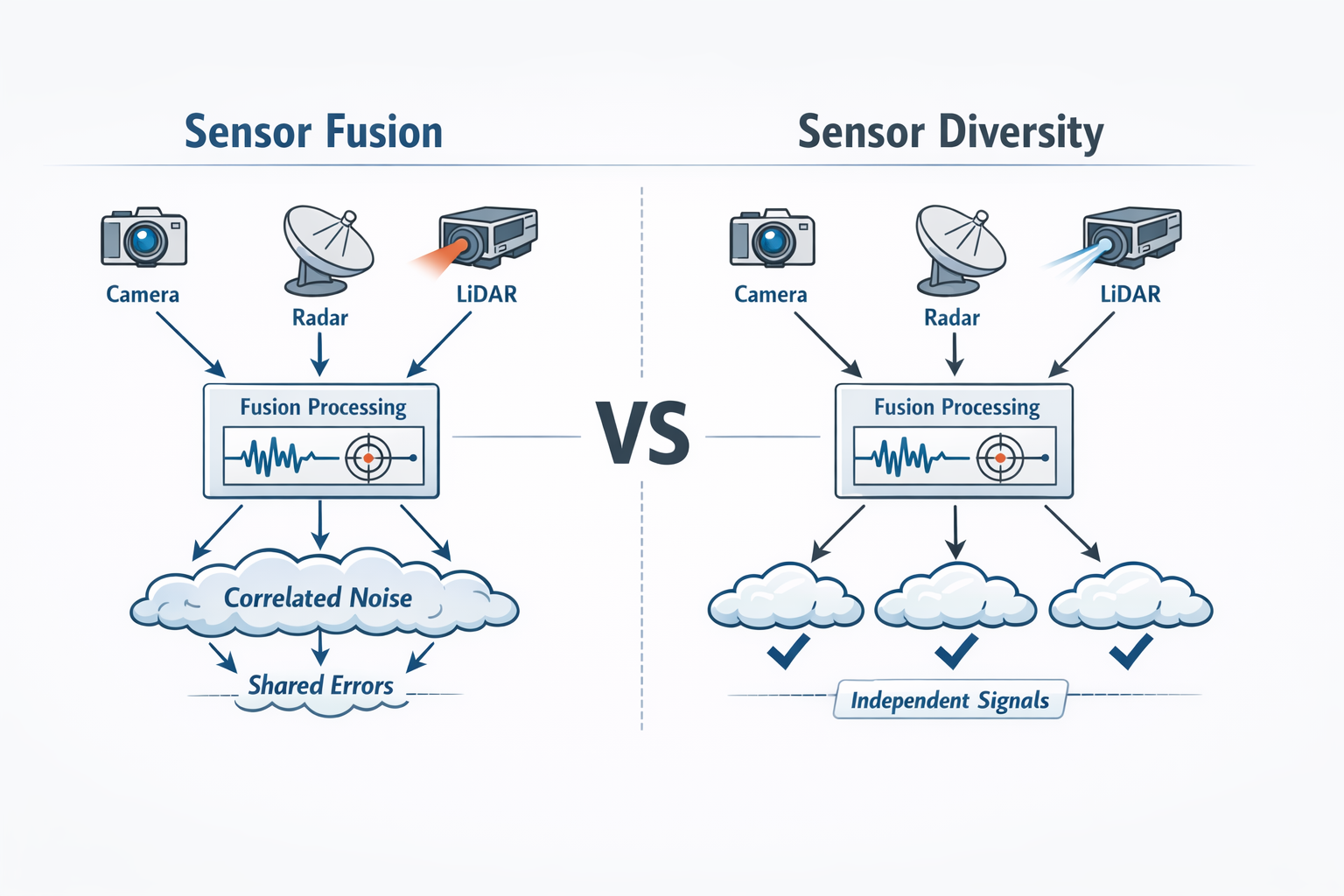
Sensor fusion combines measurements from multiple sources to produce a unified estimate of system state. In theory, additional sensors should reduce uncertainty. In practice, the effectiveness of fusion depends on whether sensing channels provide complementary information rather than repeating similar measurement patterns. Two sensors may differ in hardware design but still respond similarly to environmental disturbances such as vibration, thermal drift, or atmospheric attenuation. When measurement deviations originate from shared external factors, combining signals may reinforce bias rather than reduce it. Engineers therefore often evaluate sensing strategies based on the independence of measurement error sources rather than sensor quantity alone.
In many mobile sensing platforms, the marginal benefit of additional sensors decreases when signal correlation becomes significant. In practice, correlation effects rarely appear immediately.
Correlated Errors Can Reduce Fusion Effectiveness
Multi-sensor architectures frequently assume that measurement noise between sensing channels is at least partially independent. However, real deployment environments often introduce shared disturbances that affect several sensors simultaneously.
Examples include platform vibration, temperature gradients, optical scattering effects, and motion-induced alignment variation. When multiple sensors experience similar disturbance patterns, fusion algorithms may interpret consistent error as confirmation rather than uncertainty. This situation can lead to stable but biased estimates that are difficult to detect during early validation stages. In several UAV integration projects, these effects often become more noticeable only after extended field testing under varying environmental conditions.
As a result, sensor diversity is often evaluated in terms of physical measurement principle rather than simply counting sensing channels.
Integration Complexity Often Grows Faster Than Performance Gain
Each additional sensing modality introduces requirements related to synchronization, calibration maintenance, and interface stability. Differences in sampling frequency, processing latency, or timestamp precision may create small timing offsets between sensing channels. Over extended operation periods, these offsets can influence state estimation stability, particularly when control loops operate at relatively high update rates.
Calibration drift can also affect measurement consistency when sensors respond differently to mechanical stress or temperature variation. These issues rarely appear as isolated faults. Instead, they accumulate gradually as sensing architecture becomes more complex.
In practice, integration teams sometimes observe that system-level stability improves after simplifying sensing structure rather than expanding it.
Architectural Context Determines Whether Additional Sensors Help
Whether additional sensing channels improve reliability depends strongly on how estimation architecture manages uncertainty propagation.
Probabilistic estimation frameworks typically assign confidence weights to measurement sources depending on signal quality and predicted system state. State estimation approaches based on Kalman filtering principles attempt to balance prediction stability and measurement correction. When sensing inputs provide complementary information, fusion may significantly improve tracking continuity under challenging conditions. When sensing channels provide highly similar information, improvement may be limited even when individual sensor performance remains strong.
In real-time electro-optical tracking systems, maintaining consistency between sensing inputs often contributes more to stable operation than maximizing nominal measurement precision.
Practical Observation in Long-Range EO Architectures
Long-range ranging modules are often integrated with imaging or tracking subsystems to provide distance constraints for higher-level estimation. In compact electro-optical architectures, maintaining stable update timing may contribute more to tracking continuity than increasing the number of sensing modalities involved in fusion. Stable distance feedback provided by modules such as the LRF0305C can support consistent state estimation without introducing additional synchronization overhead from multiple redundant sensors. In mobile or airborne sensing platforms operating under limited compute resources, integration teams sometimes prioritize measurement cadence stability over expanding sensing redundancy.
These observations highlight a practical engineering consideration: improving independence between sensing principles often contributes more to system robustness than simply increasing sensor quantity. Independence between sensing principles often contributes more to estimation robustness than increasing sensor count alone.
Conclusion
Sensor fusion remains an important strategy for improving perception capability, but its effectiveness depends on the diversity and independence of information sources rather than the number of sensors involved.
Correlated disturbances, synchronization constraints, and calibration variation can reduce the practical benefit of additional sensing channels.
In real-world electro-optical and ranging architectures, stable performance often emerges from balanced sensing structures that consider timing behavior, uncertainty independence, and manageable integration complexity.
Rather than assuming more sensors will automatically improve reliability, engineering teams often evaluate how each sensing channel contributes once integration complexity becomes a primary design constraint.
Carefully designed sensing diversity can improve robustness without introducing unnecessary system complexity, particularly in environments where real-time performance must remain predictable.