
Introduction
High-performance sensors are usually judged by their specifications. Accuracy, detection range, sensitivity, and stability are often treated as direct indicators of system capability. Under controlled conditions, these metrics are useful — they provide a consistent way to compare technologies.
However, once systems move beyond testing environments, the relationship between specification and performance becomes less straightforward.
In real deployments, systems equipped with high-performance sensors do not always produce better results. In our daily usage, often the performance gap is not caused by the sensors themselves, but by the limiting factors introduced at the system level - and these limiting factors are often difficult to detect in laboratory evaluations.
1. The Gap Between Specification and Deployment
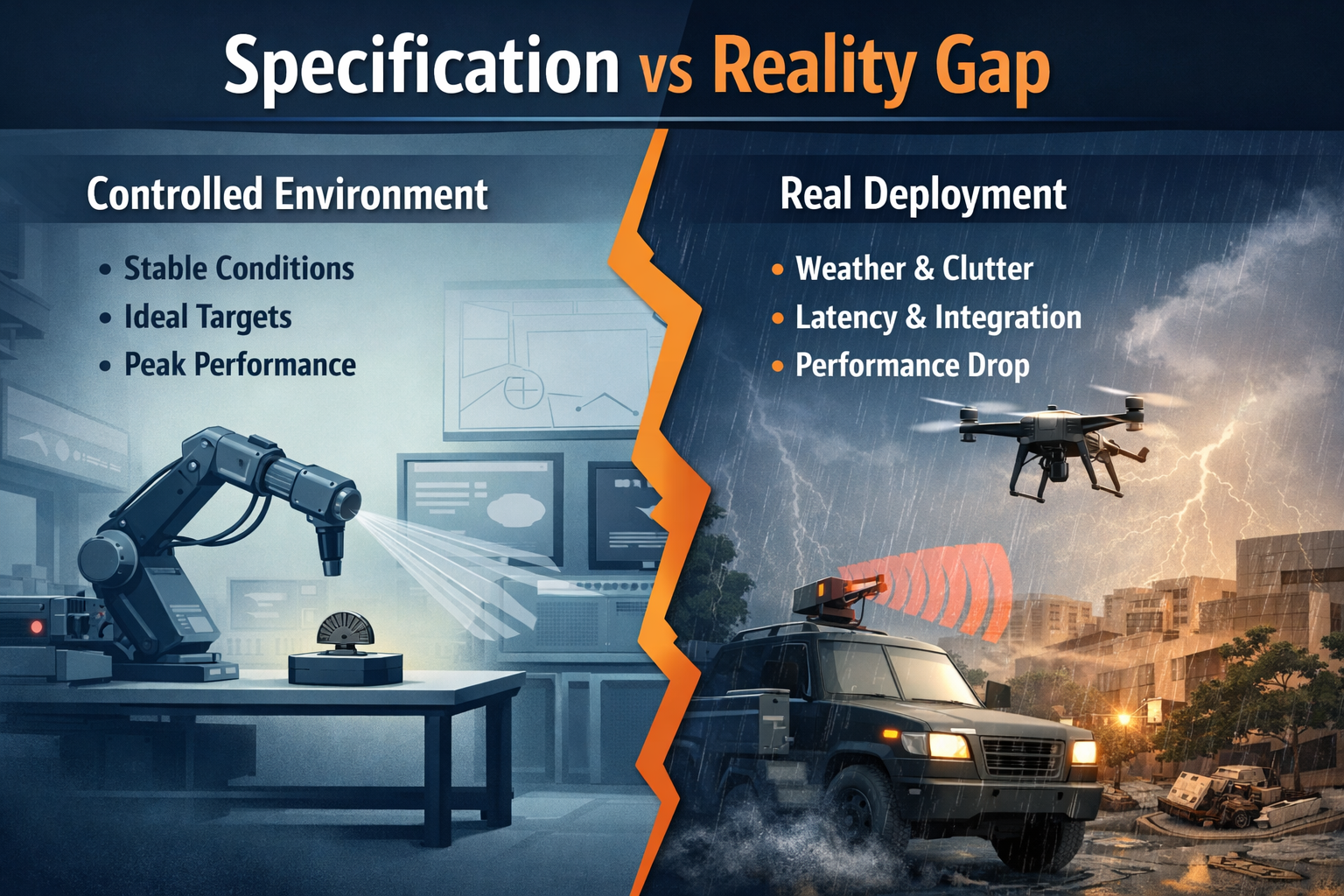
Sensor specifications are typically measured under controlled conditions:
-
stable environments
-
calibrated targets
-
fixed observation geometry
-
minimal interference
These conditions are necessary for repeatability, but they only represent a narrow slice of real-world operation. In deployment environments, sensors are exposed to:
-
changing weather conditions
-
unpredictable target behavior
-
complex and dynamic backgrounds
-
mechanical and thermal stress
It is not uncommon for a sensor that performs consistently in isolation to behave differently once integrated into a system. In practice, improving specification metrics does not always translate into proportional gains at the system level.
2. Integration Constraints That Limit Sensor Performance
Once deployed, sensor performance is shaped by integration constraints more than by standalone capability. System latency is a typical example. A sensor may produce highly accurate measurements, but delays introduced by communication links, processing pipelines, or synchronization layers can reduce the practical value of that data. Mechanical alignment and field-of-view constraints also matter.
Even a capable sensor can underperform if its observation geometry does not match how the system actually operates. Power and thermal limits are another common factor. In mobile or embedded platforms, sensors often run below their optimal conditions due to energy budgets or heat dissipation constraints. From an engineering perspective, what matters is not peak performance, but usable performance within system boundaries.
3. Environmental Variability and Hidden Failure Modes
Real environments introduce variability that is difficult to fully reproduce during testing. Conditions such as fog, rain, dust, or glare can alter signal behavior. Background clutter may introduce ambiguity, especially when targets are small or partially obscured. Lighting conditions can also shift rapidly, affecting optical systems in ways that are hard to model.
These factors do not simply degrade performance in a linear way. In some cases, systems appear stable until certain thresholds are crossed, after which performance drops more abruptly than expected.
These behaviors are often only observed during extended field operation, when less frequent conditions begin to appear.
4. System-Level Dependencies and Performance Coupling
In most modern systems, sensors do not operate independently. They are linked through shared timing references, fusion logic, and decision layers. This introduces dependencies that are not always obvious during design. A delay in one part of the system can affect the entire perception loop. A bias in one data source can influence fused outputs across multiple channels.
In some situations, improving one component can even reduce overall system stability — for example, increasing sensitivity without adjusting validation or filtering logic. These outcomes are not sensor failures in isolation, but the result of how components interact under real operating conditions.
5. From Sensor Performance to System Effectiveness
In deployment scenarios, performance tends to be evaluated differently. Instead of focusing only on peak specifications, engineers often prioritize:
-
consistency across changing conditions
-
predictable behavior under stress
-
alignment with system timing
-
tolerance to environmental uncertainty
This reflects a practical shift.
A sensor with slightly lower accuracy but stable timing may be more useful than one with higher precision but inconsistent latency. Likewise, systems that maintain predictable behavior under degraded conditions are often preferred over those that perform well only in ideal scenarios. In the field, effectiveness is defined less by maximum capability and more by reliability over time.
Conclusion
High-performance sensors remain important, but specifications alone do not determine real-world outcomes. The gap between laboratory performance and deployment behavior is shaped by integration constraints, environmental variability, and system-level interactions. Bridging this gap requires shifting focus from individual components to how the system behaves as a whole.
In practice, the most effective systems are not always built from the highest-spec sensors, but from components that work reliably together under real operating conditions.
Related Articles:
Why Sensor Fusion Alone Cannot Guarantee Robust Multi-Sensor Systems